

I Didn’t Want to Disappear
When I got my diagnosis—bipolar II—I walked out of the psychiatrist’s office with two things: a sample pack of meds and a deep, quiet panic.
The label made sense. It explained the mood crashes, the restlessness, the months I couldn’t sleep followed by weeks when I couldn’t move. But if the diagnosis was real, then what else might be? What if the meds dulled me? What if I lost the version of me that felt things deeply—the one who made weird jokes and stayed up all night writing?
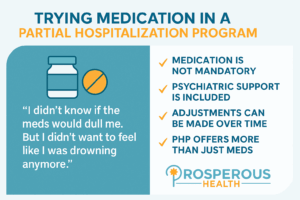
I didn’t want to disappear. I just didn’t want to feel like I was drowning anymore.
Medication Felt Like a Line I Was Afraid to Cross
Here’s what no one tells you when you’re newly diagnosed: it’s not just about the meds. It’s about what the meds mean. For me, they symbolized finality. A stamp on my identity. Like the moment I took that pill, I couldn’t go back to being “just moody” or “a night owl.”
I wasn’t anti-medication. I just wasn’t ready to give up the idea that maybe I didn’t really need it.
But underneath all that fear was something else: hope that maybe I didn’t have to keep white-knuckling my way through every day.
Enter the Partial Hospitalization Program
I landed in a Partial Hospitalization Program at Prosperous Health in San Diego after a stretch of spiraling that left me raw. I wasn’t in crisis, but I wasn’t functioning either. I needed more than a weekly therapist. I needed scaffolding.
PHP gave me that. Five days a week, I had group sessions, check-ins with a psychiatrist, and workshops that didn’t just tell me to cope—they showed me how. I wasn’t locked in. I went home every night. But during the day, I had a soft place to land.
I also had peers—people who weren’t “better,” just brave enough to show up.
The Day I Took the Pill
It didn’t happen the first day. Or the second. I sat with my questions. I asked my psychiatrist if it would change my creativity. She didn’t promise it wouldn’t. But she did say this:
“Let’s find a dose that helps you live, not silence you.”
That mattered. I didn’t want to be silenced. I wanted to stop hurting people I loved because I couldn’t regulate my own swings. I wanted to know what it felt like to not live at the mercy of my brain.
So I took the pill. Just once at first. Then again the next day. And then the day after that.
What Changed (and What Didn’t)
I didn’t wake up cured. I didn’t suddenly feel like myself. Honestly, I felt foggy and skeptical.
But about two weeks in, something shifted.
I finished a full lunch for the first time in months. I started sleeping more than four hours a night. I didn’t cry on the bathroom floor after a group session—I took a walk instead. Slowly, I noticed I could choose how to respond to a bad thought instead of reacting automatically.
And here’s the thing: I still laughed too loud. I still journaled like it was oxygen. I was still me. Just steadier.
Medication Didn’t Fix Me. But It Let Me Start Healing.
What PHP gave me wasn’t just medication. It gave me space. Time. A circle of people who weren’t trying to fix me, just hold me while I learned how to hold myself.
I met another client who was also newly diagnosed and hesitant. She said, “I thought meds would make me fake. Turns out, untreated symptoms were making me fake. I was surviving, not living.”
That hit me hard. Because I knew what she meant. I’d been performing okay-ness for years.
You Don’t Have to Be Sure. You Just Have to Be Open.
If you’re in Southern California and scared to try meds, you’re not broken. You’re asking the right questions. And a Partial Hospitalization Program in Palos Verdes or San Diego might be the right in-between: not as intense as a hospital, but way more support than a once-a-week therapy hour.
PHP gives you space to figure things out—with medical support, emotional safety, and room to ask, pause, and try again. It’s where you can say, “I don’t know if this is for me,” and still be met with care, not pressure.
FAQ: Partial Hospitalization Program & Medication Concerns
What is a Partial Hospitalization Program (PHP)?
A PHP is a structured mental health treatment program that provides intensive support during the day (usually 5 days a week), allowing clients to return home in the evenings. It’s ideal for people who need more help than outpatient therapy can provide but don’t need 24/7 inpatient care.
Will I be forced to take medication in a PHP?
No. Medication is often discussed and offered, but you have full autonomy. You’ll work with a psychiatrist who will help you make informed decisions at your own pace.
Can I attend PHP if I’m not on medication yet?
Absolutely. Many people enter PHP before starting medication or while still deciding. It’s a safe space to ask questions, explore options, and get support without pressure.
What if I start medication and don’t like how it feels?
You’re not locked in. You’ll have regular psychiatric check-ins to adjust dosage, switch meds, or pause if needed. Feedback is part of the process.
Does PHP only focus on medication?
Not at all. PHP focuses on whole-person care. That includes therapy (individual and group), coping skills, emotional regulation, and learning how to manage your mental health long-term—whether or not you choose meds.
Is PHP available in San Diego and Palos Verdes?
Yes. Prosperous Health’s Partial Hospitalization Program serves clients in both San Diego and Palos Verdes, offering regional access and community-based support.
Medication Didn’t Steal Me. It Gave Me Back to Myself.
It took courage I didn’t think I had to take that first step. Not just swallowing the pill—but letting go of the idea that I had to suffer to be real.
If you’re newly diagnosed and scared to try medication, you’re not alone. You’re not weak. You’re asking brave, important questions. And a place like Prosperous Health can help you answer them—without rushing, without judgment, and with the support of people who see your wholeness, not just your diagnosis.
📞 You don’t have to decide alone.
Call (888)308-4057 or visit to learn more about our Partial Hospitalization Program services in San Diego, CA.