

You’ve been sober for a while now.
A year. Maybe five. Maybe more.
You remember how urgent it felt in the beginning. How every day mattered. How raw and bright everything seemed.
And now?
Life feels… ordinary. Maybe even muted.
As a clinician, I want to say something directly: this phase of recovery is real. And it doesn’t mean your sobriety stopped working.
Many long-term alumni quietly ask themselves, “Is this all there is?” Not because they want to drink—but because they feel disconnected from the spark they once had.
What you built still matters. And you can return to it.
Within the first 100 days—or first year—many of you engaged in some level of Alcohol Addiction Treatment. At the time, it may have felt like survival. But clinically speaking, it was much more than that.
It was foundation work.
Early Recovery Built Structure — Not Just Sobriety
When people think back on treatment, they often remember the crisis.
The sleepless nights.
The fear.
The conversations that cracked something open.
But what was happening beneath the surface was structural.
You were:
- Regulating your nervous system after chronic stress
- Learning emotional tolerance without alcohol
- Practicing accountability
- Rebuilding trust with others
- Developing daily rhythms that didn’t revolve around drinking
Those patterns don’t disappear just because the intensity fades.
In fact, what often happens in long-term recovery is this: the crisis resolves, but the deeper identity work continues quietly in the background.
Sobriety stops feeling heroic. It starts feeling normal.
And that’s where some people begin to feel lost.
The “Flat” Season Is More Common Than You Think
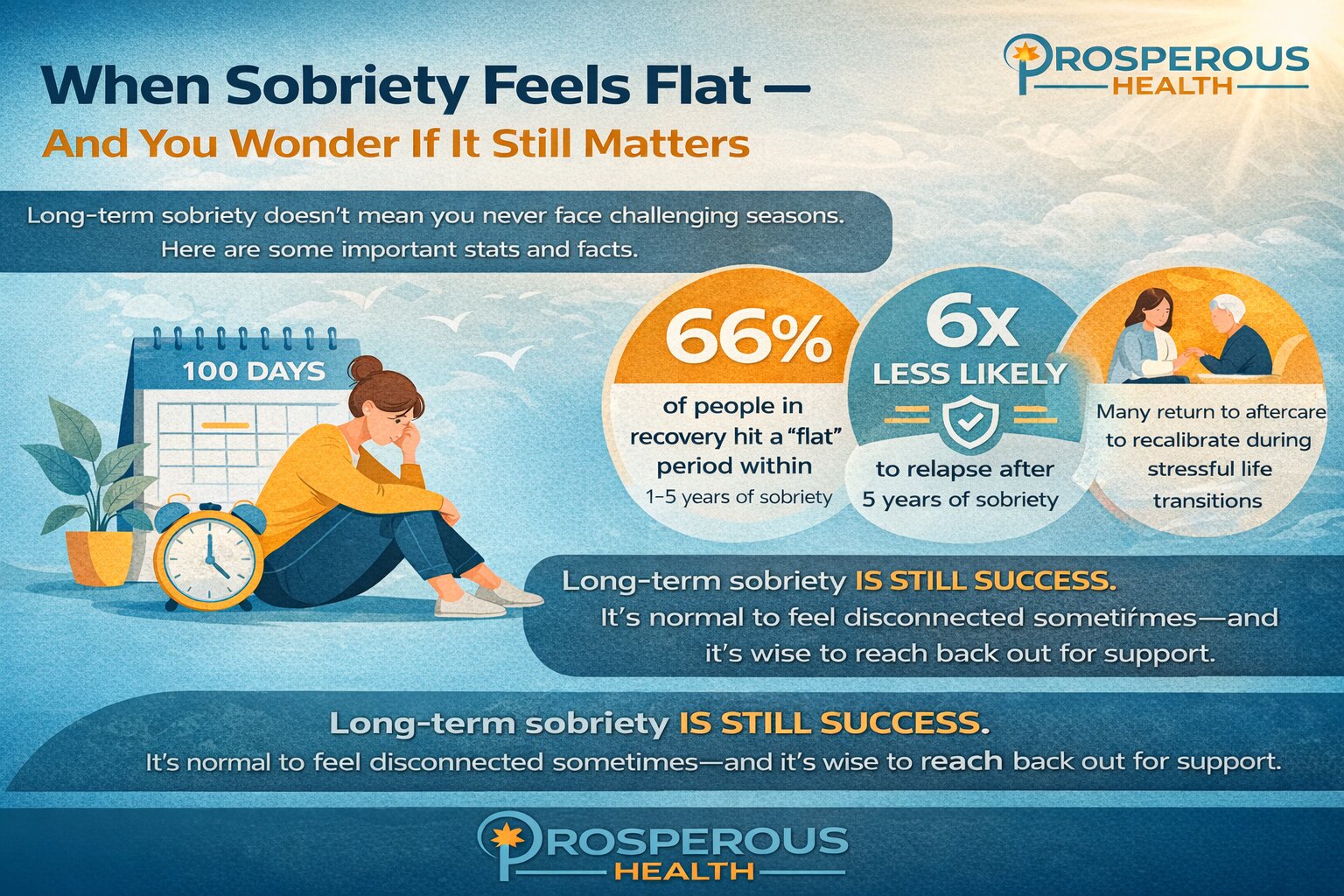
Clinically, there is often a stage in long-term recovery where things feel emotionally muted.
Not chaotic.
Not desperate.
Just… flat.
This can happen for several reasons:
- The dopamine system has stabilized after years of alcohol use
- The novelty of sobriety has worn off
- Life stressors are resurfacing in new forms
- Old trauma, once numbed, is now asking to be addressed
- Identity questions begin to emerge: Who am I without the fight?
Early sobriety is about not drinking.
Long-term sobriety is about building meaning.
That shift can feel disorienting.
And here’s the important part: feeling disconnected does not mean you’re at risk of relapse. It means you may be ready for a different layer of growth.
The Foundation Is Still There — Even If You Haven’t Touched It
Think of your early treatment like pouring concrete.
When it’s wet, it demands attention.
When it’s dry, you stop thinking about it.
But the building stands because of it.
The coping skills you learned—pausing before reacting, naming emotions, reaching out instead of isolating—are still wired into you. Even if you haven’t consciously practiced them in a while.
Sometimes alumni tell me, “I feel like I’ve drifted so far from what I learned.”
But when we sit together and slow down, those skills are still accessible. They just need to be reactivated.
Returning to support is not about starting over.
It’s about reinforcing what you already built.
Returning Doesn’t Mean You’ve Failed
This is one of the most common fears I hear:
“If I go back, it means I couldn’t maintain it.”
That belief is understandable—and inaccurate.
We don’t tell people who go back to the gym that they failed at health.
We don’t tell people who see their therapist again during a stressful season that therapy “didn’t work.”
Support is cyclical.
Some alumni benefit from revisiting structured daytime care or multi-day weekly treatment—not because they relapsed, but because they want recalibration.
It’s maintenance.
It’s growth.
It’s choosing to stay awake instead of slowly disconnecting.
If you’re in Southern California and feel that subtle drift, exploring treatment in Palos Verdes or reconnecting with care in California can feel less intimidating than you imagine. Familiar support, familiar language, familiar grounding.
Sometimes just walking back into a therapeutic space reminds your nervous system: Oh. This is what steadiness feels like.
You’re Not Supposed to Feel Inspired All the Time
Another misconception about long-term recovery is that it should feel free.
Grateful.
Clear.
Spiritually aligned.
But long-term sobriety is still life.
There are seasons of:
- Burnout
- Loneliness
- Career dissatisfaction
- Relationship strain
- Grief that hits years after the crisis
Alcohol used to mute those seasons. Without it, you feel them fully.
And sometimes fully feels heavy.
That doesn’t mean you want to drink. It means you’re human.
The foundation you built during Alcohol Addiction Treatment wasn’t designed to eliminate discomfort. It was designed to help you tolerate it without destroying your life.
That distinction matters.
When Disconnection Is Actually a Growth Signal
In my clinical experience, the “flat” period often precedes expansion.
It signals that the coping strategies that got you sober may now need refinement.
You might need:
- Deeper trauma work
- Relationship repair
- Purpose exploration
- Spiritual redefinition
- Or simply community again
Recovery evolves. The version of you who got sober is not the same version navigating year five.
Revisiting support can help you update the blueprint.
Not because something broke.
Because you’re building higher.
Frequently Asked Questions
Is it normal to feel disconnected years into sobriety?
Yes. Many long-term alumni experience emotional flatness or a sense of drift. Early recovery is intense and structured. As life stabilizes, that intensity fades, and it can feel like something is missing. In most cases, this reflects growth and transition—not failure.
Does feeling flat mean I’m at risk of relapse?
Not automatically. Emotional disconnection alone does not mean relapse is imminent. However, ignoring it long-term can increase vulnerability. Checking in with support early—before crisis—helps maintain stability.
I haven’t relapsed. Is it okay to return to treatment anyway?
Absolutely. Returning for structured support can be preventative and growth-oriented. Many alumni re-engage in care during stressful life transitions, major losses, or identity shifts. It is reinforcement—not regression.
What if I feel embarrassed reaching back out?
That feeling is common. But treatment providers expect alumni to have seasons of reconnection. There is no scoreboard. There is no judgment. From a clinical standpoint, returning to support is often a sign of maturity and self-awareness.
How do I know if I need more structured support again?
You might consider reconnecting if you notice:
- Emotional numbness that doesn’t lift
- Increasing isolation
- Loss of daily structure
- Irritability or low-grade resentment
- Thinking more often about drinking—even casually
- Avoiding coping skills you once relied on
These are not moral failures. They are signals.
Can support look different the second time?
Yes. Long-term alumni often need a different approach than first-time treatment seekers. Support may focus more on purpose, relationships, identity, or trauma processing rather than crisis stabilization.
Recovery is layered.
Long-term sobriety is not meant to feel dramatic forever.
It’s meant to become steady.
But steadiness doesn’t mean stagnation. If you feel disconnected, it may simply mean you’re ready to deepen—not restart—the work.
The foundation you built during Alcohol Addiction Treatment is still beneath you. You can return to it anytime.
Call (888)308-4057 or visit our Alcohol Addiction Treatment services in Orange County, CA.