

You know you need help.
Not in the dramatic, fall-on-the-floor kind of way. But in the quieter, scarier way—where you’re still functioning, but not really living.
You’re exhausted by your own patterns. You’ve outgrown your excuses. And even though the idea of treatment still feels huge… you’re here, reading this.
If you’ve been looking into options and landed on a partial hospitalization program in San Diego, CA, you’re in the right place.
Let’s talk about what actually happens when you say yes to PHP. No vague promises. No scripts. Just a clear picture of what it’s like to walk in on day one—and what it could feel like to walk out a few weeks later.
Arrival: You Don’t Have to Be Okay Yet
Most first-time clients walk in feeling some combination of ashamed, unsure, and braced for impact. You’re not alone if you’re scared people will look at you like you’re broken—or worse, like you don’t belong because you’re “not bad enough.”
Here’s the truth: there’s no right way to arrive.
You could walk in hungover. You could be withdrawing from pills. You could be three months dry but still falling apart emotionally.
The team will welcome you exactly as you are.
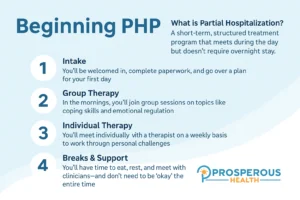
Your first day usually includes:
- A warm intake and orientation (no lab coats, no judgment)
- Basic paperwork (we’ll help if your brain is foggy—no stress)
- A tour of the space
- A light group introduction (if you’re ready)
- A plan for your next day so you know what’s coming
No one expects you to “open up” right away. You’re not here to perform. You’re here to land.
Mornings in PHP: Structure That Grounds You
The morning often starts with a group check-in. It’s not a performance—it’s just a way to let yourself be seen, maybe for the first time in a long time.
You’ll hear people say things like:
- “I almost didn’t come today.”
- “I used last night but I’m here.”
- “I don’t want to talk yet, but I’m listening.”
Every one of those is welcome.
After check-in, most mornings include psychoeducational or process groups. That might sound clinical, but in practice, it looks like real conversations about:
- Why your brain reacts the way it does under stress
- How to sit with sadness without numbing
- What boundaries actually sound like in real conversations
- What trauma does to trust (and how to rebuild it)
Group sessions are led by licensed clinicians who know how to hold space, not dominate it. You don’t have to spill your life story. You just have to stay curious.
Midday: Breath, Food, and Room to Be a Human
Between sessions, you’ll have built-in breaks. You can eat lunch, step outside, journal, or just breathe.
No one’s tracking how productive you are. This isn’t school. It’s a place to practice existing without the need to hustle or hide.
At some PHP locations in The Valley or Palos Verdes, clients use break time to walk, call a sponsor, or just sit with staff who understand how heavy it is to just be present.
We honor that. Slowness is part of healing.
Afternoons: 1:1 Therapy and Skills That Stick
Each week, you’ll meet with an individual therapist. These sessions are for you to go deeper—into what brought you here, into what’s still hurting, and into what you want life to look like after this.
It’s not always easy. But it’s real.
Afternoons often include experiential groups or skills-based sessions. These are designed to help you:
- Cope with cravings and urges without shame
- Identify and interrupt thought spirals
- Learn actual emotional regulation tools (that aren’t “just breathe”)
This is where many clients start to feel something shift. Not everything, not at once. But a crack of possibility. A pause between reaction and response.
That’s the start of freedom.
Psychiatry & Medical Support—If You Need It
Some clients come to PHP needing medication support. Others are exploring it for the first time.
You’ll have the option to meet with a psychiatrist or nurse practitioner to talk about medication, sleep, nutrition, and any physical symptoms impacting your emotional stability.
There is no pressure to medicate. But if you do choose that route, it’ll be handled collaboratively and respectfully.
You’re in charge of your care. Always.
What People Notice After Week One
It’s not usually some giant transformation. It’s subtler, quieter—but deeply important.
Clients often say things like:
“I didn’t snap at my mom this morning. That hasn’t happened in weeks.”
“I woke up and didn’t dread the day.”
“I went one full day without a drink—and I didn’t white-knuckle it.”
The world doesn’t change. But you do. One real moment at a time.
And by the end of week one, you’ll probably start to believe something that felt impossible before: this might actually help.
What Happens When PHP Ends?
Discharge planning starts early. That means you and your care team will talk about what comes next:
- Intensive Outpatient (IOP)
- Weekly therapy
- Sober living options
- Support groups
- Family therapy
We won’t just drop you at the finish line. We’ll walk with you into what’s next.
If you’re in or near San Diego, our local PHP location can help you transition smoothly into ongoing care that fits your pace and goals.
FAQs: PHP for First-Time Treatment Seekers
Do I have to stop using before I start PHP?
No. Many clients enter PHP while still using. What matters is your willingness to engage. We’ll support you in finding stability—on your timeline.
How long do most people stay?
Typically 2 to 6 weeks, but it’s flexible. We adjust based on your needs, progress, and readiness—not a fixed calendar.
Is it okay to still work while in PHP?
Maybe. PHP is typically 5 days a week, 6 hours a day. Some clients work part-time or arrange temporary leave. We can help you explore your options.
What if I don’t “click” with my therapist or group?
That’s okay. We value fit. If something’s not working, speak up. We’re here to adapt—not force you into a mold.
Will I be the only one who’s new to this?
Absolutely not. Many clients are here for their first real attempt at treatment. You’ll be surrounded by people who get how scary and brave that is.
You Don’t Have to Figure It All Out Alone
You don’t have to be certain. You don’t have to be brave every second. You just have to be tired of pretending—and open to something different.
Call (888) 308-4057 to learn more about our partial hospitalization program services in San Diego, CA.
We’ll walk with you through the fear, the unknown, and into the kind of life that feels possible again.