

You did the hard thing.
You stopped drinking. You sat in rooms that felt uncomfortable. You told the truth when it would’ve been easier to hide. You rebuilt relationships. You learned how to wake up without dread.
And now, years later, you might be thinking:
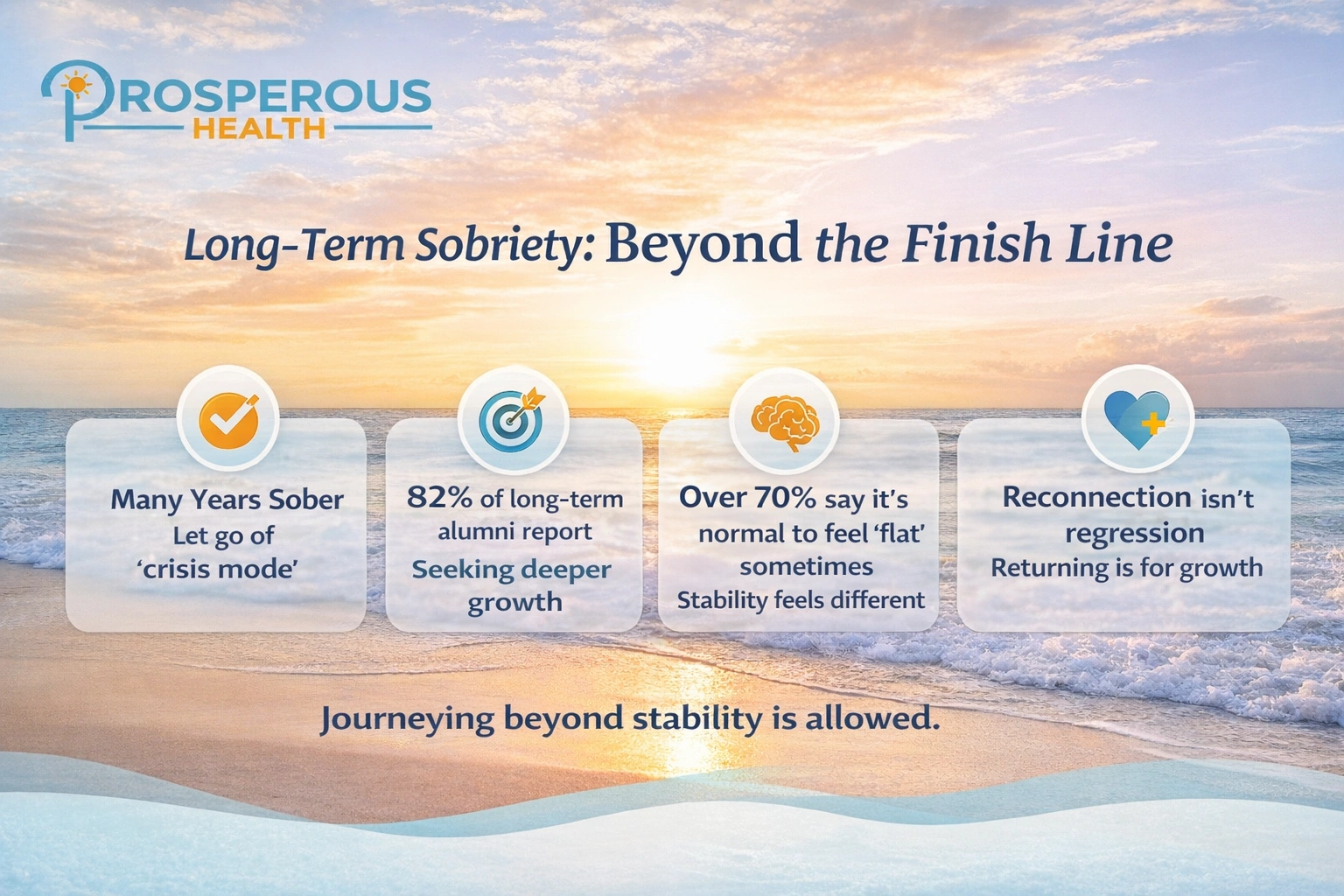
“Why does this feel… flat?”
“I thought I’d feel freer than this.”
“I’m sober. So why do I feel disconnected?”
As a clinician, I want to say this clearly: long-term sobriety can feel quieter than expected. That doesn’t mean something is wrong. It doesn’t mean you’re failing. And it doesn’t mean the work you did didn’t matter.
The work you did laid a foundation. And foundations are meant to be returned to.
Within the first months of care, you likely learned skills and built structure that still exist today. If you’ve ever been part of a formal program like our Alcohol Addiction Treatment, you know it wasn’t just about stopping a behavior. It was about rebuilding a life.
That foundation is still there — even if you haven’t thought about it in a while.
Sobriety Was Never the Finish Line
In early recovery, everything feels urgent.
You’re counting days. You’re building routines. You’re avoiding triggers. You’re checking in constantly. There’s intensity to it — a focus that can almost feel like a full-time job.
Then something shifts.
Time passes. The crisis fades. Life stabilizes. You stop counting days because there are too many to count.
And here’s the part no one talks about enough: when the urgency fades, so does the adrenaline. What’s left is stability.
Stability can feel peaceful.
It can also feel… ordinary.
Many long-term alumni interpret “ordinary” as emptiness. But ordinary life was the goal. Predictable mornings. Safe evenings. Trust rebuilt slowly over time.
Sobriety isn’t fireworks. It’s flooring. It’s the ground you stand on so you can build something else.
If you feel flat, it may simply mean you’ve been living on stable ground long enough to forget what chaos felt like.
Emotional Distance Doesn’t Mean You’re Slipping
There’s a quiet pressure among alumni to feel grateful all the time.
You should be happy.
You should feel free.
You should feel proud.
And you probably do — sometimes.
But long-term sobriety often uncovers something subtler: emotional fatigue.
After years of vigilance, accountability, and growth, it’s common to feel tired. Not relapse-tired. Just human-tired.
Some people describe it as:
- Feeling spiritually disconnected
- Feeling less excited about recovery spaces
- Feeling unsure who they are outside of “the sober one”
- Feeling emotionally muted
This isn’t a moral failure. It’s a developmental phase.
Early recovery focuses on stopping. Long-term recovery asks deeper questions:
Who am I now?
What do I want?
What still needs healing?
Those questions can feel heavier than cravings ever did.
The Tools You Learned Are Still Holding You Up
Think back to what you practiced in treatment.
You learned how to:
- Sit with discomfort without numbing it
- Identify emotional triggers
- Ask for support instead of isolating
- Create routines that protect your energy
- Repair relationships with humility
- Set boundaries
Those weren’t temporary skills. They were structural beams.
Even if you haven’t consciously “used” them in a while, they’ve been quietly holding your life together.
I often tell alumni: recovery skills are like physical therapy exercises. You don’t need them every second once you’re healed — but when strain returns, they’re there.
If you feel disconnected, the answer may not be dramatic change. It may be a gentle return.
- Call someone who understands recovery.
- Revisit journaling or reflection practices.
- Schedule therapy not because you’re in crisis, but because you want depth.
- Reconnect with alumni spaces without pressure.
Returning to your foundation doesn’t mean you’re weak. It means you’re maintaining the structure.
Growth After Sobriety Is Different Work
Stopping drinking is visible work.
Identity development is invisible work.
Many long-term alumni discover that once alcohol is gone, deeper layers surface:
- Career dissatisfaction that was once masked by stress drinking
- Relationship dynamics that need healthier boundaries
- Old trauma that didn’t disappear with sobriety
- A sense of restlessness without a clear cause
This stage can feel confusing because it doesn’t look like addiction. It looks like existential discomfort.
And yet, it’s often where the most meaningful growth begins.
The goal was never just abstinence. It was alignment. Integrity. Self-trust.
Sometimes reconnecting with structured support — even briefly — helps recalibrate. Not because you’re relapsing, but because you’re evolving.
If you’re in Southern California and thinking about refreshing your support system, you can explore treatment in Irvine or seek help in Palos Verdes depending on where you live. Support isn’t reserved for emergencies. It’s allowed for growth.
You’re Allowed to Feel Restless
There is a common but unspoken belief in recovery culture:
If you’re sober, you should be satisfied.
That’s not how human beings work.
You are allowed to want more:
- More connection
- More purpose
- More emotional depth
- More clarity about who you are becoming
Wanting more doesn’t mean sobriety failed you. It means you’re growing beyond survival mode.
The foundation you built during Alcohol Addiction Treatment was never meant to confine you. It was meant to stabilize you so you could expand.
Restlessness is often a signal that expansion is ready.
Returning Is Not Regressing
Some alumni hesitate to re-engage because they’re afraid it means starting over.
It doesn’t.
Returning is maintenance, not regression.
You wouldn’t tear down a house because you decided to reinforce the roof. You wouldn’t call it failure to repaint walls that have faded.
Coming back to therapy, alumni groups, or structured support years later often looks different:
- Less crisis, more curiosity
- Less fear, more refinement
- Less survival, more intentional growth
The tone is calmer. The conversations are deeper. The stakes feel different.
And often, the peace that follows is richer than early recovery ever was.
FAQ: Long-Term Sobriety and Feeling Disconnected
Is it normal to feel flat years after getting sober?
Yes. Many people experience periods of emotional flatness or restlessness after the urgency of early recovery fades. Stability can feel unfamiliar if you lived in chaos for years. Flatness doesn’t automatically mean something is wrong — but it can be a signal that new growth is needed.
Does feeling disconnected mean I’m close to relapse?
Not necessarily. Disconnection can be about identity, purpose, or emotional fatigue — not craving. That said, isolation is a risk factor for relapse. Re-engaging with support early, even preventatively, is a healthy step.
I don’t relate to recovery spaces the way I used to. Is that a bad sign?
It’s common for recovery needs to evolve. The intensity of early sobriety may no longer match where you are now. Instead of forcing old structures to fit, consider what new forms of support might align with your current stage of life.
Should I go back to treatment even if I’m not drinking?
Treatment isn’t only for active use. Some alumni return for short-term support, therapy, or structured care to address emotional stagnation, life transitions, or unresolved issues. Re-engaging can be proactive, not reactive.
What if I feel guilty for not feeling happier about being sober?
Guilt adds weight but doesn’t solve anything. You can be grateful for sobriety and still feel unfulfilled. Those emotions can coexist. The key is honest reflection without self-judgment.
A Quiet Invitation
If you’re reading this as someone years into sobriety, I want to speak plainly.
You did something extraordinary. You rebuilt your life from the inside out. That matters. It always will.
But long-term recovery isn’t static. It has seasons.
There are seasons of urgency.
Seasons of stability.
Seasons of questioning.
Seasons of expansion.
If you find yourself in a season of disconnection, it may not be a warning sign. It may be an invitation.
An invitation to return to the foundation you built.
An invitation to deepen rather than restart.
An invitation to grow beyond simply “not drinking.”
The structure is still standing.
And if you’d like support revisiting or strengthening that foundation, we’re here.
Call (888)308-4057 to learn more about our Alcohol Addiction Treatment in California.