

There are some days that divide your life into before and after.
For many, that day starts in a room with a whiteboard, a clipboard, or a kind-eyed clinician. You think you’re there for answers. And then, suddenly, you have one.
“We believe what you’re experiencing is major depression.”
“It looks like generalized anxiety disorder.”
“This may be early signs of bipolar disorder.”
The words come softly, usually. Carefully chosen. But once they land, they’re loud in your body. You might not even remember the rest of the appointment. Just a word, maybe a prescription, and a wave of questions you didn’t expect to face.
What does this mean?
Do I have to take medication?
Will people treat me differently?
Am I broken?
If that day has just happened—or if you’re still living in the shadow of it—you are not alone. And you are not a diagnosis. You are a person at the very beginning of something hard and human and hopeful.
At Prosperous Health, we walk with people in this exact place: the fragile, blurry space between hearing the words and knowing what to do next. And sometimes, what helps most in this in-between is a Partial Hospitalization Program—a place to steady yourself, learn, ask questions, and start again without pressure.
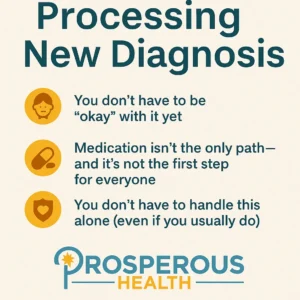
You Don’t Have to Be “Okay” With It Yet
Let’s start here: getting a diagnosis doesn’t mean you have to agree with it right away. You’re allowed to be unsure. Confused. Even angry.
A diagnosis doesn’t erase your story. It doesn’t define your future. It’s just a framework—a language clinicians use to understand and respond to patterns in how your mind and emotions are functioning.
But it can still feel like a label. And labels feel heavy when you’re already carrying so much.
We don’t expect you to jump into treatment with confidence. We expect you to need time, questions, support—and space to feel your feelings. PHP gives you that space, with professionals who understand what it’s like to feel hesitant, scared, or unsure if this is even “necessary.”
Medication Isn’t the Only Path—And It’s Not the First Step for Everyone
For many newly diagnosed individuals, the biggest fear isn’t the label—it’s the pill bottle.
You might be thinking:
- “I don’t want to be numbed.”
- “What if I lose who I am?”
- “I’m afraid to change my brain.”
These are valid concerns. And they deserve more than a 10-minute conversation and a prescription pad.
In a Partial Hospitalization Program, medication isn’t the only topic—or the only tool. You’ll work with therapists and psychiatrists who take the time to understand your full picture. Your values, your concerns, your identity, your fears.
You might start meds. You might not. You might try something, then pause. The process is yours. We simply help you explore it with clarity, support, and the permission to go slow.
You Don’t Have to Handle This Alone (Even If You Usually Do)
You may be used to keeping it together. You might be the “strong one,” the “functional one,” the “I’ll figure it out myself” one.
But a new diagnosis can rattle even the most self-sufficient people. It can make everyday choices feel heavier. It can blur the edges of who you thought you were.
And if you’ve been dealing with your symptoms for a long time already, the idea of starting something new—like a program—might feel exhausting.
That’s exactly why Partial Hospitalization is designed the way it is:
- Structured but flexible
- Supportive but not suffocating
- Intensive enough to help—but not so rigid that it takes over your life
You still go home every night. You still have your space. But during the day, you’re surrounded by clinicians, peers, and calm structure designed to help you stabilize before you have to “figure things out.”
Looking for a Partial Hospitalization Program in San Diego, CA? We’re right here when you’re ready to take that next step—without pressure, without urgency, just support.
What Actually Happens in a Partial Hospitalization Program?
A lot of people hear “program” and picture white walls, clipboards, and clinical coldness. But PHP is not a hospital. It’s a healing environment—a day-program with structure and safety, designed to feel human.
A typical PHP week at Prosperous Health includes:
- Group therapy where you learn skills like emotional regulation, boundaries, or how to respond to anxiety without spiraling
- Individual therapy focused on what you want to work on
- Psychiatric care that’s collaborative—not prescriptive
- Peer connection with others who are also newly diagnosed or exploring new ways of understanding themselves
- Time to breathe—with lunch breaks, movement, quiet time, and space to just be
The goal isn’t to fix you. It’s to support you while you find your footing.
Looking for Partial Hospitalization Program in The Valley, CA? We offer options in Palos Verdes and beyond, because recovery should feel accessible, not out of reach.
You Don’t Have to Rush Into a Life Plan
Diagnosis often creates pressure:
- You need a plan.
- You need to start meds.
- You need to adjust your job, your relationships, your routines.
It’s too much.
PHP slows that down.
You get to pause. You get to not know what you want next. You get to ask your questions and sit with your fear without being asked to fix it right away.
Sometimes, just showing up each day to a space where you’re not judged for feeling overwhelmed is the first and most healing step.
How Change Starts Quietly
People expect transformation to feel big. But here’s what change often looks like in PHP:
- You sleep through the night without a panic attack
- You eat lunch without nausea or dread
- You name a feeling without shutting down
- You sit in a group and don’t feel so alone
- You start to believe maybe—not definitely, just maybe—things could get better
You don’t have to be all in. You just have to stay in long enough to let something soften.
FAQ: For the Newly Diagnosed (and Still Processing)
What if I don’t believe the diagnosis?
That’s okay. You don’t need to fully agree to get help. We’ll explore your story with curiosity, not judgment.
What if I’m afraid of medication?
Then let’s talk about it. You’re not forced into anything. Medication decisions are made collaboratively, and slowly if needed.
Is PHP only for people who’ve been hospitalized?
Not at all. PHP is often the first step after diagnosis—especially when symptoms are affecting your daily life but you don’t need inpatient care.
Can I do PHP while working?
Most people take time off while in PHP. It runs 5 days a week, usually 4–6 hours per day. We can help you coordinate time off or work with your employer.
How long is the program?
It depends on your needs, but most people stay 2–6 weeks. We reassess weekly to make sure the level of care is still right for you.
You Just Heard the Words. Now What?
Call (888)308-4057 or visit Partial Hospitalization Program in San Diego, CA to learn more about what comes next—and what doesn’t have to come fast. You don’t need a 5-year plan. You need somewhere safe to land while you find your way forward.
We’re here when you’re ready.