
When your child starts using opioids again—after you thought they were safe—it shatters your sense of time. One minute, you’re planning dinner or checking on school loans. The next, you’re wondering if this relapse will be the one they don’t walk away from.
You’ve read articles. You’ve tried boundaries. Maybe you’ve driven them to detox before, only to watch them walk back out. So when you decide to explore opioid addiction treatment again, it’s not just a decision—it’s an act of courage. One that deserves straight answers.
Below are the questions every parent has a right to ask. Not just as a checklist, but as a way to reclaim clarity in a situation that often feels impossible.
What levels of care do you offer, and how do you decide what my child needs?
Opioid addiction affects people differently. Some need medical detox due to physical withdrawal risks. Others may be more stable but require deep therapeutic work or a structured outpatient setting. Good treatment centers should be able to assess this—and explain it clearly to you.
Look for programs that offer a continuum of care, meaning they don’t just admit people into one type of program by default. You want a center that can evaluate where your child is physically, emotionally, and psychologically, and match that with the appropriate care level.
✅ Ask: What’s your assessment process like? Who conducts the evaluation? What happens if my child needs to step up or step down in care?
How do you involve families, and do you support us too?
Treatment is not just about the person using—it’s also about the people who’ve been impacted by their use. As a parent, you carry trauma, fear, and exhaustion. You deserve support, not just updates.
Some treatment centers integrate family therapy into the program itself. Others offer psychoeducation workshops, phone support, or regular progress updates. If they don’t mention family involvement at all—that’s a red flag.
✅ Ask: Will I be part of the process? Is there support for me as a parent navigating this?
💬 Real Parent Reflection:
“I used to think if he just went to treatment, everything would reset. But I needed help too. Learning how to support without rescuing—that changed everything.” — Parent of client, 2023
What’s your philosophy around medications like Suboxone or Methadone?
This is one of the most important—and most misunderstood—questions you can ask. Medication for opioid use disorder (MOUD) has been shown to reduce overdose risk and improve long-term outcomes. But not every center uses it. Some even stigmatize it.
Ask not only whether they offer MOUD, but how they decide when it’s appropriate, and whether it’s integrated with therapy and support. Look for language that’s evidence-based, respectful, and centered on the person—not the provider’s preference.
✅ Ask: What are your options for medication support? Are those medications optional or mandatory?
What does aftercare look like?
Treatment is a chapter—not the whole book. The days and weeks after discharge are often the most vulnerable, especially for people who don’t have strong peer support, housing stability, or purpose right away.
A strong program will help build an aftercare plan before your child leaves—whether that means sober living, outpatient therapy, virtual support, or alumni groups. Beware of programs that focus only on the 30 or 60 days inside their walls.
✅ Ask: What support do you provide or recommend after discharge? Do you help with transitions like housing or finding an outpatient program?
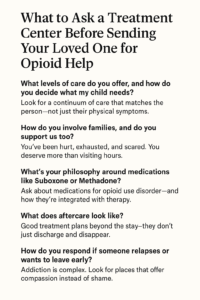
How do you respond if someone relapses or wants to leave early?
This is one of the hardest questions to ask, because it forces you to look at the “what if.” But the answer you get can tell you everything about a center’s heart. Addiction is relapsing by nature. A program that punishes or shames someone for struggling isn’t a healing environment.
Instead, look for places that treat relapse or resistance as clinical information—not moral failure. That might include re-assessment, family involvement, or motivational interviewing—not just discharge.
✅ Ask: What happens if my child stops participating or relapses during treatment?
How is your staff trained—and do they understand trauma?
Many people struggling with opioids are also carrying trauma—whether from past abuse, grief, or even their own experiences in the system. Staff should be trained not just in addiction treatment, but in trauma-informed care.
That means they’re trained to respond with sensitivity, avoid re-traumatizing someone during care, and recognize that behavior is communication—not defiance.
✅ Ask: Is your staff trained in trauma-informed approaches? What qualifications do your therapists and counselors hold?
Frequently Asked Questions
How can I tell if a treatment center is legitimate?
Look for accreditation (e.g., The Joint Commission, CARF), licensed staff, transparent policies, and a real intake process—not just a sales pitch. Avoid any center that guarantees success or won’t clearly explain costs and care models.
Is it okay to ask about insurance and costs up front?
Absolutely. A reputable program should be willing and able to verify your benefits, explain out-of-pocket costs, and walk you through your options—without pressuring you to commit immediately.
Should I be worried if my child doesn’t want to go?
Ambivalence is common. The right center can help work through that by offering pre-admission support, motivational calls, or even family intervention guidance. Don’t assume unwillingness means they won’t benefit—it just means they’re scared, unsure, or overwhelmed.
Can I visit the center before deciding?
Yes, and you should if possible. Touring the facility, meeting staff, and asking questions face-to-face can provide insight that no brochure or website can replicate.
You Deserve a Team That Stands With You
You’ve fought for your child. You’ve cried in parking lots. You’ve Googled treatment centers at 3am, hoping the next one is the one. At Prosperous Health in Southern California, we don’t take that trust lightly.
Whether your child is ready or just barely considering it, we meet them—and you—where you are. With clarity. With care. With a plan that honors your family’s truth.
📞 Ready to talk?
Call Prosperous Health at (888)308-4057
Or learn more about our opioid addiction treatment programs.