

Relapse after 90 days feels different. Not like the chaos of early detox or the denial of active use. It’s clinical. Quiet. Like watching your own rerun, but this time you know exactly how the episode ends—and it still plays out anyway.
This blog isn’t a confession. It’s a map. A peer-to-peer breadcrumb trail for anyone who, like me, found themselves lost after 90 days and thought: I thought I was past this. If that’s where you are, I want to tell you what no one told me: returning to a partial hospitalization program (PHP) isn’t going backwards. It’s exactly what forward can look like.
The Truth No One Says Out Loud After 90 Days
People love the “clean 90” narrative. You get high-fives, coins, maybe a slice of cake. But the truth? 90 days is often when the real fight begins.
Here’s what I didn’t know:
- By 90 days, my body was catching up—but my brain was still doing recon.
- The cravings didn’t scream anymore. They whispered.
- The routines that got me sober weren’t built to carry me through uncertainty, loneliness, or grief.
I had tools—but not the right toolbox for what was coming. And no one told me that the 90-day mark isn’t the finish line. It’s the halfway point between hope and heartbreak.
PHP Wasn’t a Step Back—It Was the Step I Skipped
The first time, I went straight from detox into IOP. I was eager, compliant, determined. But deep down, I still believed I could outsmart this thing. I didn’t think I needed PHP. I wasn’t that bad.
But after my relapse, I knew: I didn’t need another quick fix. I needed re-integration with support. PHP gave me exactly that.
At Prosperous Health’s PHP program in San Diego, I found:
- Structured daytime care that didn’t rip me from my life
- Trauma-informed therapy that went deeper than surface skills
- Real-time support as I rebuilt trust—both in myself and with others
And most importantly: I didn’t have to pretend I was starting from scratch. They met me where I was—not where I had fallen.
Relapse Doesn’t Mean You Lied About Wanting This
Let me be clear: I meant every word I said during my first 90 days. I wanted recovery. I still want it. Relapse doesn’t cancel that desire—it reveals where support was missing.
There’s a myth that relapse means we weren’t serious. That we must not have wanted it enough. But here’s what I know now: relapse is often about underestimated wounds and overestimated readiness.
PHP helped me slow down and rebuild the scaffolding I skipped.
“I didn’t go back to day one—I went back to where I last felt safe. And this time, I stayed longer.”
– PHP Alumni, 2024
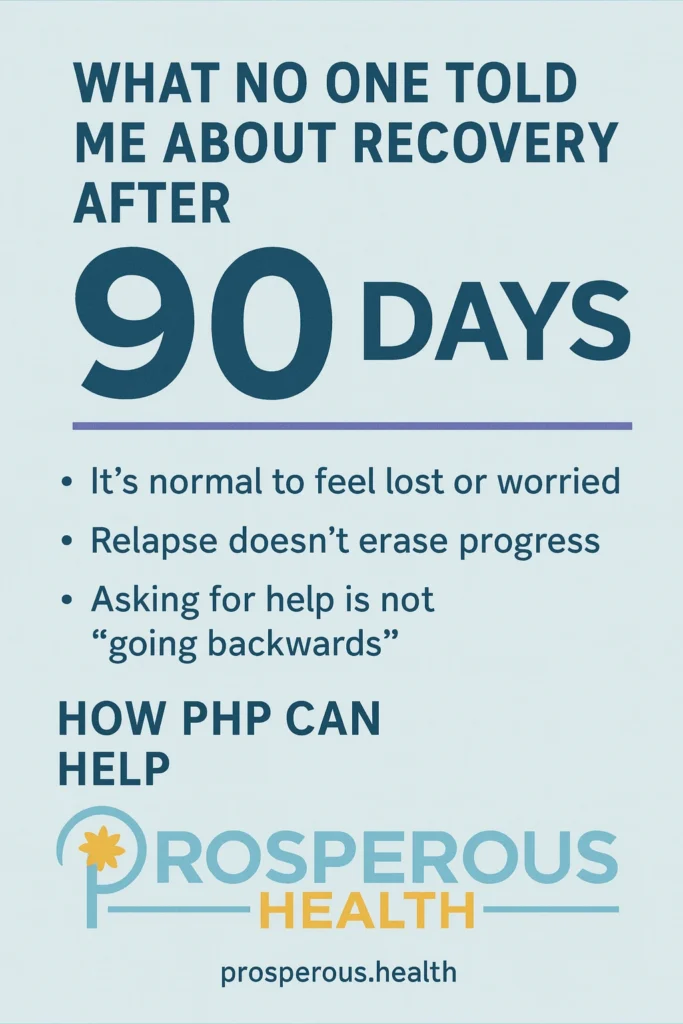
What PHP Feels Like After a Relapse
I won’t sugarcoat it—walking back through those doors after relapsing was humbling. I carried shame like luggage. But that feeling didn’t last long.
Because inside PHP, I found something rare: a room full of people who got it.
Not just counselors, but peers who’d stumbled too—and gotten back up.
We talked honestly. About grief. About anger. About how early sobriety is romanticized and what happens when the dopamine resets and real life still sucks.
PHP became my landing pad. My recalibration space. Not a punishment—but a pause with purpose.
The Pink Cloud Pops—And PHP Is Your Parachute
The “pink cloud” is real. That early high of sobriety where everything feels possible. You’re clear-headed. Sleeping. Laughing again. It’s a rush.
But when it ends, and the emotional weight returns, it’s jarring. And if no one prepped you for that crash? It’s easy to panic.
PHP helped me land that fall.
- I learned to sit with discomfort without reacting.
- I practiced being honest about my fear of screwing up again.
- I had help restructuring my life—not just my calendar.
Because let’s be real: no one gets sober to become a productivity robot. We get sober to feel again. And that’s messy work.
You’re Not “Back at Square One.” You’re Just in a New Layer.
Here’s the truth I needed someone to say out loud:
You didn’t ruin everything. You just hit a deeper layer of healing.
Relapsing after 90 days doesn’t mean you’ve failed—it means you’re human. And being human in recovery means sometimes needing help more than once.
If you’re in The Valley and need a PHP that gets this, know that compassionate, structured care is available—and it’s not just for beginners.
You don’t have to prove you deserve another shot.
You don’t have to “explain” the relapse.
You just have to show up. Again.
FAQ: PHP and Relapse Recovery
What is PHP and how does it help after a relapse?
Partial Hospitalization Programs (PHP) offer structured, daytime treatment that provides clinical therapy, peer support, and psychiatric care without requiring overnight stays. For those who’ve relapsed, PHP gives you a space to re-center—without restarting from zero.
Is PHP only for people new to recovery?
Not at all. Many people enter PHP after relapse or when they recognize their outpatient support isn’t enough. It’s ideal for building stronger coping strategies, repairing relationships, and addressing deeper emotional triggers.
How long do PHP programs usually last?
It varies, but most programs run for 3–6 weeks depending on your clinical needs and progress. At Prosperous Health, treatment plans are personalized and adjusted as you stabilize.
Will people judge me for relapsing?
Not in PHP. At least not here. Prosperous Health’s team and community understand relapse as part of many people’s story—not a source of shame. You’ll find compassion, structure, and clarity—not judgment.
Is PHP available near me in California?
Yes. Prosperous Health offers PHP in multiple locations including San Diego, The Valley, and Palos Verdes. Each site provides region-specific support with consistent care quality.
📞 Ready to Take the Next Step?
Call (888) 308-4057 or visit to learn more about our PHP services in San Diego, CA. Whether it’s your first time—or your restart—you’re welcome here.