

You’ve been through the calls. The clinics. The conversations that ended in silence, slammed doors, or maybe just a heartbreaking “I’m fine” that didn’t feel fine at all.
If your 20-year-old is using again, it might feel like nothing is going to work. Not therapy. Not rehab. Not even your love, which you’ve given in every possible way.
So when someone suggests a Partial Hospitalization Program—or PHP—you wonder: Why would this be any different?
That question makes sense. And you deserve a real, honest answer.
This isn’t a promise that PHP will fix everything. But it is a chance to explain why, for families in your shoes, this level of care is often where change finally takes root.
PHP Isn’t Just “More Treatment.” It’s the Right Kind of Care at the Right Time.
If you’ve tried outpatient therapy, you’ve likely seen its limits. One or two sessions a week can’t hold the weight of serious addiction or mental health struggles—especially not when they show up every day.
And inpatient? That might have helped for a time, but maybe it was too much—or too disconnected from real life.
Partial Hospitalization Programs exist in the space between.
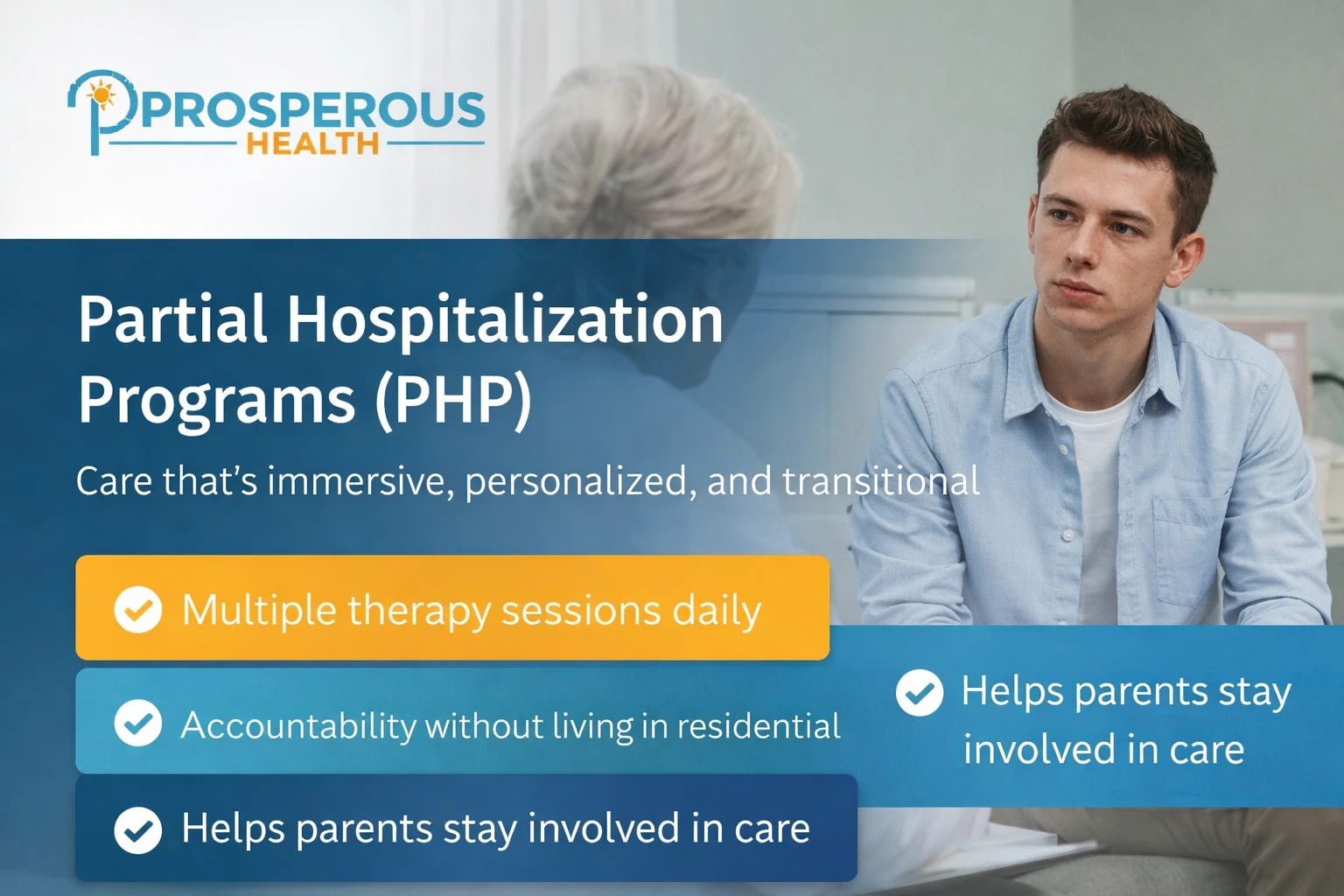
They offer the structure of inpatient care—intensive therapy, daily programming, real accountability—without removing your loved one from everyday life. Your child returns home each evening. But during the day, they’re in a clinical setting with trained professionals, doing the work that outpatient couldn’t hold.
It’s immersive. It’s monitored. It’s daily.
And for many young adults stuck in the loop of relapse, it’s the first time they’ve had enough support and enough real-world connection to make recovery stick.
You’re Not Left Wondering What’s Happening
One of the hardest things for parents is being in the dark.
Your kid goes to a therapist, or maybe even finishes rehab, and suddenly you’re expected to “give them space”—but you’re still walking on eggshells. You see signs. You feel things in your gut. But you’re not sure what’s real.
In PHP, your loved one is seen daily by a team: licensed therapists, psychiatric providers, case managers, and support staff. That team notices when something’s off. They track progress, not just attendance. They’re not just checking boxes—they’re paying attention.
You’re not left guessing if today was a good day or a mask.
You’re also not excluded. Family updates, when your loved one consents, are part of the process. So are family therapy sessions—not to place blame, but to rebuild communication and safety on both sides.
PHP Meets Your Family Where You Are—Not Where You “Should Be”
Let’s be real: you’ve probably heard a lot of advice that feels like judgment in disguise.
Set boundaries. Let them hit bottom. Trust the process.
That’s a lot to carry when your child is hurting and your heart’s in pieces.
At Prosperous Health, our Partial Hospitalization Program doesn’t operate from a one-size-fits-all model. We’re not starting from square one—we’re starting from here. Where things are complicated. Where you’re exhausted. Where your child has tried things that didn’t work. And where you still, somehow, have hope left.
This is the level of care designed for “gray area” families. For young adults who’ve been in and out of programs. For people who don’t need hospitalization but aren’t safe being left to figure it out alone.
It’s structured. It’s responsive. And it’s personal.
Mental Health. Substance Use. Trauma. All Treated Together.
Sometimes what looks like “just using again” is really a symptom of something deeper.
- Untreated anxiety that’s become paralyzing
- Depression they hide behind sarcasm or isolation
- Trauma they’ve never had the words for
- ADHD or emotional dysregulation that gets labeled as laziness or rebellion
Our PHP treats the whole person. We don’t just focus on the behaviors—we look at the root systems underneath. That includes:
- Daily group therapy for skills, processing, and emotional growth
- Individual therapy for targeted, personalized work
- Psychiatric assessment and medication management when needed
- Case management for life skills, transitions, and housing/job planning
- Family therapy to begin healing the relationships that matter most
This is not “just more therapy.” It’s an integrated system that addresses what’s really going on—not just what’s visible.
If you’re searching for treatment options in California, we offer this full spectrum of support at our The Valley location.
Your Child Comes Home—But They’re Not Just “Back Home”
PHP is a day program. That means your loved one sleeps in their own bed at night—but spends most of the day in a clinical setting, participating in therapy, group work, and recovery planning.
It’s not a loophole. It’s a lifeline.
Why? Because young adults often shut down in residential. It can feel like punishment. But too little structure—like in outpatient—can leave too much room to spiral.
PHP offers the balance. It gives them time to practice life with a safety net. And it gives you the gift of evenings that aren’t consumed by monitoring, panic, or emotional triage.
You’re no longer their entire support system. We are.
And if you’re close to our Palos Verdes campus, there’s access to local support in Palos Verdes that continues after PHP, too.
PHP Is Where “This Time” Starts to Feel Different
We’ve worked with hundreds of families who’ve said the same thing:
“We’ve tried everything.”
“They know what to say in therapy but nothing changes.”
“They got clean before—but it didn’t last.”
And then, after PHP:
“They started opening up.”
“They finally said yes to a real plan.”
“They didn’t just comply—they connected.”
When PHP works, it’s because it gives young adults both space and support. It meets their resistance with consistency. It matches their independence with accountability. And it includes families in a way that strengthens—not splinters—the healing.
Frequently Asked Questions About PHP
What does “partial hospitalization” actually mean?
It refers to a program that provides hospital-level therapeutic care during the day, while allowing clients to return home at night. It’s often used as a step-down from inpatient or as a step-up from outpatient.
How is PHP different from IOP (Intensive Outpatient)?
PHP usually involves more hours per day and more days per week than IOP. It’s more structured and better suited for people who need daily monitoring and more intensive therapy.
Does my child have to be sober before starting PHP?
Not necessarily. Some clients enter PHP while still struggling with substance use. The clinical team helps determine medical and emotional stability, and detox referrals may be provided if needed before starting.
Will we, as parents, be involved?
Yes. Family involvement is a crucial part of the program. With your child’s permission, you’ll receive updates, participate in therapy, and have access to educational resources.
What if my child refuses to go?
That’s common. Our team is trained to speak with young adults directly, answer their concerns, and help them feel safe making that decision. Sometimes just hearing from a provider—not a parent—can make all the difference.
This Isn’t the End. It’s a Different Beginning.
Your child is not broken. They are not beyond help.
And you? You’re not out of options. You’re just in need of the right one.
A Partial Hospitalization Program offers a level of care that’s neither overkill nor underwhelming. It’s steady. Grounded. Clinical but compassionate. Built to support real families dealing with real pain—and real hope.
We’re ready when you are.
Call (888) 308-4057 to learn more about our Partial Hospitalization Program in Orange County, California.
Let us hold some of the weight. You’ve carried it long enough.