

You’re still performing.
Still leading meetings. Still packing lunches. Still showing up to family dinners and answering texts like everything is fine.
From the outside, your life looks intact.
Inside, it feels like you’re duct-taping cracks no one else can see.
If you’ve been quietly researching options late at night — wondering whether an outpatient detox program could help without dismantling your life — you’re not alone.
And you’re not dramatic.
You’re tired.
You Don’t Fit the Stereotype — That’s Why This Is So Lonely
High-functioning addiction doesn’t look like chaos.
It looks like achievement.
You haven’t lost your job.
You haven’t alienated everyone you love.
You’re not waking up in jail.
So you convince yourself you don’t qualify for help.
But here’s what we hear from people exactly like you:
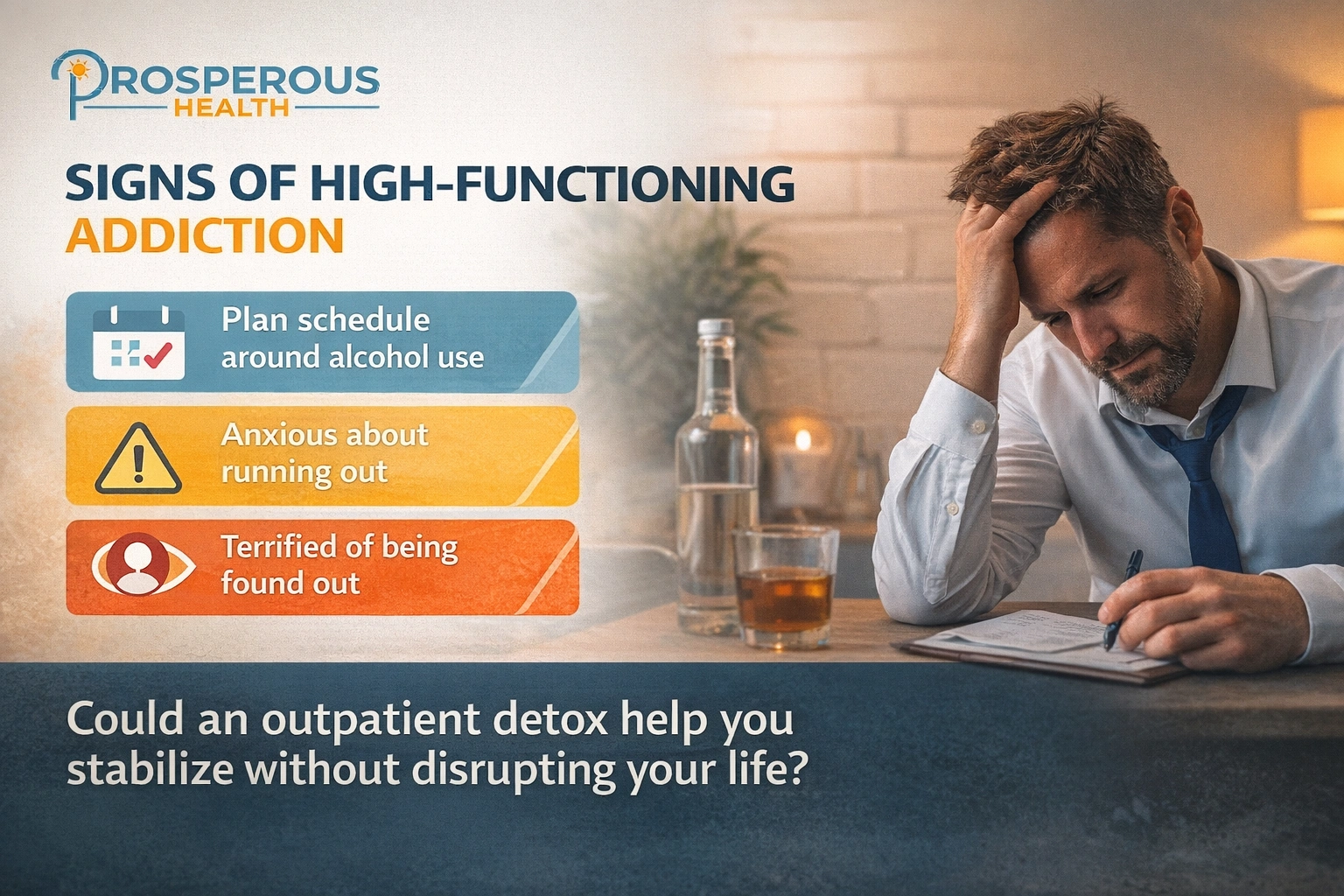
- “I plan my schedule around when I can drink.”
- “I’m anxious if I don’t know I have enough.”
- “I’m terrified someone will notice.”
- “I can’t keep doing this, but I don’t know how to stop.”
You don’t need a public collapse to justify private relief.
Sometimes the most painful bottom is the one no one else sees.
The Real Fear Isn’t Sobriety — It’s Disruption
When high-performing adults hesitate, it’s rarely because they don’t want change.
It’s because they don’t want fallout.
You’ve built something. A career. A reputation. A family ecosystem that runs because you run it.
The idea of stepping away feels like pulling the keystone from an arch and hoping everything doesn’t fall apart.
Questions spiral:
- Will I have to tell my employer?
- Will my partner panic?
- What happens to my income?
- What if I can’t function without it?
The truth is, getting help doesn’t automatically mean disappearing.
There are ways to stabilize your body and mind without burning down your responsibilities.
Keeping Your Life Intact While You Get Stabilized
One of the biggest misconceptions about detox is that it requires isolation.
For many high-functioning individuals, that simply isn’t realistic.
An outpatient detox program is designed for people who need medical oversight during withdrawal but also need to remain present in their daily lives. That might mean adjusting your schedule temporarily — not abandoning it.
You can:
- Sleep in your own bed
- Maintain work with coordination
- Stay connected to your family
- Protect your privacy
This isn’t about punishment.
It’s about medical stabilization and strategic recovery.
The goal isn’t to dismantle your life. It’s to make it sustainable.
The Hidden Cost of “Managing It”
You’re good at managing things.
Deadlines. People. Crisis. Logistics.
So you try to manage this, too.
You taper. You set rules. You switch substances. You promise “just weekends.” You track. You negotiate. You reset every Monday.
And every week, the bar moves.
What starts as “I just need to take the edge off” slowly becomes “I can’t relax without it.”
You might still be functioning — but it’s costing you:
- Mental bandwidth
- Emotional availability
- Physical health
- Authentic connection
It’s like running ten background apps on your phone all day. It still works… but the battery drains fast.
Eventually, it overheats.
What the First Few Days Actually Feel Like
The anticipation is often worse than the reality.
People imagine dramatic scenes, public admissions, or unbearable discomfort.
But what most high-functioning clients experience is something quieter.
The first morning without scrambling to steady your nerves.
The first evening where you’re not calculating whether you’ve crossed a line.
The first full breath that isn’t layered with shame.
Medical supervision during detox helps reduce withdrawal risks and discomfort. You’re not left alone to white-knuckle it. You’re monitored, supported, and guided.
The relief isn’t flashy.
It’s subtle.
But it’s real.
You’re Not Weak. You’re Overextended.
High-achieving clients rarely lack discipline.
If anything, you’ve been surviving through sheer willpower.
You push through discomfort. You outperform expectations. You absorb stress without complaint.
Substances may have started as fuel. Or relief. Or reward.
But somewhere along the way, they became necessary.
That shift is frightening.
Not because you’re reckless.
Because you’re aware.
There’s a specific kind of exhaustion that comes from being admired publicly while unraveling privately.
We see it every day.
Professionals from The Valley, California often come to us saying the same thing: “I can’t let this affect my work — but I can’t keep doing this either.”
Both can be true.
You can care deeply about your responsibilities and still need structured help.
Privacy Matters — And So Does Location
High-functioning individuals often worry about visibility.
Who will see me?
What if someone recognizes me?
Will this follow my record?
Confidentiality in treatment is not optional. It’s foundational.
For individuals seeking discreet support near Palos Verdes, California, access to structured, medically guided care doesn’t require public exposure or dramatic announcements.
You can protect your reputation while protecting your health.
Both matter.
The Decision Point Most People Don’t Talk About
There’s a quiet line people cross.
It’s not a DUI.
It’s not a divorce.
It’s not a hospital visit.
It’s a realization.
“I am organizing my life around this.”
That awareness is uncomfortable.
But it’s also powerful.
It means you’re early enough to intervene before external consequences force the issue.
That’s not weakness.
That’s intelligence.
You Don’t Have to Identify as an “Addict” to Need Help
Labels can be intimidating.
Many high-functioning adults resist treatment because they don’t connect with traditional narratives of addiction.
You might think:
- “I’m not that bad.”
- “I still perform.”
- “Other people have it worse.”
Recovery doesn’t require comparison.
If your substance use is creating internal distress, physical dependence, or loss of control — even subtly — it deserves attention.
You don’t have to implode to qualify.
You just have to be honest.
FAQs: What High-Functioning Clients Usually Ask
Will I Have to Stop Working Completely?
Not necessarily. Many outpatient models are structured to accommodate work schedules. Some clients adjust hours temporarily; others maintain their responsibilities with minimal disruption. The specifics depend on medical evaluation and safety needs.
How Do I Explain This to My Employer?
You may not need to disclose details. Some clients use medical leave protections. Others simply adjust schedules without disclosing specifics. Confidentiality laws protect your privacy. We help you think through this strategically.
What If My Family Doesn’t Think It’s “That Bad”?
High-functioning addiction is often invisible. You don’t need unanimous agreement to pursue care. If you feel the strain internally, that’s enough to explore options.
Is Withdrawal Dangerous?
Depending on the substance, it can be. That’s why medical oversight matters. Attempting to detox alone can carry risks. Supervised care reduces complications and increases comfort.
What Happens After Detox?
Detox addresses physical stabilization. Many clients transition into continued outpatient support, therapy, or structured weekly care. Recovery isn’t a single event — it’s a process. But detox can be the stabilizing first step.
Will This Go on My Permanent Record?
Treatment is confidential healthcare. It is not public record. Privacy protections are legally enforced.
What If I Start and Regret It?
Ambivalence is normal. Starting care doesn’t trap you. It gives you information, support, and options. You’re not signing away your autonomy.
The Alternative Is Quiet Escalation
Addiction in high-functioning adults rarely explodes overnight.
It escalates gradually.
Tolerance builds. Stress increases. Recovery time lengthens. Emotional resilience shrinks.
What once felt manageable begins to require more effort.
Eventually, something gives.
The earlier you intervene, the less dramatic the correction needs to be.
Think of it like financial planning. Addressing a small leak now prevents structural damage later.
You don’t wait for bankruptcy to adjust spending.
Why wait for collapse to address dependence?
You Can Be Capable and Still Need Help
This is the part people struggle with.
You pride yourself on competence.
Admitting you need support feels like contradiction.
It isn’t.
Capability doesn’t make you immune to biology.
Substances alter brain chemistry. Dependence can happen gradually — even predictably — especially under chronic stress.
Seeking structured care isn’t an admission of failure.
It’s an acknowledgment of reality.
And reality handled early is far less painful than reality ignored.
If You’re Reading This at Night
Most high-functioning clients reach out late.
After everyone is asleep.
After the emails stop.
When the silence makes it harder to ignore the internal conversation.
If that’s you right now, notice something:
You’re not in denial.
You’re thinking strategically.
That’s strength.
The version of you that built your career, maintained your family, and held everything together?
That person doesn’t disappear in recovery.
They get clearer.
More present.
Less exhausted.
You don’t have to burn your life down to fix it.
You can reinforce it — quietly, intentionally, and with support.
If you’re ready to explore next steps without chaos or exposure, we’re here to help you do this intelligently and privately.
Call (888)308-4057 to learn more about our outpatient detox program in Orange County, California.