
You’re not a mess. You haven’t lost your job. You haven’t gotten arrested. You pay your bills, show up for people, and no one’s staging an intervention. On the surface, everything looks solid.
But inside? You’re unraveling. Quietly. Gradually. Sometimes you think, If someone else lived inside my body for a day, they’d be terrified.
You don’t need rock bottom to qualify for help. You just need to be honest with yourself: This isn’t working anymore.
That’s why outpatient detox exists—especially for people who are “high-functioning” but quietly dependent. It’s private. It’s medical. And it’s often the very first step toward feeling like yourself again. At Prosperous Health’s outpatient detox program, we see you. And we know what it’s like to look fine and feel like you’re hanging on by a thread.
You’re “High-Functioning” — But Also Running on Empty
There’s a specific kind of exhaustion that comes with hiding how bad things have gotten. You go to work. You make dinner. You show up for the PTA meeting or the Zoom call. And then you retreat into the one thing that gets you through.
You might tell yourself it’s not addiction. Not yet. Just stress management. Just “a little something” to help you sleep or turn your brain off. But let’s be real:
If you’ve tried to stop and felt sick, anxious, or shaky?
If you’ve started hiding how much you’re using—or when?
If mornings feel like a recovery mission from the night before?
You’re not just tired. Your body might be dependent. That means detox isn’t about shame. It’s about getting your system back to baseline—without the crash.
The Real Red Flags: How Slipping Shows Up When You’re Still “Holding It Together”
Some of the most dangerous patterns are the most invisible. Especially when you’re a master of appearances. Here’s what “slipping” can look like behind a polished front:
- You time your day around when you can safely drink or use — not to get high, but to avoid withdrawal.
- You’ve started canceling things — social plans, workouts, even minor obligations, all because you’re foggy, shaky, or just “off.”
- You use more than you planned, then regret it—but do it again anyway.
- You minimize how bad it is by comparing yourself to people with “real” problems.
- You feel resentment when people ask how you’re doing. Not because they’re wrong—but because you don’t want to lie again.
- You’re more irritable, anxious, or emotionally numb. And it’s creeping into your work, your relationships, your sleep.
None of this makes you weak. It just means your body’s not cooperating with the double life anymore.
Why Outpatient Detox Works for High-Functioning Adults
The thought of checking into a 30-day rehab may feel extreme. Maybe impossible. You can’t leave your job or family. You don’t want to explain anything to anyone.
That’s where outpatient detox comes in. It’s not a watered-down version of care. It’s real medical support for people whose lives don’t allow—or require—a full shutdown.
Here’s what makes it work:
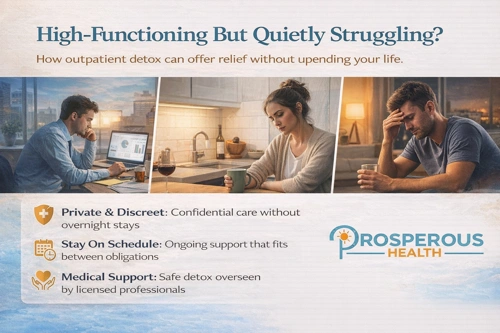
- Medical supervision: We monitor your withdrawal process with licensed clinicians who know how to keep it safe and manageable.
- Flexible scheduling: You return home between sessions, making it possible to maintain responsibilities while getting help.
- Privacy and discretion: No overnight stays. No dramatic exits. Just support that meets you quietly where you are.
- Supportive team: We don’t treat you like a crisis. We treat you like someone worth saving before things fall apart.
For many people in San Diego who are trying to get clean without blowing up their life, this is the safest first step.
Detox Is Just the Beginning—But It’s the Right One
Outpatient detox doesn’t fix everything—but it makes clarity possible.
When you’re not battling physical withdrawal, you can finally think. You can sleep. You can see your choices. You might still feel overwhelmed, but at least you’re not drowning in fog and shame.
This is why we don’t just hand you a medication and send you home. At Prosperous Health, we help you build a next-step plan—whether that’s IOP, therapy, or just breathing room to decide what comes next.
Because you deserve more than sobriety. You deserve support that sees your full life and fits around it.
“Not That Bad” Is Still Bad Enough
A lot of our clients tell us the same thing:
“I thought I had to be worse off to get help.”
“I didn’t think outpatient detox was for people like me.”
“I thought I had to white-knuckle it myself to prove I wasn’t really addicted.”
But here’s the thing: If you’re reading this? You’re already in the zone where support is safer than solo.
This isn’t about labels. It’s about relief. It’s about being able to stop without spiraling. It’s about getting back in control of your body without risking your job, your family, or your sanity.
Real Talk: What It’s Like to Detox While Still Living Your Life
We don’t sugarcoat detox. It’s uncomfortable. Your body’s relearning how to function without the substance it depended on. There may be nausea, anxiety, sleep disruption, or mood swings.
But unlike detoxing alone, you’ll be monitored. You’ll have medication support. You’ll have someone checking in. You won’t be pacing your apartment at 3am wondering if you should call 911—or just keep sweating it out.
You won’t be alone. And for a lot of people who’ve spent months (or years) pretending they’re okay, that’s the first real relief they’ve felt in a long time.
Looking for an Outpatient Detox Program in San Diego, CA?
Prosperous Health offers discreet, compassionate detox services for high-functioning adults who need help—but don’t want a spectacle. If you’re in San Diego or surrounding areas and you’re tired of holding it together while falling apart inside, it’s time to reach out.
FAQs About Outpatient Detox
What is outpatient detox and how is it different from inpatient detox?
Outpatient detox allows you to receive medical supervision for withdrawal symptoms while living at home. Inpatient detox requires a hospital or residential stay. Outpatient is ideal for people who are medically stable and prefer privacy, flexibility, and less disruption to their lives.
Am I “sick enough” to qualify for detox if I’m still working and parenting?
Yes. Detox isn’t reserved for emergencies. If you’ve developed physical dependence and feel anxious, shaky, nauseated, or off when you try to stop using—you’re a candidate. You don’t need to hit a crisis to deserve help.
Will people find out I’m in detox?
Not unless you tell them. Outpatient detox is discreet. Sessions are scheduled to accommodate your life. We protect your privacy and treat you with the same professionalism you’d expect from any other medical provider.
How long does outpatient detox last?
It depends on the substance and severity of use, but most programs last between 5 to 10 days. We’ll evaluate your needs and develop a personalized care plan that fits your medical profile and schedule.
What happens after detox?
Once your body is clear, we’ll help you figure out what’s next—whether it’s therapy, outpatient treatment, support groups, or just space to feel stable again. Detox is a doorway, not a destination.
You Don’t Have to Be a Wreck to Need Help
You don’t have to lose everything to ask for support. You just have to be done living in a body that’s stuck in survival mode.
If your outside looks fine, but your insides are screaming for a break—listen to that voice. You don’t have to keep pretending. We see you. We know what it costs to keep holding it all together.
Call (888)308-4057 or visit our outpatient detox program page to take your first real breath in a long time. Healing starts the moment you stop hiding.
And if you’re looking for outpatient detox in San Diego, CA, we’re here to help—quietly, capably, without judgment.