

When your child is spiraling and alcohol is part of it, the fear is constant.
Every call unanswered, every slammed door, every moment of “they’re just tired” feels heavier.
And when someone finally says the word treatment, you might feel a mix of relief and dread: What does that actually mean? Will it help? What happens in alcohol addiction treatment, really?
If you’re a parent asking those questions, you’re not alone. You love your child. You’re scared for them. And you deserve to know what comes next—not just for their sake, but for your own peace of mind.
This guide walks you through how alcohol addiction treatment works—especially here in San Diego, Ca—so you can stop guessing and start breathing again.
Explore our alcohol addiction treatment program at Prosperous Health, where we specialize in care for young adults and support for the parents who love them.
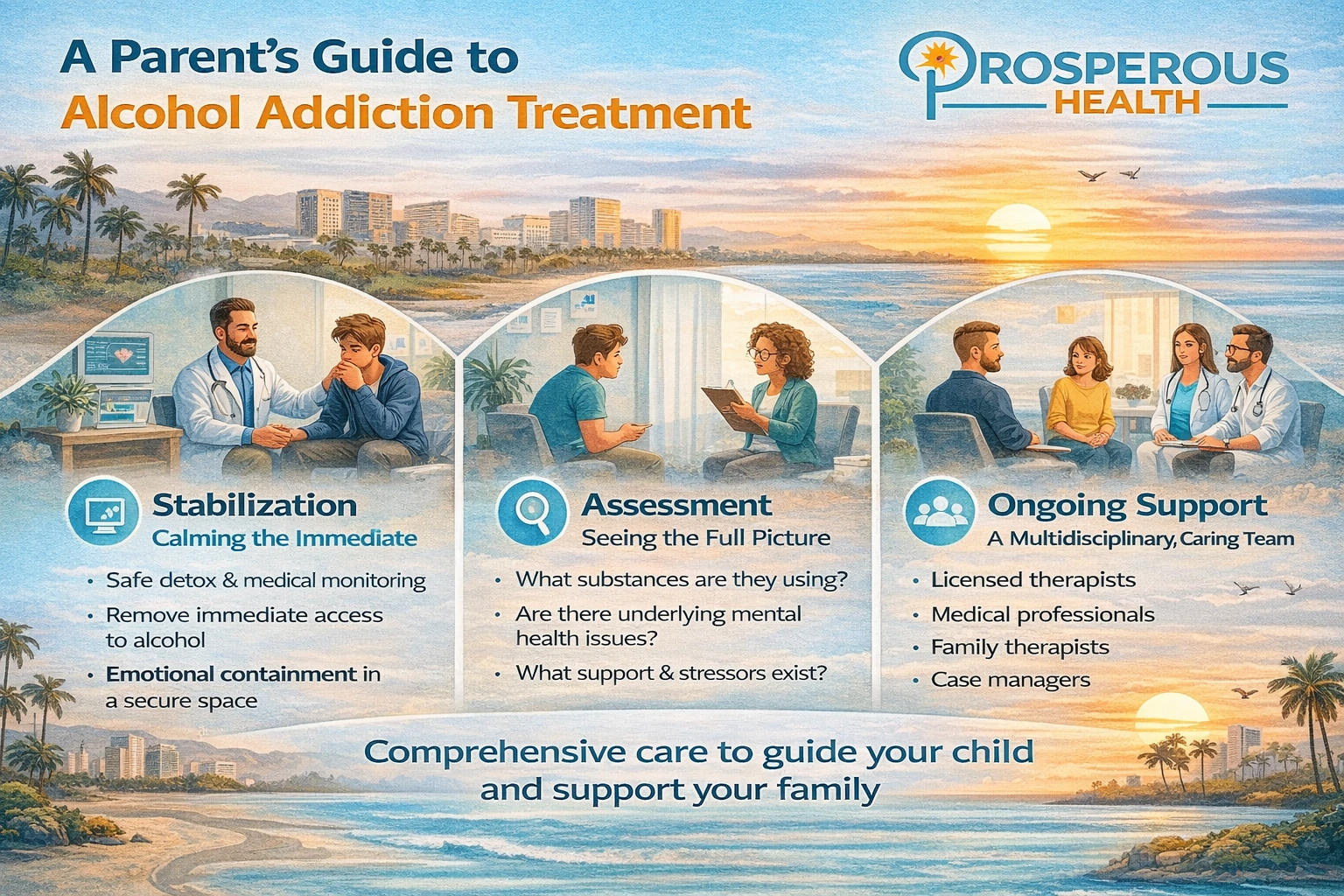
First Comes Stabilization: Calming the Immediate Chaos
For many families, reaching out for help happens during a crisis.
Maybe your child came home blackout drunk. Maybe they missed a final exam or lost a job. Maybe they scared a sibling, or you found something you can’t unsee. The first priority isn’t therapy or steps—it’s safety.
Stabilization means helping your child land safely in a space where the spiral slows down.
That might involve:
- Removing immediate access to alcohol or risky situations
- Medical monitoring if detox is needed
- Emotional containment—someone steady who can listen without judgment
This phase doesn’t fix everything. But it starts the slowing. It helps your child begin to feel safe enough to consider what help could look like.
Then Comes Assessment: Seeing the Full Picture
Once they’re stable, the next step is clinical assessment. This isn’t about labeling your child. It’s about understanding them.
We ask:
- What are they using? How often?
- What stressors, traumas, or symptoms are present?
- Are there signs of depression, anxiety, ADHD, or trauma-related disorders?
- What support systems exist—or don’t?
This step is collaborative. We ask for input from parents and caregivers when appropriate (especially for clients under 25). Your observations can help us catch things they might not know how to say.
The goal? To build a clear, compassionate map of where they are—so we can guide them forward with precision and care.
Building a Personalized Treatment Plan: No One-Size-Fits-All
Treatment isn’t boot camp. It’s not punishment. It’s a process of healing and skill-building tailored to your child’s specific needs.
At Prosperous Health, our alcohol addiction treatment plans are built around:
- Level of need: Some young adults need high-support outpatient care. Others might do best with a lower-frequency model.
- Underlying issues: If trauma, anxiety, or family dynamics are fueling the alcohol use, we build in care for those too.
- Cognitive and emotional maturity: We tailor programming for emerging adults who might still be learning basic life navigation skills.
Treatment may include:
- Individual therapy
- Group counseling (with peers)
- Family therapy
- Medication support for co-occurring conditions
- Experiential therapies (like mindfulness, movement, or expressive arts)
This isn’t a checklist. It’s a care plan built to help your child engage, grow, and stabilize—on their terms, with our guidance.
The Team: A Support System That’s Bigger Than You
Parents often ask, “Will someone actually connect with my child?”
It’s a valid fear. You’ve watched them tune out teachers, fight with you, ghost their friends. But in treatment, connection looks different.
Your child will be supported by a multidisciplinary team, including:
- Licensed therapists trained in addiction, trauma, and adolescent development
- Medical professionals who can evaluate and manage detox, nutrition, and medications
- Family therapists who guide healing between generations
- Case managers who handle logistics and long-term planning
- Support staff who model consistency, kindness, and healthy boundaries
And all of us operate with the same mission: to treat your child with dignity—even when they’re resistant, angry, or afraid.
What the Day-to-Day Looks Like
Depending on the level of care, your child’s schedule may include:
- Therapy sessions multiple times per week (individual and group)
- Skills groups that cover emotional regulation, communication, and relapse prevention
- Check-ins with medical or clinical staff
- Family sessions where you’re invited to join, listen, and speak without shame
- Structured free time and accountability systems to reduce impulsivity and chaos
It’s not about keeping them busy—it’s about helping them create a rhythm that supports healing.
How Long Does Alcohol Addiction Treatment Take?
We wish we could give a perfect timeline. But like healing from any chronic illness, recovery isn’t linear.
Typical outpatient treatment lasts 8 to 12 weeks, though some clients stay involved longer. After initial programming, they may shift into:
- Step-down services (less frequent but ongoing care)
- Continuing therapy
- Support groups (in-person or virtual)
- Recovery coaching or academic/vocational mentorship
What we do promise is this: we stay with you through it. You won’t be handed a pamphlet and left on your own.
The Role of the Parent: Still Important, Even If They Act Like You’re Not
Some parents think, “They’re 22. It’s on them now.” Others think, “I failed them. I have to fix this.”
The truth is somewhere in between. You are still part of their healing—but not responsible for all of it.
In treatment, parents may be invited to:
- Participate in therapy (to heal rupture, not to be blamed)
- Learn new communication tools for de-escalation and boundary-setting
- Understand addiction as a brain-based illness, not just a choice
- Take space for your own healing, whether through family support groups or coaching
You are not powerless. You are not invisible. And you don’t have to do this alone anymore.
FAQ: What Parents of Young Adults Often Ask
Will my child be forced to talk in therapy?
No. We move at their pace. While participation is expected, we create space where clients feel safe enough to speak—without pressure.
Can I be involved if they’re over 18?
With consent, yes. We always encourage family involvement for young adults, but we also respect legal privacy rights. We’ll guide you on how to navigate this.
What if they don’t think they have a problem?
That’s incredibly common. Our team is trained in motivational interviewing and harm-reduction approaches that meet clients where they are—not where we wish they’d be.
Do you treat mental health issues too?
Yes. Most of our clients have co-occurring conditions—meaning they struggle with both substance use and mental health. We treat both, not just the addiction.
Will they be safe during treatment?
Absolutely. We prioritize physical, emotional, and psychological safety. If detox is required, it’s medically supervised. If emotional stability is a concern, we have supports in place.
What If This Isn’t Their “Rock Bottom”?
Here’s what we want you to know:
You don’t have to wait for total collapse to get help.
The myth of rock bottom has cost families time, safety, and even lives. If your gut says something is wrong, that’s enough.
Alcohol addiction treatment can help before the crisis gets worse. It can offer hope, healing, and structure to a life that’s teetering—and give you, as a parent, the first true exhale you’ve had in months.
You Don’t Have to Do This Alone
You’ve carried a lot already. Worry. Guilt. Sleepless nights. Quiet panic.
You don’t have to keep holding it all on your own.
Whether your child is in deep crisis or just beginning to unravel, there is help—and it works best when families are supported too.
Call (888)308-4057 or visit Prosperous Health’s Alcohol Addiction Treatment page, The Valley, Palos Verdes to talk with someone who understands what it means to love a child through a crisis.
We’ll meet you both right where you are—and walk with you through whatever comes next.