

Let’s just say it: being sober in your twenties can feel like being the only one in color while everyone else is still living in black and white.
Your friends are drinking at brunch, at concerts, after work, on weekends… and you’re the one holding a sparkling water wondering if something’s wrong with you.
You might hear:
“Come on, you’re too young to be sober.”
“You weren’t even that bad.”
“Don’t you want to live a little?”
We hear this all the time at Prosperous Health. Young adults in our alcohol addiction treatment program often feel isolated—not because they’re failing, but because they’re actually paying attention to what most people ignore.
Here’s what our clinicians want you to know about getting sober young—and why it might be one of the most powerful things you ever do.
1. You’re Building Self-Awareness Most People Don’t Get Until 40
Getting sober young means you’re learning to observe yourself—your patterns, reactions, and habits—long before most people ever do.
You start to notice:
- How stress makes you want to reach for something
- How certain people or places change your mood
- How much of your social life was centered around not feeling anything
That level of self-awareness? It’s rare.
While others are years away from facing their emotional defaults, you’re already making conscious choices. That’s not just maturity—it’s a head start.
2. You’re Practicing Boundaries While Others Are Still People-Pleasing
Let’s talk about boundaries—the superpower that saves lives but rarely gets taught.
Saying no to a drink when everyone else is saying yes isn’t just about alcohol. It’s about choosing your values, your body, and your truth—out loud.
And when you do that repeatedly, something shifts. You stop shrinking to make others comfortable. You learn that discomfort isn’t a threat. You realize that peace isn’t found in approval—it’s found in alignment.
You’re building a skill that most people don’t even know they need until their 30s, 40s, or later.
3. You’re Learning to Feel the Hard Stuff Without Running From It
Here’s the unfiltered truth: alcohol works. It numbs, softens, loosens. Until it doesn’t. Until it takes more than it gives.
When you get sober, especially young, you start feeling things without a chemical buffer—and that’s intense.
But it also teaches you what your emotions are really trying to say. Instead of silencing pain, you start hearing its messages. Instead of drinking away anxiety, you learn to sit with it and survive.
This is where emotional strength starts. Not in avoiding pain—but in learning that you don’t have to escape it to survive.
4. You’re Not Behind—You’re Actually Way Ahead
There’s this cultural myth that you’re supposed to drink your way through your 20s. That everyone gets wasted. That it’s just a phase.
But not everyone makes it out of that phase.
You getting sober now isn’t you quitting life—it’s you choosing to live it on your terms. You’re not behind. You’re ahead.
You’re gaining years of clarity, energy, and freedom that others won’t tap into until they’re burned out, deep in debt, or emotionally lost.
This isn’t a detour. It’s a shortcut to the kind of life most people are still looking for in their 40s.
5. You Don’t Need to Fit the “Alcoholic” Mold to Deserve Support
Maybe you never blacked out. Maybe you didn’t lose your job. Maybe no one staged an intervention.
But if alcohol made your life smaller, foggier, or harder—you get to question your relationship with it.
You don’t need to hit a dramatic rock bottom to deserve care.
At Prosperous Health, we work with people who are:
- High-functioning
- Quietly spiraling
- Still going to school or work
- Not sure if it’s “bad enough” to ask for help
If that’s you, you’re not broken. You’re brave. And our alcohol addiction treatment was built with your reality in mind.
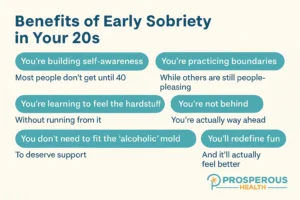
6. You’ll Redefine Fun—and It’ll Actually Feel Better
In early sobriety, fun can feel… complicated.
You may worry that without alcohol, you’ll be boring. Flat. Alone.
But something strange starts to happen when the fog lifts:
- Your laugh gets louder.
- Your memories get clearer.
- Your joy comes back—unscripted, unfiltered, yours.
Real fun doesn’t need a filter or a buzz. It doesn’t need to end in regret. And when it returns in sobriety, it’s often deeper than it ever was before.
What Young Adults in Treatment Often Ask Us
1. Am I really “addicted” if I only drank on weekends?
Labels don’t matter as much as impact. If alcohol was messing with your mood, motivation, mental health, or relationships—it’s worth exploring. You don’t need to fit a stereotype to deserve care.
2. Will I lose my friends if I stay sober?
Some relationships might shift. But the ones that matter—the ones that see you—will stay. And you’ll build new ones. Real ones. The kind that aren’t based on what’s in your cup.
3. What if I relapse—does that mean I failed?
Not at all. Recovery is rarely linear. Relapse isn’t proof that you can’t do it. It’s information. It’s an opportunity to adjust, not a reason to give up.
4. I’m scared treatment will be too intense—what if I’m not ready?
You don’t have to be ready. You just have to be willing to be honest. At Prosperous Health, we pace your care with you. No forced sharing. No rushed steps. Just support that fits where you are.
5. Can I still have a social life in sobriety?
Absolutely. It may look different—but it won’t be empty. Over time, you’ll find friends, joy, and connection that don’t require alcohol to exist. And that kind of social life? It lasts.
Getting Sober Young Doesn’t Make You Weak—It Makes You Wise
You didn’t fail. You woke up early.
You looked around and said, “This isn’t working for me.”
And that decision? That awareness? It’s your superpower.
At Prosperous Health, we specialize in supporting young adults through the messiness of early recovery. Our alcohol addiction treatment program in San Diego isn’t about labels or pressure—it’s about finding what works for you.
Call (888) 308-4057 to learn more. You’re not too young to heal—you’re just ahead of the curve.