

You can have the calendar, the career, the family responsibilities—and still feel like you’re constantly treading water.
High-functioning addiction is often invisible to the outside world. You meet deadlines, pay bills, and make it to every appointment. But underneath that surface competence is a quiet exhaustion, the kind that makes you think, I can’t keep doing this—but you do, because stopping feels like losing control.
When one of my clients started virtual IOP, they didn’t think they needed it. They thought they needed “better self-discipline.” What they found was something much more life-changing: a framework for living that actually worked, not just for sobriety, but for stability.
Here’s how virtual IOP gave them control over their life again—without requiring them to walk away from everything they’d built.
1. Structure That Works in Real Life
High-functioning clients are no strangers to structure. In fact, their calendars are often jammed with obligations—back-to-back meetings, family events, workouts, social commitments. The problem isn’t a lack of structure; it’s that the structure is built around maintaining appearances, not supporting well-being.
In virtual IOP, my client didn’t just “add” therapy to an already overloaded schedule. We helped them reorganize their day so treatment became the anchor, not the afterthought.
They attended morning group three days a week before work, carving out mental space to start the day grounded. Evenings that had been filled with numbing rituals—like a drink after work that turned into three—were replaced with brief check-ins and journaling.
The structure worked because it was realistic. It didn’t require them to take months off work or uproot their life. It slotted into the life they already had, but in a way that started shifting the foundation toward health.
Structure isn’t about adding more to your plate—it’s about making sure what’s on it is worth carrying.
2. Learning Self-Regulation in the Moment
One challenge with traditional in-person care is that the skills you learn are practiced in a “safe” environment. That’s valuable, but it doesn’t always translate to the messy reality of home and work.
With virtual IOP, my client learned self-regulation in real time, in the actual environments where they’d struggled before. They practiced grounding techniques between Zoom meetings, learned to pause and breathe before firing off a stressed-out email, and created short sensory breaks in the middle of a chaotic workday.
Instead of relying on the emotional safety of a therapy room, they were building tools where they needed them most—at their desk, in their kitchen, on their couch at 9 p.m. when the urge to escape was strongest.
Self-regulation isn’t about never feeling stressed. It’s about knowing how to stay steady in the middle of it.
3. Communicating Without the Mask
High-functioning people are experts at masking. They can present as confident, engaged, and agreeable while silently wrestling with overwhelm. Over time, that mask becomes second nature—so much so that they struggle to be fully honest even in safe spaces.
In virtual IOP, my client learned to talk without rehearsing. To answer “How are you?” without the reflexive “I’m fine.” In group sessions, they began sharing what was actually going on—not just the version they thought others wanted to hear.
That new honesty began to spill over into other parts of life. They started telling their partner when they were drained instead of pushing through. They gave clearer feedback at work instead of swallowing frustration. They even found that setting honest limits with friends deepened their relationships instead of damaging them.
Clear communication stripped away a layer of isolation they hadn’t realized they were carrying.
4. Boundaries That Actually Hold
Boundaries are a buzzword in self-help circles, but for high-functioning people, they can feel like a luxury they can’t afford. Saying no risks letting someone down. Asking for space risks looking unreliable.
Through group discussions and one-on-one work, my client identified exactly where their limits were—and practiced holding them. At first, it was small: saying no to one extra shift that would interfere with therapy, or skipping a social gathering that was more draining than restorative.
As they got more comfortable, the boundaries grew clearer and stronger. They realized that protecting their time and energy wasn’t selfish—it was essential.
Boundaries didn’t push people away. They actually allowed my client to show up more fully for the commitments they chose to keep.
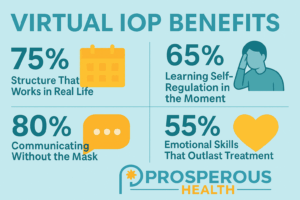
5. Emotional Skills That Outlast Treatment
Early in recovery, emotions can feel unpredictable—either muted and numb or overwhelming and sharp. High-functioning clients often default to avoiding them entirely, focusing instead on productivity or distraction.
In virtual IOP, my client learned to see emotions as information, not threats. They started to identify patterns—like how irritation after work was often about exhaustion, not incompetence, or how sadness on Sundays was tied to feeling disconnected, not weak.
By learning to name and understand these feelings, they were able to respond with intention. Instead of pouring a drink to “fix” the discomfort, they reached out to a friend, took a walk, or practiced a relaxation exercise.
These emotional skills didn’t end when the program did—they became part of how they navigated daily life.
Why Virtual IOP Works for High-Functioning People
If you’ve kept your life running despite heavy stress or substance use, you might think treatment will require you to step away from it all. For some, that’s the right choice. But for many high-functioning clients, virtual IOP offers a way to get help without dismantling their existing life.
You can attend sessions from home or the office. You can integrate new skills directly into your routines. And you can stay connected to work, family, and community while building a healthier foundation beneath it all.
If you’re looking for Virtual IOP in San Diego, CA, it’s possible to get the help you need in a way that fits the life you’ve built—without losing the parts of it you value.
FAQs About Virtual IOP for High-Functioning Clients
1. Do I have to quit my job to do virtual IOP?
No. Virtual IOP is designed to fit around work and personal commitments. Many clients attend morning, evening, or midday sessions based on their availability.
2. Is virtual care as effective as in-person?
For many, yes. The skills are learned in the same environment where they’ll be applied, making them highly relevant to daily life.
3. Will people in my life know I’m in treatment?
Only if you choose to share. You can attend from a private space, and sessions are confidential.
4. What if I’m not sure I “need” treatment?
High-functioning clients often minimize their struggles because life hasn’t fallen apart. But if you feel exhausted, anxious, or reliant on unhealthy coping habits, treatment can help before a crisis forces the issue.
5. How long does virtual IOP last?
Programs vary, but most run for several weeks to a few months, with multiple sessions per week. Your care plan will be tailored to your needs and goals.
6. Can I move to in-person care later?
Absolutely. Virtual IOP can be a stand-alone program or a bridge to more intensive in-person treatment if needed.
Final Thought
Control doesn’t come from keeping everything together at any cost. It comes from knowing which pieces matter most—and having the skills, structure, and support to protect them.
If you’ve been holding it all together for everyone else, maybe it’s time to hold something back for yourself.
Call (888) 308-4057 to learn more about our Virtual IOP services in San Diego, CA.