

Sometimes, life gets heavy in ways even treatment can’t carry all at once.
Maybe your schedule collapsed. Maybe a tough session brought up more than you expected. Maybe you just stopped showing up—and then felt too ashamed to come back.
If that sounds familiar, take a breath. You’re not alone—and you’re not disqualified.
Returning to intensive outpatient treatment after stepping away isn’t failure. It’s a reset. And this time, you get to come in with more honesty, more clarity, and one very important thing you didn’t have before: experience.
At Prosperous Health in San Diego, we believe that second tries deserve fresh hope—not old guilt. Here’s how to set goals that actually fit your life this time.
Start with Where You Actually Are—Not Where You “Should” Be
It’s easy to fall into “catch-up mode” when you re-enter treatment. You might feel like you need to prove something. To yourself, to your therapist, to the group. But the truth is, you don’t.
Where you are now is the only place you need to start from.
Whether you’re still navigating depression, anxiety, trauma, or just the mental weight of having left something unfinished—it’s all workable. And it’s welcome here. Second tries aren’t about doing it better; they’re about doing it differently.
You don’t have to pretend you’re okay if you’re not. In fact, your honesty might be the most powerful part of your return.
Choose Just One Goal to Begin With
If the first time around felt overwhelming, it’s not because you lacked discipline—it’s because you were probably holding too much.
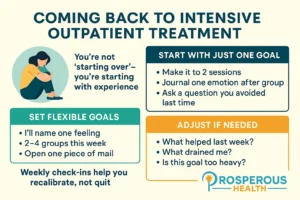
Start simple. Choose one focus for your first week back:
- Make it to 2 sessions
- Journal one emotion after group
- Ask a therapist a question you avoided last time
That’s enough.
Why one goal? Because one goal gives you direction. Five goals give you pressure. When you succeed at one, momentum builds naturally. And when you miss it? There’s room to try again without collapse.
Your “one thing” is a lighthouse. It’s not a contract. It’s something to steer by, not a standard to punish yourself with.
Set Goals That Flex—Not Snap
Rigid goals break under pressure. Flexible ones bend with you.
That might mean:
- “I’ll attend 2–4 groups this week” instead of committing to 5
- “I’ll name one feeling in group” instead of trying to bare your soul
- “I’ll open one piece of mail” instead of “Get all my finances in order”
Flexible goals reduce shame spirals and leave room for the real conditions of your life—like energy dips, childcare, work shifts, or unexpected emotions.
Progress isn’t about consistency. It’s about return.
Let the Past Inform You, Not Shame You
What didn’t work for you last time? Be honest about it—and bring it into the room.
If the group didn’t feel safe, say so. If the schedule felt off, mention it. If you didn’t feel heard, talk about it.
That’s not being difficult. That’s being real.
Returning to IOP gives you a second chance to make it your own. You’re not starting from zero—you’re starting from knowledge.
Let your care team know what support would actually feel helpful this time. That collaboration is the key difference between “trying again” and actually getting what you need.
Use Weekly Check-Ins to Adjust Instead of Abandon
Many people fall out of treatment not because they don’t care—but because no one helped them adjust.
Try this: Every Sunday or Monday, take 5 quiet minutes to ask yourself:
- What helped last week?
- What drained me?
- What feels too heavy to do right now?
- Is there a smaller version of this goal I could still move toward?
Recalibration is a skill—not a failure.
IOP isn’t about finishing a checklist. It’s about getting support for your actual life, as it is today.
Rebuild Trust at Your Own Pace
You might be worried about how the clinical team will receive you. That’s normal.
If you ghosted, you might fear judgment. If you left angry, you might assume you burned bridges. But here’s the truth: leaving doesn’t make you bad. It makes you human.
At Prosperous Health, we don’t close the door. We know that people step away for all kinds of reasons—some emotional, some logistical, some hard to explain even to yourself.
You’re allowed to return with hesitation. You’re allowed to ask, “Is it okay if I come back?” even if the answer is always yes.
Explore a Different Location or Format if You Need It
Was the location too far? Was the group too big? Did in-person sessions clash with your work hours?
This time around, explore what might work better.
Looking for Intensive Outpatient Treatment in San Diego, CA?
Looking for Intensive Outpatient Treatment in The Valley, CA?
You might find that a different location—or a virtual session option—makes the difference between burnout and sustainability.
Second tries should be built with your reality in mind. Not just your ideal self.
You’re Not the Only One Who Needed a Second Try
Here’s something clients say more often than you think:
“I felt like I had to be perfect to come back. But everyone was just… glad I did.”
Treatment is full of people who’ve started, stopped, and started again. It doesn’t mean you’re weak. It means you’re still willing to show up.
And that’s strength—on your terms.
FAQs: Coming Back to IOP at Prosperous Health
Can I re-enroll if I left without notice?
Yes. We don’t punish pauses. We’ll talk with you about what happened and what support you’d need now—but judgment isn’t part of the process.
Will I have to start over from the beginning?
Not necessarily. Your care plan will be reviewed and adjusted based on what’s still relevant and what’s shifted. Sometimes people repeat early sessions. Sometimes they move into a new group. Either way, it’s personalized.
What if I’m still not sure I can commit?
That’s okay. We can talk. Returning to IOP doesn’t mean locking yourself into something you can’t handle. We’ll help you explore what’s actually doable.
What if I need a different location?
We’ve got multiple options. If you’re near San Diego, you can check out our IOP location here. We also offer IOP in The Valley and Palos Verdes.
Will my insurance still cover it?
Coverage depends on your plan, but many providers will still cover IOP if you meet medical necessity criteria. Our admin team can walk you through this step-by-step—no pressure, just clarity.
One Honest Step Is Still Progress
You don’t have to come back with a glowing sense of readiness. You don’t have to come back perfectly organized.
You just have to come back.
And if you’re not ready to walk in the door yet? That’s okay too. You can call. You can ask questions. You can take your time. Returning to IOP isn’t a declaration—it’s a decision. Quiet, real, and entirely yours.
Ready to Talk About a Second Try?
Call (888)308-4057 or visit Intensive Outpatient Treatment in San Diego, CA to explore what coming back could look like. No shame. No pressure. Just support—on your terms.