

There’s no shame in stepping away. Life gets messy. Cravings come back. Sometimes the pressure to heal feels heavier than the pain you’re carrying. If you paused your care or disappeared from an outpatient detox program, you might be thinking: Can I even go back? Did I blow my chance?
We hear those questions often—and we want to offer a clear answer: yes, you can come back. And yes, you’ll still be met with care, not criticism.
At Prosperous Health, we work with people in every stage of recovery—including those who’ve walked away and are now wondering how to return. Whether it’s been a few days or a few months, the door is still open.
This blog offers a gentle, step-by-step way to re-engage with outpatient detox—without judgment, without pressure, and at your own pace.
1. Know That Leaving Doesn’t Cancel Your Progress
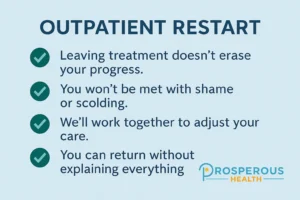
It’s easy to feel like disappearing from treatment means starting over from scratch—but that’s not how recovery works.
You might’ve walked out in the middle of a tough session. You might’ve just stopped showing up. Maybe it was intentional, maybe it wasn’t. Either way, that decision doesn’t erase the work you already did.
The truth is, treatment dropout is common. And not because people don’t care about getting better—but because healing is hard. Life continues. Schedules crash. Shame creeps in. The very symptoms we’re treating (withdrawal, anxiety, fear of change) can interfere with staying in treatment.
Leaving doesn’t mean you weren’t serious about recovery. It means you’re human—and it means this: you’re still eligible for support.
2. Start With a Small Reach-Out (Even If You’re Unsure)
You don’t need a perfectly worded explanation. You don’t even need a full plan. A simple message—“Hey, I’m thinking about coming back”—is enough.
Our team at Prosperous Health’s Outpatient Detox Program in San Diego is trained to respond with warmth, not red tape. We know that early steps are often the hardest.
And if picking up the phone feels like too much? You can also:
- Send a text or secure portal message
- Ask a friend or loved one to call for you
- Just walk in during open hours and ask to speak with someone
Even a whisper toward help is a valid reentry.
3. You Won’t Be Scolded or Shamed
Maybe you’re expecting a “Why did you leave?” Or a long talk about policy violations. That’s not how we work.
Instead, you’ll be met with curiosity, not interrogation.
- “What’s been hard lately?”
- “How can we make things feel safer this time around?”
- “What support would actually help right now?”
Returning to treatment isn’t about rehashing what went wrong. It’s about reconnecting with what you still want—and what still matters.
4. Review What Worked—And What Didn’t
Treatment should never be one-size-fits-all. If something in your last experience made you want to disappear, that deserves airtime—not avoidance.
When you return, we’ll invite you to talk about what felt right and what didn’t. Maybe group sessions were overwhelming. Maybe the commute was too much. Maybe the plan didn’t fit your schedule.
Together, we can look at:
- Adjusting your detox schedule
- Adding or removing therapy elements
- Connecting with a new provider
- Revisiting goals that actually feel doable
You’re not starting over—you’re starting smarter.
5. Expect an Honest, Flexible Rebuild
Outpatient detox works best when it meets your reality. That might mean:
- Fewer hours at first.
- More focus on medication support.
- Addressing barriers like transportation or childcare.
- Support around ambivalence or fear.
Returning doesn’t mean “jump back in like nothing happened.” It means saying, “Let’s try again—with better support this time.”
For clients in other areas, we also serve those looking for a Outpatient Detox Program in The Valley, CA or Outpatient Detox Program in Palos Verdes, CA.
6. Re-Entering Doesn’t Mean Explaining Everything
We understand that some people leave programs during a moment of crisis—and explaining that moment can feel almost impossible.
If you don’t know how to talk about what happened, that’s okay. You don’t owe us your entire story on day one. You can say:
- “I was overwhelmed.”
- “It got too hard.”
- “I didn’t think I was ready.”
Or you can say nothing at all. Your presence is enough.
7. You Might Still Feel Unsure—Come Anyway
Even as you reach out, part of you might still be second-guessing everything:
“What if I fail again?”
“What if it’s just as hard?”
“What if they’re disappointed in me?”
Those fears are normal—and we won’t try to talk you out of them.
But here’s what we can say: It’s okay to come back while still feeling unsure.
In fact, that might be the bravest thing you do.
8. Trust Rebuilds Through Relationship, Not Perfection
Healing happens in relationships. That includes your relationship with your care team.
We know we’re asking you to trust again—to trust that we’ll treat you with respect, that we won’t punish you for leaving, that we’re still here for you.
That trust doesn’t have to show up all at once. It builds slowly, in moments:
- When someone looks you in the eye and listens
- When a session ends and you feel even a little lighter
- When no one makes you feel bad for being late, quiet, or uncertain
That’s how trust rebuilds. One breath at a time.
9. This Program Is Still for You
Sometimes, people think outpatient detox is only for those who “stay committed.” But treatment is for people—not perfection.
If you’ve used again, relapsed, or just emotionally checked out, you still qualify. If you’re back at square one, or square three, or lost track of the squares entirely—you still qualify.
Our Outpatient Detox Program in San Diego is built around real-life relapse, avoidance, fear, return, healing—and yes, ghosting too.
10. A Fresh Start Can Be Quiet
You don’t have to announce your return. No big declarations. No pressure to “get it right this time.”
A quiet start still counts. Showing up counts. Breathing through the discomfort and staying for the second session counts.
There is no minimum energy required to return—just the flicker of willingness.
Frequently Asked Questions About Returning to Outpatient Detox
Is it common to leave treatment and come back?
Absolutely. Many clients step away for a period—intentionally or not—and later return. It’s more common than most people think, and treatment programs are prepared to support that process.
Will I be judged for leaving?
No. At Prosperous Health, our clinicians are trained to respond with compassion and understanding. We focus on helping you re-engage safely and meaningfully—without guilt trips or shame.
Do I have to explain why I left?
Only if you want to. You’re welcome to share what happened, but it’s not a requirement. The priority is moving forward in a way that supports your needs now.
Can I adjust my treatment plan if I return?
Yes. In fact, we encourage it. We’ll work with you to make adjustments that improve fit—whether that means a lighter schedule, different focus areas, or additional support resources.
What if I’ve started using again?
You’re still welcome. Detox programs are specifically designed to help people manage withdrawal and re-stabilize. Using again doesn’t disqualify you from care—it just means you’re still in the process, and that’s okay.
Will I still be eligible for medication support?
Yes. If you were previously on medication-assisted treatment (MAT) or considering it, our team can assess whether restarting—or beginning—a medication plan is appropriate.
How soon can I return?
Often, same-day or next-day re-entry is possible. We recommend calling ahead so we can make sure the right staff are available to welcome you back and begin planning next steps.
Ready to take that first step back?
Call (888)308-4057 to learn more about our Outpatient Detox Program services in San Diego, CA. You’re still welcome here. The door is still open—and we’re ready when you are.