

It’s easy to think you blew it.
That you messed up your shot. That you disappeared from your Intensive Outpatient Program (IOP) too long ago to be welcome back.
But you didn’t blow it.
You hit a pause. And that’s not the same thing as quitting.
Recovery isn’t a straight line. And IOP isn’t a closed door the second you ghost. In fact, leaving—and returning—is more common than most people talk about.
At Prosperous Health, we’ve walked with hundreds of people who stepped out for a while, then chose to come back. This guide is here to help you do the same—without shame, without pressure, and at your own pace.
1. The Door Is Still Open (Even If It’s Been a While)
If you hear one thing in this blog, let it be this:
You are still welcome.
Whether you left two days ago or two months ago, there’s still a place for you in our Intensive Outpatient Program in San Diego. We don’t close the door when someone leaves. We keep it cracked open—quietly, gently—waiting for the moment you’re ready to return.
You might worry that too much time has passed. That your spot is gone. That you’ll have to explain everything. But here’s the truth: we expect people to struggle. We expect people to disappear. And we expect them to come back.
2. We’ll Help You Restart—Not Re-Explain
When you return, you don’t have to tell your whole story all over again.
You don’t need to walk in with a PowerPoint presentation of what went wrong.
You’ll likely have a brief re-engagement session—a conversation, not a confrontation. It might involve:
- Checking in on your mental and physical health
- Updating your treatment goals
- Exploring what made it hard to stay before
- Collaboratively adjusting the schedule, if needed
Our goal isn’t to pick up where you left off. It’s to meet you where you are now—and help you begin again with fresh insight, not guilt.
3. Start Small—Recommitment Doesn’t Have to Be Loud
Rejoining IOP doesn’t require some grand announcement or full-schedule sprint.
Your re-entry might look like:
- One individual therapy session
- One group session to reorient
- A short meeting with your care team to plan next steps
- A modified schedule until you feel grounded again
The goal is re-connection—not performance. No one is waiting for you to show up with all the answers. We’re just waiting for you to show up.
You don’t have to do it all. You just have to do the next right thing.
Looking for a convenient location? Explore:
4. You Didn’t “Fall Behind”—Recovery Isn’t a Race
One of the biggest barriers to returning is shame.
They’re ahead of me now. I missed too much. I don’t belong anymore.
But here’s the truth: there’s no leaderboard in recovery. No perfect attendance trophy. Everyone is on their own timeline—and yours is valid.
When you return, your care team will help you re-enter in a way that works:
- Maybe you rejoin your old group.
- Maybe you try a new one.
- Maybe you do a few 1:1s first to catch your breath.
You don’t need to “catch up.” You just need to come back. We’ll handle the rest.
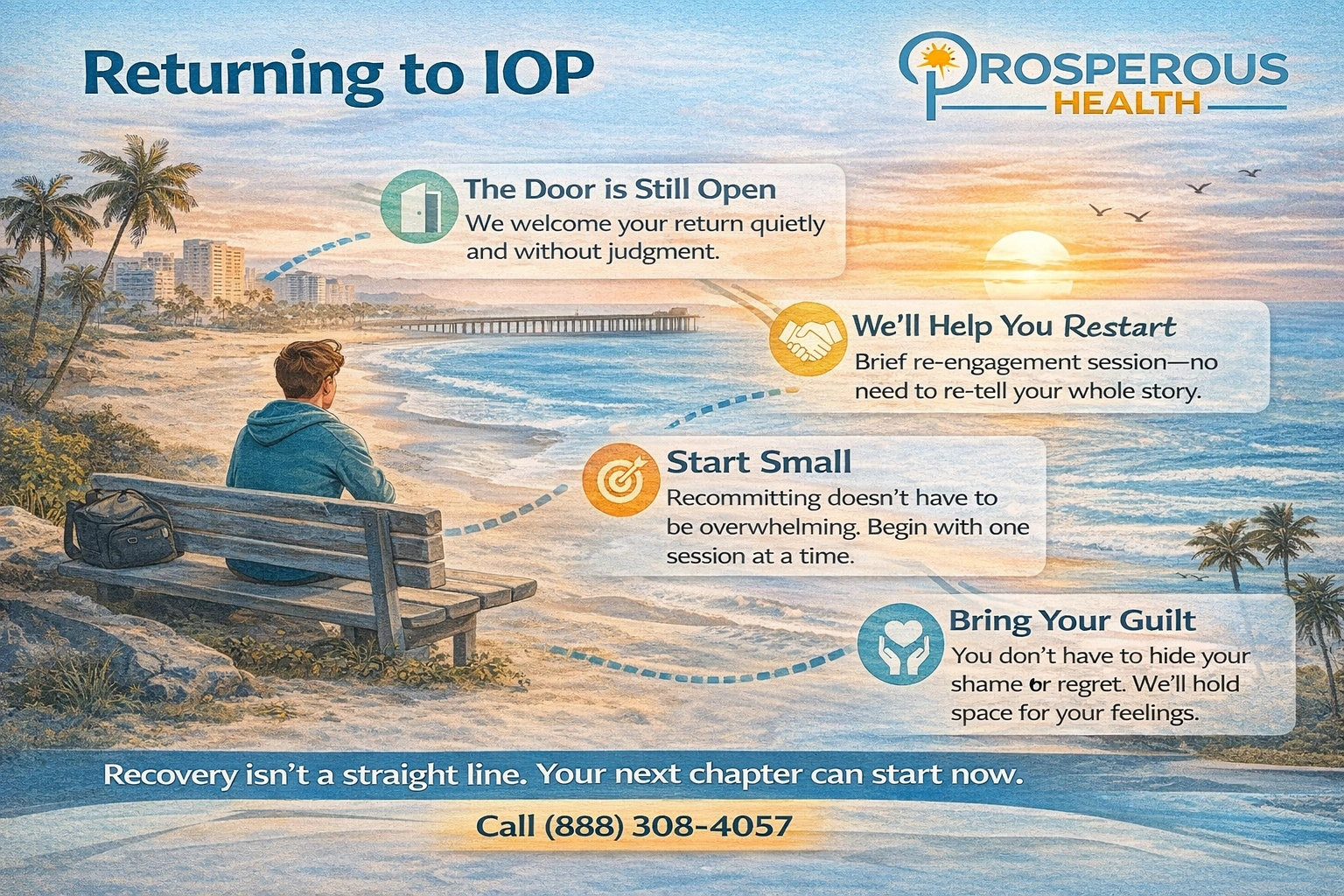
5. Bring Your Guilt With You—We Can Hold That, Too
You might feel guilty for leaving. For ignoring check-ins. For ghosting your group. For saying “I’m good” when you weren’t.
That guilt is heavy. But it doesn’t have to come between you and your recovery.
In fact, naming it might be the very thing that helps you move forward.
Because when you say, “I messed up, but I want to come back,” you are practicing the kind of self-honesty recovery is built on.
At Prosperous Health, we make room for the whole version of you—not just the polished parts. Bring the guilt, the fear, the regret. We’ll help you sort through it safely.
6. Ask What Needs to Be Different
Leaving treatment usually isn’t random. It’s a sign something wasn’t working—or wasn’t tolerable yet.
Ask yourself gently:
- What made it hard to stay last time?
- Were the groups too big or too intense?
- Was the schedule unworkable with your life?
- Did you feel like you didn’t fit in?
These aren’t “excuses.” They’re data.
And when you bring that data back with you, your team can work with it. We can adjust your plan so that it meets you where you are now—not where you were when you first enrolled.
7. Expect Mixed Feelings—and Come Anyway
You might still feel unsure.
You might be thinking: “What’s the point? I’m just going to leave again.”
Those thoughts are normal. Especially after stepping away.
We don’t need you to feel certain. We just need you to feel willing.
Willingness is enough to start with. And from there, trust and strength can grow.
FAQ: Returning to IOP After Stepping Away
Is it normal to leave IOP before completing it?
Yes. Many people pause treatment. Life happens. Emotions overwhelm. It’s not failure—it’s part of the process for many.
Will I have to start over completely?
Not necessarily. We’ll reassess what’s best for you. You may rejoin your old group, or shift into a new one depending on fit and scheduling.
Will people judge me for coming back?
No. Not your care team. Not your peers. If anything, people will respect that you came back—because they know how hard that can be.
Can my schedule be adjusted this time?
Yes. We’ll collaborate with you on a schedule that fits your work, school, or other obligations, while still supporting your progress.
What if I feel too ashamed to return?
That’s okay. Shame is common—and welcome here. Bring it with you. You won’t be punished for it. You’ll be supported through it.
What If You Still Don’t Feel “Ready”?
Readiness is a myth.
Most people don’t feel “ready” to come back. They feel scared, uncertain, tired of trying. That’s okay. You don’t need confidence. You need courage.
If you’re even thinking about returning, that’s a sign something inside you still wants to heal. And that’s enough.
This Could Be Your Turning Point—Not a Backtrack
We don’t see your return as a rewind.
We see it as a recalibration.
You’re coming back with more knowledge about yourself. More awareness. More strength—because it takes strength to return, especially when it’s hard.
Let this be the beginning of your next chapter, not a redo of your last one.
Call (888)308-4057 or visit Intensive Outpatient Program to talk to someone who understands what it’s like to take a break—and how powerful it can be to come back.