

You don’t have to be in crisis to want more.
Maybe your life looks functional from the outside—work, social stuff, plans made and kept. But inside, something’s off. The anxiety under the surface doesn’t let up. You can’t remember the last time you felt really present. You’re not falling apart, but you’re definitely not thriving.
If you’ve ever caught yourself thinking “I shouldn’t feel this stuck,” or “Something needs to change, but I don’t know what,”—you’re not alone. A lot of us have lived in that in-between place.
And for some of us, a Partial Hospitalization Program (PHP) was what helped everything finally shift.
1. You’ve Outgrown Coping, But Don’t Know What Comes Next
You’ve learned how to get through hard days. Maybe you’ve tried therapy, or meditation, or sober months. You know how to “manage” stress—up to a point.
But managing isn’t healing. And deep down, you might feel it: that something inside you is ready for more than surviving.
Partial Hospitalization Programs aren’t just for crisis or relapse. They’re built for people who are ready to go deeper. You show up five days a week for structured therapeutic care, then go home at night. It’s outpatient—but intensive.
It’s for people who are functioning, but quietly burning out. Who are self-aware, but stuck. Who want to break the loop—but need more support than a once-a-week session can offer.
2. Your Mornings Are Heavy, Even When You Slept
Sleep should help, right? But even after a full night, you wake up tired—not just physically, but emotionally. Like something in you is dragging a weight you can’t explain.
A lot of clients who join PHP say mornings were the hardest. The pressure to pretend they’re okay started the second they opened their eyes.
In PHP, mornings don’t start with panic or pressure. They start with grounding. You check in, breathe, connect with a group that understands what emotional exhaustion feels like.
You don’t need to show up “ready.” You just need to show up.
3. You Crave Connection That Isn’t Surface-Level
You can talk about the weather. Your weekend plans. Work stuff. But that other stuff—the loneliness, the fear, the guilt about feeling numb when you “should be happy”? That doesn’t come up over coffee with coworkers.
In PHP, connection is built into the schedule. You sit in group therapy with others who aren’t shocked by big emotions. You have space to speak, or just listen, without judgment or pressure.
Some of the deepest healing happens in moments that seem small:
- Someone across the circle says something you’ve never dared to admit—and suddenly, you feel seen
- You laugh—really laugh—for the first time in weeks
- You say something out loud that’s lived in your head for too long, and the world doesn’t fall apart
You don’t have to be extroverted or expressive. You just have to be willing to let yourself be in the room.
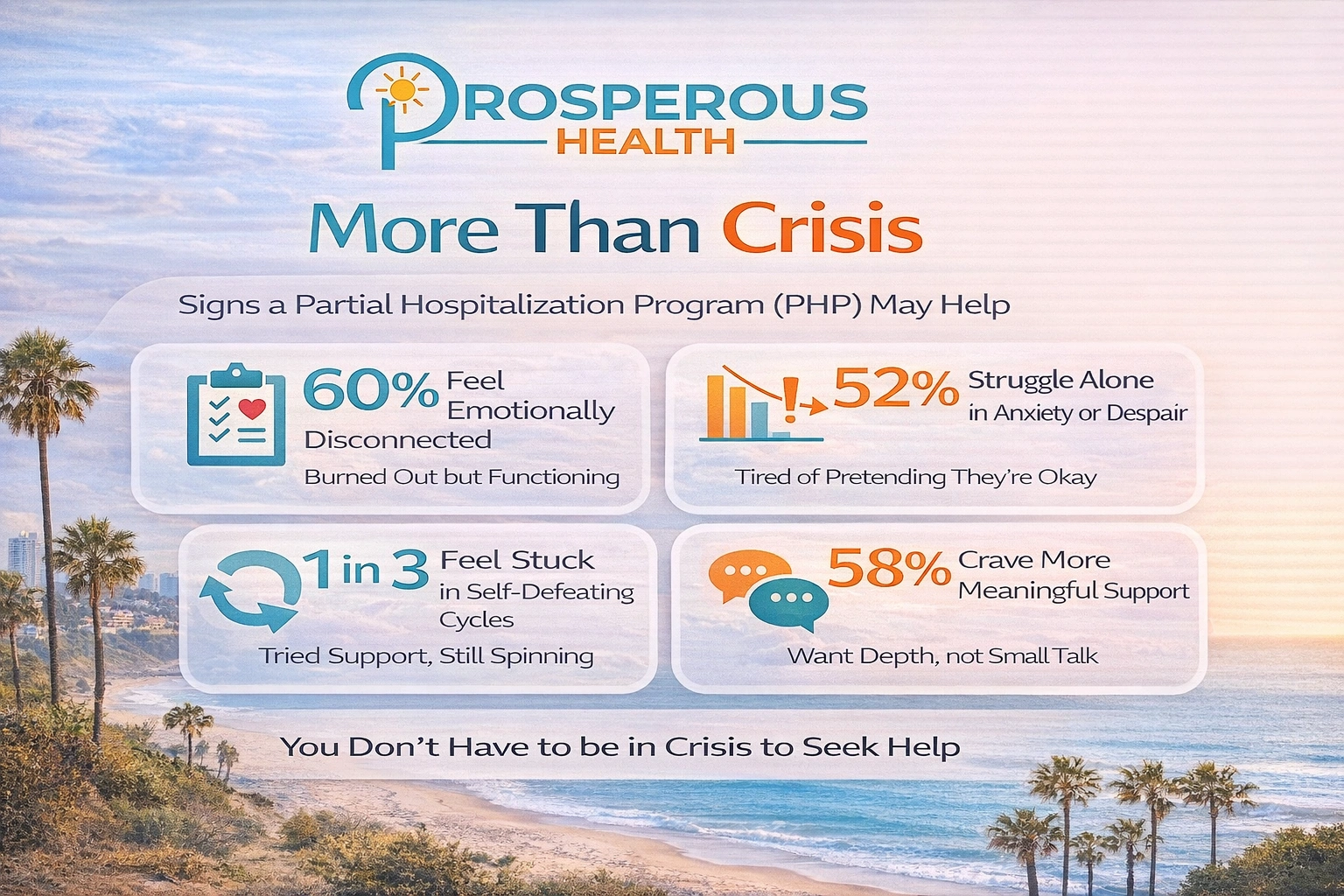
4. You’re “Fine” on the Outside, But It’s Taking a Toll
Being high-functioning doesn’t mean you’re okay.
If anything, it can make it harder to ask for help. You’re not missing work. You’re not using heavily. You’re still getting things done.
But you might also:
- Feel emotionally detached from the people you care about
- Find it harder to feel joy or even interest in things you used to love
- Numb out more than you want to admit—with food, scrolling, substances, or busyness
- Secretly wonder how long you can keep holding it all together
PHP is one of the only treatment settings designed for people like this—people who aren’t in immediate danger, but are deeply tired of holding the weight alone.
5. You’ve Tried Solo Growth—and You’re Still Spinning
You’ve done the inner work—or at least tried. You’ve journaled. Meditated. Maybe even been in and out of therapy.
But something’s still looping. Old patterns sneak back in. You start strong, then slide. You make plans, but can’t seem to keep them. There’s no accountability, no scaffolding.
PHP gives you that scaffolding. Real structure. A clinical team. Peers. A rhythm that supports healing—not just managing symptoms.
You don’t need more willpower. You need a container that helps hold your growth steady.
6. You Want to Understand Yourself—Not Just “Fix” Something
PHP isn’t about fixing you. It’s about helping you understand yourself with more clarity, more kindness, and more tools.
You’ll learn:
- What actually triggers your overwhelm or shutdown responses
- How to track your nervous system before it spikes or crashes
- How past experiences shaped current behaviors—and how to change the ones that aren’t serving you
- That emotional healing is a skill you can build, not a mystery you’re supposed to figure out alone
And you’ll practice these things in real time—with clinicians who guide, not lecture.
7. You’re Ready for More Than Numbing Out
Maybe your use of alcohol or weed or social media isn’t extreme. Maybe it’s just… convenient. A way to shut your brain off for a bit. A way to get through.
But if you’re here, reading this? Something in you is probably craving more than just getting through.
Partial Hospitalization Programs meet you in that craving. You don’t need to label yourself. You don’t need to swear off everything forever. You just need to be open to learning a new way to feel things without fear.
And that? That’s a massive act of courage.
Real Words from Real People Who Tried PHP
“I thought I wasn’t ‘sick enough’ to get help. Turns out, I was just tired of pretending I was fine.”
— PHP Client, San Diego
“This wasn’t a last resort for me—it was a conscious choice. I wanted more than numbness. And I got it.”
— Alumni, The Valley Location
“The structure of PHP was exactly what I didn’t know I needed. It made healing feel doable, not overwhelming.”
— Client, Palos Verdes Program
FAQ: Is PHP Right for the Sober Curious?
What exactly is a Partial Hospitalization Program?
It’s a structured outpatient program that runs several hours per day, usually five days a week. You attend therapy groups, meet with clinicians, and go home at night.
Do I need to be in a crisis to join?
Not at all. Many people in PHP are working professionals, students, or caregivers who feel overwhelmed, emotionally disconnected, or stuck—but not in danger.
Is PHP only for people with addiction?
No. While PHP can support people exploring their relationship with substances, many clients attend for depression, anxiety, burnout, trauma, or emotional numbness.
What’s the difference between PHP and weekly therapy?
PHP provides daily support, deeper clinical work, and a consistent structure. It’s ideal if weekly therapy hasn’t been enough, or if you need more momentum in your healing.
Will I lose my job or have to put my life on hold?
Our team works with you to make treatment fit your life. Some clients use FMLA or short-term leave, but others adjust their schedule. We’ll talk you through your options.
You Don’t Have to Be in Crisis to Want to Heal
Sometimes healing starts with curiosity—not collapse.
If something in you has been whispering, There’s got to be more than this,—that whisper matters.
And if you’ve been waiting for permission to take the next step—this is it.
Call (888)308-4057 to learn more about our Partial Hospitalization Program services in San Diego, CA. Whether you’re near The Valley or Palos Verdes, we’re ready when you are.