

Starting treatment can feel like walking into a room where everyone else already knows the rules—and you’re the only one still figuring out how to sit in the chair.
If you’re sober curious or stepping into a Partial Hospitalization Program for the first time, there’s a good chance your guard is up. Maybe you’re not sure if you belong here. Maybe you’ve tried group therapy before and it didn’t click. Maybe you’re still carrying some shame, or doubt, or plain old fear.
That’s okay. You don’t have to be ready for full vulnerability. You don’t have to be convinced this will work. You just have to be willing to try again—gently.
At Prosperous Health, we help people build trust from the ground up. No performances. No pressure. Just real, consistent care and a chance to connect at your own pace.
1. Understand That Mistrust Isn’t a Flaw—It’s a Signal
If you’re feeling cautious about opening up, that’s not resistance—it’s intelligence. Somewhere along the line, your mind learned to be careful with who you trust. That might have come from:
- Family dynamics that punished honesty
- Friends who weren’t safe with your story
- Previous treatment experiences that felt impersonal or dismissive
So if you walk into PHP feeling skeptical, that’s a sign your brain is trying to protect you. You don’t need to shut that down—you just need a space where safety can be rebuilt.
Trust doesn’t mean “I believe everything you say.” It means “I feel safe enough to show up, little by little.”
2. Start With One Thread of Truth
You don’t have to tell your life story on day one. And honestly, you shouldn’t. The best trust-building in group therapy comes from small moments of honesty.
Try sharing one thread:
- “I’ve never done this before.”
- “I’m not sure this is for me.”
- “I don’t usually talk about this stuff.”
These small admissions build something important: emotional traction. When you’re honest about where you’re starting, you give your peers and treatment team something real to respond to.
At Prosperous Health in Palos Verdes, we value transparency over performance. No one’s expecting you to bare your soul—just to be here, as you are.
3. Know That Trust Is Built With Actions, Not Words
It’s easy to say “you can trust us.” But that means nothing if our actions don’t back it up.
In our PHP model, we earn trust through:
- Showing up on time
- Following through on what we say
- Responding to feedback without defensiveness
- Being consistent, even when things get uncomfortable
If you’re looking for a Partial Hospitalization Program in The Valley, CA, or exploring options in Palos Verdes or San Diego, you’ll find the same core promise: we’re not perfect, but we’re accountable.
4. Notice Who Feels Safe (Even If You Don’t Know Why)
Group therapy is like a classroom where emotional energy walks in before the syllabus. You’ll instantly feel drawn to some people. Others? Not so much.
You don’t have to force closeness. Just notice:
- Who makes space without dominating the room?
- Who listens without interrupting?
- Who seems grounded, even when they’re vulnerable?
Let these people be your starting points. Trust often begins not with similarity, but with shared humanity. You’ll feel it when it’s there.
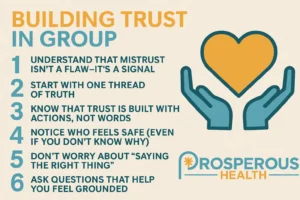
5. Don’t Worry About “Saying the Right Thing”
There’s a weird pressure in group therapy: the idea that your shares need to be deep, or insightful, or emotionally tidy.
They don’t.
Sometimes, the most healing thing you can say is: “I don’t know what to say.” Or “I’m here, but I’m not ready to talk.” Or “I kind of hated that last group.”
Group isn’t about performance. It’s about presence. The more real you are, the more likely it is that someone else will say, “I feel that too.”
And that’s how trust multiplies.
6. Ask Questions That Help You Feel Grounded
Trust grows when you feel like you can understand what’s happening to you—not just follow along silently.
Ask:
- “What’s the structure of today’s group?”
- “Can I step out if I feel overwhelmed?”
- “What’s the purpose of this activity?”
Your treatment team should welcome these questions. They show you’re engaged, even if you’re still unsure.
At Prosperous Health, we’re never offended by curiosity. We encourage it—because informed clients are empowered clients.
7. Name What’s Working—and What’s Not
Building trust isn’t about agreeing with everything. It’s about feeling like you can speak up—and be heard.
You might say:
- “I connect more with the smaller groups than the big ones.”
- “I didn’t feel safe when someone interrupted me.”
- “That session felt really helpful because it gave me language I didn’t have before.”
Feedback like this deepens trust. It tells us what matters to you, not just what the treatment plan says on paper.
8. Track the Small Shifts in Your Body
You might not realize you’re starting to trust until you notice your body responding differently:
- Your shoulders drop in group
- You stop rehearsing what you’re going to say
- You laugh—like really laugh—for the first time in weeks
- You look forward to seeing a familiar face at check-in
These aren’t small things. They’re signs. And they often mean: I feel a little safer here than I did yesterday.
That’s progress.
FAQs: Building Trust in Group and PHP
What if I’ve never done therapy before?
Totally okay. Many PHP clients are brand new to therapy. Our team helps orient you from the ground up—no jargon, no judgment.
What if someone in group triggers me?
Group settings can be intense. If you feel triggered, we’ll support you with grounding techniques and one-on-one processing. You’re always allowed to pause.
Can I request a different therapist if I don’t connect?
Yes. Chemistry matters. We want you to work with someone you can build rapport with. Switching isn’t seen as failure—it’s seen as self-advocacy.
What if I don’t feel ready to talk?
You don’t have to. Listening is a powerful part of group. When you’re ready to share, you will. Until then, your presence matters.
Is it okay if I’m still unsure about sobriety?
Absolutely. Many sober curious clients come into PHP exploring their relationship with substances. We work from a place of curiosity, not condemnation.
You Don’t Have to Trust Everyone—Just Start With One Connection
Call (888)308-4057 or visit Partial Hospitalization Program in San Diego, CA to learn more. You don’t need to be “all in” to get started. You just need a little space to breathe—and one person to meet you where you are.
We’re ready when you are.