

It wasn’t supposed to happen again.
You had 90 days. A full three months without benzos. You were breathing deeper. Your hands didn’t shake as much. Maybe you’d started journaling again, cooking your own meals, even laughing sometimes. You were finally starting to feel like someone you recognized.
And then, it slipped.
It might have been one pill to calm your nerves before a flight. A prescription refill you told yourself you’d “manage this time.” A panic attack that felt too loud, too fast, too much. One moment where benzos felt like the only option.
Relapse is a punch to the gut—not just because of what you used, but because of what you’d built. Now you’re sitting with that quiet, gnawing voice: I messed it all up.
But here’s the truth, as gently and clearly as we can say it:
You didn’t mess everything up. You’re still here. And you can begin again.
At Prosperous Health, our benzodiazepine addiction treatment program in San Diego is built to meet people exactly where you are right now—relapsed, hurting, uncertain, but still trying.
This Isn’t Starting Over—It’s Starting Again With Wisdom
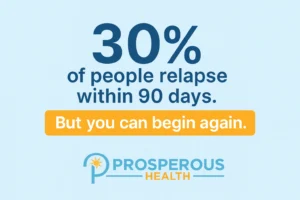
Relapsing after 90 days doesn’t put you back at zero.
It might feel like that, especially in early recovery where milestones mean everything. But the truth is: you’ve learned things in those 90 days that haven’t disappeared.
You’ve learned:
- What helped you sleep without benzos
- What pulled you through your worst craving
- What grounded you when your anxiety felt unbearable
- What made you feel safe in your own skin—even briefly
That knowledge is still inside you. Relapse doesn’t erase it. If anything, it sharpens it.
You’re not starting from scratch. You’re starting from experience.
Shame Will Try to Shut You Up—Don’t Let It
If relapse has a co-pilot, it’s shame.
Shame says:
- “You should’ve known better.”
- “They’re going to be so disappointed.”
- “You had one shot and you blew it.”
Shame loves silence. It thrives in isolation. And it convinces you that you don’t deserve another chance.
But shame is a liar.
The truth? You’re not the only one. In fact, many people relapse after 30, 60, even 180 days. And not because they’re weak—but because benzodiazepines are powerful, and recovery is a long road.
At Prosperous Health, we never shame someone for coming back. We honor it. Because walking through our doors again—after a slip, a spiral, or a quiet ghosting—is an act of courage.
Your Nervous System Didn’t Betray You—It’s Just Wounded
Benzos don’t just numb the mind—they condition the body.
When you’ve used them to soothe panic, silence obsessive thoughts, or sleep through trauma, your brain and nervous system start to rely on them. Even after 90 days away, your body remembers that shortcut.
That doesn’t make you weak. That makes you human.
It also means that relapse often isn’t a moral failure—it’s a nervous system overwhelm. Your body defaulted to what it knows brings relief. And while that relief is temporary (and costly), it doesn’t mean you wanted to go back. It means your system still needs healing.
That’s what we do in our benzodiazepine addiction treatment program in Palos Verdes: help your body learn safer ways to calm down, sleep, and reset—without the chemical hijack.
You Already Know Some of What Works—Let’s Build On That
Think back. What supported you during those 90 days?
Was it morning walks? DBT skills? A specific group therapist who didn’t make you feel judged?
Whatever you reached for in those sober weeks—that’s gold. And that’s where we begin again.
We don’t expect you to return and pretend none of that happened. In fact, we use it. Our care team will ask what helped and what didn’t, and together, we’ll adjust your treatment plan so it fits better this time.
Not tighter. Not stricter. Better.
You Deserve to Be Met With Respect, Not Rules
The fear of returning to treatment after relapse is real. You might be expecting to:
- Be scolded
- Be asked to explain yourself
- Be treated like you’re back at square one
That’s not what we do.
We’ll meet you with compassion. With boundaries, yes—but not blame. With honesty, not harshness. With a team that sees relapse not as failure, but as information.
You’ll still have a voice in your care. You’ll still be treated like a full human being. You haven’t lost your dignity here. You bring it with you.
You’re Not Alone—Even If It Feels Like It
The loneliest part of relapse is the silence. You stop responding to messages. You drop out of support groups. You scroll past people celebrating recovery milestones and think, I’m the only one who slipped.
You’re not.
You’re just the one brave enough to admit it—and consider coming back.
Every day, someone returns to treatment after a benzo relapse. Quietly, bravely, scared but ready. You’re in good company. And your return is not a walk of shame. It’s a step toward hope.
You’re Not Broken—You’re Still Becoming
One slip doesn’t define you. One relapse doesn’t undo everything you’ve fought for.
In fact, some of the most resilient people we’ve ever worked with were the ones who relapsed—because they came back more honest, more grounded, more ready to build something real.
This isn’t about going back to who you were before. It’s about becoming someone new—with your mistakes integrated, your lessons intact, and your self-respect slowly growing back.
That’s what long-term recovery is: not perfection, but persistence.
Frequently Asked Questions
Is it normal to relapse after 90 days?
Yes. It’s more common than most people admit. Ninety days is a huge milestone—but it’s also where new challenges arise. Your support may shift, routines change, or your brain might start testing the limits of your recovery. It’s common, and you’re not alone.
Will I be judged for coming back?
Absolutely not. Our staff understands that relapse is part of many people’s recovery story—especially with benzodiazepines. You will be treated with dignity, compassion, and respect from the moment you call.
Do I have to start the program over from scratch?
Not always. If you’ve been in treatment with us before, we’ll revisit your care plan and adjust it to meet your current needs. Sometimes that means restarting some components. Other times, we pick up from where you left off and build forward.
What if my relapse was minor—do I still need treatment?
If you’re reading this and asking that question, it’s a sign something needs attention. Even a “small” relapse with benzos can indicate that stress, anxiety, or unresolved issues are resurfacing. A conversation with our clinical team can help determine the best next step.
Is this confidential?
Yes. Everything you share with us is protected by HIPAA and treated with the utmost privacy and discretion. You can call, ask questions, or return without fear of exposure.
If you’re ready to begin again, we’re ready to meet you.
Call (888) 308-4057 or visit our benzodiazepine addiction treatment page to explore what coming back to recovery can look like in San Diego, CA. We’ll walk this next chapter with you—no shame, just support.