

Some chapters in life don’t close neatly—and for many of us, recovery is one of them. If you’ve been sober or stable for a while, but lately things feel off—emotionally flat, unmotivated, or just… distant—you’re not alone. At Prosperous Health, we want to say something plainly: you’re not behind. And you haven’t lost your place.
Our Partial Hospitalization Program in San Diego, CA wasn’t just a phase. It was a foundation. And it still stands, ready to hold you up—whether you need to reconnect, re-center, or just remember who you are.
Recovery Doesn’t End—But It Does Evolve
When you were with us in PHP, the structure was solid. There were clear steps. A team around you. A plan on paper. You probably got familiar with the rhythm: group sessions, individual therapy, breaks that weren’t just pauses—but breathing room.
Back then, every small win was celebrated. Every emotion had a place to land.
But now?
Now it’s you, out in the world, and the rhythm might feel more like noise than support. People assume you’re “good now”—and maybe you even told yourself that, too. But somewhere underneath the day-to-day, there’s a quiet question rising:
Why do I feel disconnected from my own life?
This is common among long-term alumni. Not because you’re failing—but because you’ve grown. And growth invites new layers of care.
The Emotional Plateau Is Real
There’s a unique ache that can come after you’ve stabilized. You may not be in crisis—but you’re also not fulfilled. The energy you once had for healing might feel distant. The spark you had in early recovery has dimmed.
Some alumni describe it like this:
- “I know I should feel proud, but I just feel tired.”
- “I’m functioning, but I feel hollow.”
- “I used to be so connected to my ‘why’—now I don’t know where it went.”
This isn’t relapse. It’s not failure. It’s emotional fatigue. And it’s part of the long game.
At Prosperous Health, we don’t think your recovery needs to stay loud to be real—but we do believe it should still feel alive.
Our Partial Hospitalization Program Wasn’t Just for the Crisis
The word “partial” can be misleading. There’s nothing halfway about the work that happens in a PHP.
When you entered our Partial Hospitalization Program, you began something deeply personal. You gave language to your pain. You built relationships that made healing feel possible. You made uncomfortable changes, sat with hard truths, and tried again when it didn’t all click right away.
Those foundations weren’t built to expire after discharge.
Even years later, the space you created for your mental health still matters. And it can still grow.
Whether you’re local to San Diego or exploring alumni support across our California locations, your place with us remains.
Reconnection Looks Different for Everyone
You don’t need to come back full-time. You don’t need to explain everything that’s happened since you left. You don’t need to justify why you feel off when everything “looks fine.”
Reconnection could be as simple as:
- Sitting in one familiar group to hear something real
- Calling a staff member who remembers your name
- Asking about alumni meetups in your area
- Journaling through your old worksheets to see what still fits
- Letting someone know, “I’m not in crisis, but I could use a touchpoint”
This isn’t about going backward. It’s about widening your path forward.
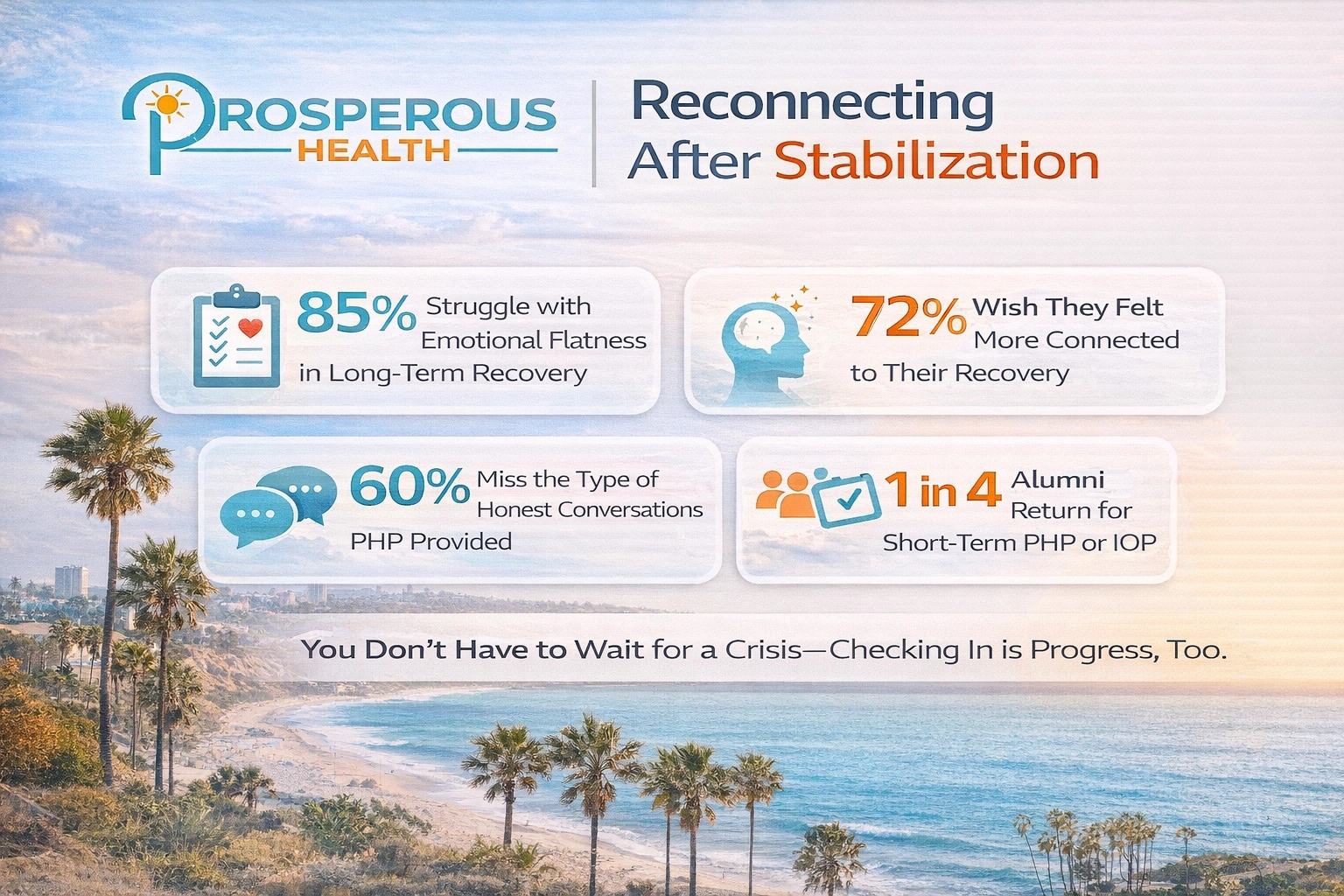
You’re Allowed to Want More Than Stability
Let’s be honest: stability is a massive win. Especially after what you’ve walked through.
But once things settle, you may start to want more—depth, connection, creativity, peace. That doesn’t make you ungrateful. It makes you human.
And in recovery, those longings can feel tricky. You might wonder:
- Shouldn’t I just be happy I’m okay?
- Is it selfish to feel restless?
- Is something wrong with me for not feeling lit up by this life I fought so hard for?
No. Nothing’s wrong with you. Long-term healing includes the right to grow into new discomforts—and to seek support without spiraling.
We’re still here for that part, too.
You Were Never Just a Discharge Date
Our team doesn’t remember you by your chart. We remember you by the light you brought into session. The brave things you said on hard days. The way you laughed when it finally felt okay to laugh again.
You don’t stop being part of our community just because your treatment phase ended. If anything, you embody what this program is for: to build something sustainable.
If you’re feeling flat, stuck, or spiritually disconnected—we invite you to return to something familiar. Not because you need fixing, but because you deserve support that grows with you.
Whether it’s a phone call, a walk-in, or a quiet moment on our San Diego PHP patio, there’s room for you here.
When to Check In (Even If It’s Been Years)
You don’t need a breakdown to justify a tune-up.
Here are some signs it might be time to reconnect:
- You feel numb, like life is happening at you
- Joy feels like something you remember, not something you feel
- You’re tired of pretending you’re “fine”
- Old patterns are whispering, even if they’re not back in full
- You miss the kind of conversations that don’t happen at work or in your social circle
These are not crises. They’re signals. And they deserve care.
Why PHP Support Still Matters
You might wonder why a Partial Hospitalization Program would still be relevant. After all, you’re not in the same place you were. That’s true—and that’s the point.
PHP isn’t just for beginning recovery. It’s also a place to recalibrate. To go deeper. To realign your emotional, spiritual, and mental wellness with who you are now.
Whether you drop in for alumni support or explore a short-term re-engagement, the container still holds. And the program still works—not because you need saving, but because you’re worth sustaining.
FAQ: Partial Hospitalization Program & Alumni Support
Can I return to PHP years after completing it?
Yes. Many alumni return for short-term refreshers or as a way to address new emotional layers. You don’t need to be in crisis to come back.
What if I feel like I “should be past this”?
That’s a common feeling—and it’s rooted in unrealistic expectations. Healing doesn’t follow a straight line. Seeking support now reflects strength, not regression.
Do I have to start over?
No. We’ll meet you where you are. You may revisit some familiar tools, but your care will be aligned with your current growth stage—not a reset.
I’m not local to San Diego anymore. Can I still connect?
Yes. We have alumni offerings across other regions too, including Palos Verdes and The Valley. Virtual options may also be available.
What kind of support is available to alumni?
Depending on your location and needs, we offer alumni groups, check-ins, events, and pathways for re-engagement in PHP or IOP. Just ask—we’ll walk you through it.
You’ve come so far. And if you’re feeling a little lost now, it doesn’t erase any of that progress. But it might mean it’s time to pause and look inward again—with support.
Call (888)308-4057 to learn more about our Partial Hospitalization Program services in San Diego, CA. Whether you’re restarting or just reconnecting, we’re still here.