

You’re sober. You’re stable. And maybe, on the outside, you’re thriving.
But lately? You feel… disconnected.
Not in crisis. Not spiraling. Just off. Flat. Like recovery got quieter than you expected—and not in a peaceful way.
If you’ve found yourself wondering, “Is this all there is?” or “Why don’t I feel more alive?”, you’re not alone. This isn’t failure. It’s a signal. And you don’t have to ignore it just because your last discharge summary had the word “success” on it.
At Prosperous Health, we want to say something that many providers won’t:
Our Partial Hospitalization Program (PHP) still matters—even after you’ve graduated.
Not because you’re back at square one, but because growth in recovery doesn’t stop. And neither should your support.
You can learn more about the clinical structure of our program here. But this blog is about something different. This is about why returning to PHP isn’t a setback—it’s a move forward. And how the version of you reading this now might need something deeper than when you first got sober.
Recovery Doesn’t End Where Treatment Stops
Graduation is a milestone—not a finish line.
The structure of early recovery gives many people the safety and scaffolding they need to rebuild. But years later, when life feels routine, emotions feel muted, or spiritual dryness creeps in, many long-term alumni start asking deeper questions:
- Why do I feel numb, even though I’m doing everything “right”?
- Why don’t meetings land like they used to?
- Is it normal to feel disconnected even when I’m not using?
You don’t need a crisis to deserve help. You don’t need to relapse to justify wanting more. You’re allowed to pursue emotional depth, renewal, and reconnection just because you feel called to. PHP can still be part of that.
Especially if you’re near The Valley, California, where we offer targeted treatment options in Addiction that speak to both the early and later stages of recovery.
PHP Isn’t Just About Stabilizing—It’s About Realigning
Too often, Partial Hospitalization Programs are framed as emergency settings: last stops before inpatient or detox.
But for alumni, PHP can function as something else entirely: a structured reset for the soul.
Here’s what that can look like:
- Stepping away from autopilot
- Re-engaging with trauma work you weren’t ready for the first time
- Exploring grief, identity shifts, or life transitions
- Giving yourself time to ask what’s next—without pressure to have an answer
We’re not here to rerun your Step 1. We’re here to hold space for the version of you that’s already done the foundation work—and now needs room to deepen, stretch, or soften.
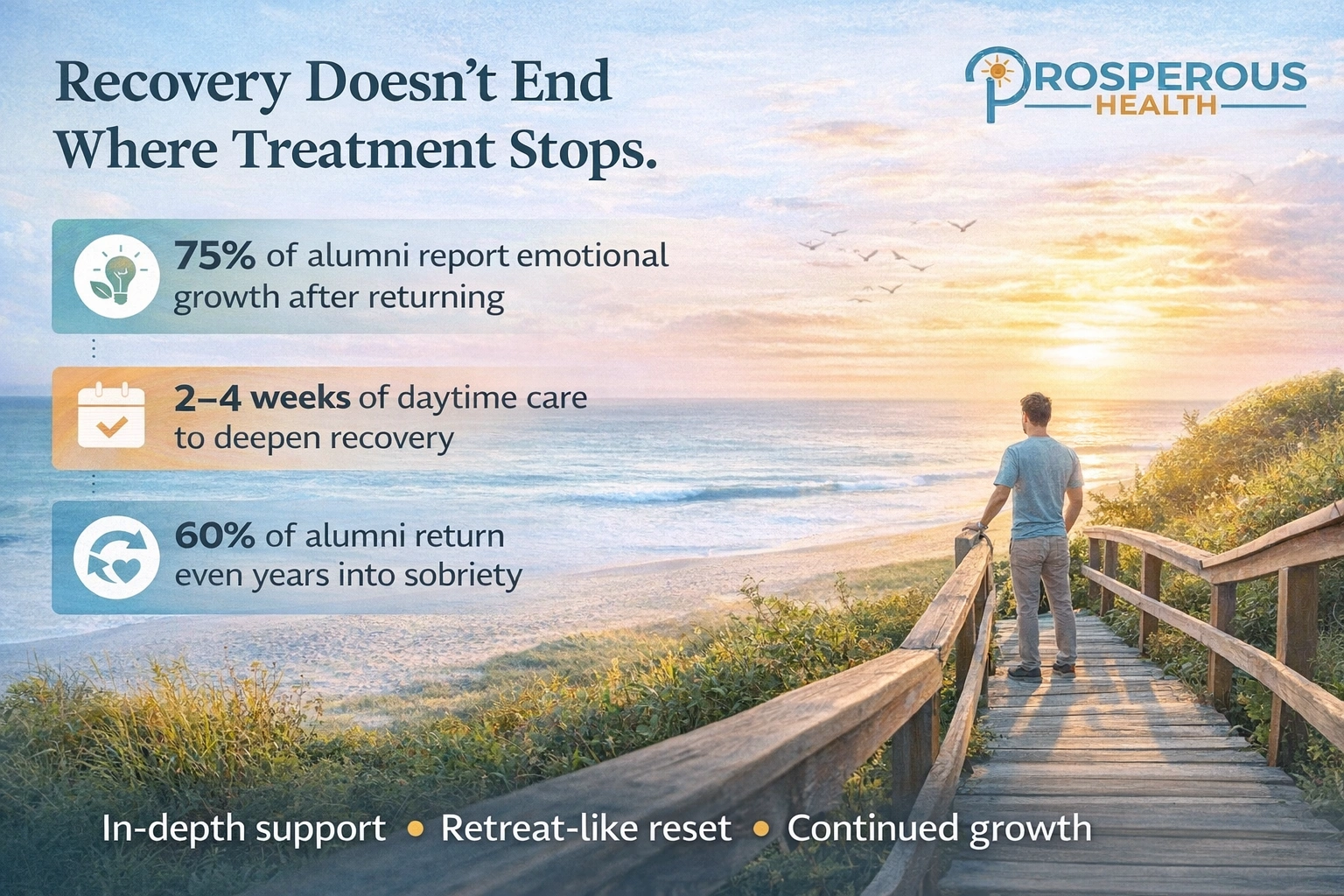
You Don’t Need to Wait for a Breakdown
Let’s be real: many alumni don’t come back to treatment until things fall apart. Not because they want to wait—but because they’re afraid they’ll be seen as “starting over.”
You’re not.
When you come back to PHP, you bring every tool, insight, and ounce of growth you’ve earned with you. That doesn’t disappear just because you’re tired. Or stuck. Or needing help again.
In fact, we consider alumni who return some of the most courageous people we treat. Not because they’re in crisis, but because they’re wise enough to notice when something feels off—and brave enough to do something about it.
Structure Can Be Sacred—Even in Long-Term Recovery
Life outside of treatment is beautiful and brutal. You’ve got bills, relationships, career stress, triggers that don’t fit into neat boxes.
In early sobriety, structure saved you. But years later, when you’re juggling everything, that same structure may have slowly slipped away.
Returning to PHP gives you:
- Consistent rhythm: A reason to pause and reflect daily
- Community alignment: Peers doing deep work, not just early sobriety survival
- Emotional challenge: Space to go further, not just maintain
- Accountability without shame: No one’s expecting perfection—just presence
Whether it’s grief that won’t soften, anxiety that’s grown louder, or a creative or spiritual block that’s drained your energy, PHP can create room to work through it.
Especially if you’re near Palos Verdes, California, where we offer regional access to treatment options in Palos Verdes designed for full-spectrum recovery—early and ongoing.
Alumni Return Because It Works—Not Because They Failed
We’ve seen people come back to PHP after 2, 5, even 10 years sober. Not one of them said, “I wish I’d waited longer.”
In fact, most say this:
“I didn’t know how much I needed this until I got back in the room.”
Why? Because something happens in structured care that’s hard to replicate in the wild. Time slows. Reflection deepens. The noise of life quiets just enough to hear what’s underneath.
We help you tune into that signal again.
You’re not regressing. You’re refining.
You’re Allowed to Want More Than Just “Okay”
Maintenance is not the goal. Recovery isn’t a job to keep. It’s a relationship to grow.
If you’re showing up to therapy, hitting meetings, doing “the right things”—but still feel emotionally distant or spiritually flat—you don’t have to accept that as your baseline.
PHP gives you a container to ask the bigger questions:
- Who am I now, after all this change?
- What am I avoiding by staying “busy”?
- What does growth look like when it’s not about staying sober, but staying whole?
You’re allowed to want more. And you’re allowed to seek it in the same place that helped you rise the first time.
FAQ: Returning to Partial Hospitalization as an Alum
Am I allowed to come back even if I haven’t relapsed?
Yes. Many of our returning clients are still sober and functioning. They come back for emotional, spiritual, or relational growth—not crisis management.
What will people think if they see me in PHP again?
They’ll think you’re serious about your growth. Our community culture honors alumni who return. There’s no shame—only respect.
How long would I need to stay?
That depends on your goals. Some clients return for 2–3 weeks of structured reset. Others stay longer to unpack deeper work. We co-create the plan with you.
Will I have to start from scratch?
No. We honor your previous work. This is not a reboot—it’s an evolution. Your treatment plan will reflect your current stage, not your starting point.
Can I work or take care of my family while in PHP?
We’ll help you explore flexible arrangements. PHP does require daytime availability, but we’ll collaborate to make it doable wherever possible.
You’re Not Starting Over—You’re Continuing On Purpose
Call (888) 308-4057 or visit Partial Hospitalization Program in California to learn more.
You already know what support can do. Let’s find what it can do next.