

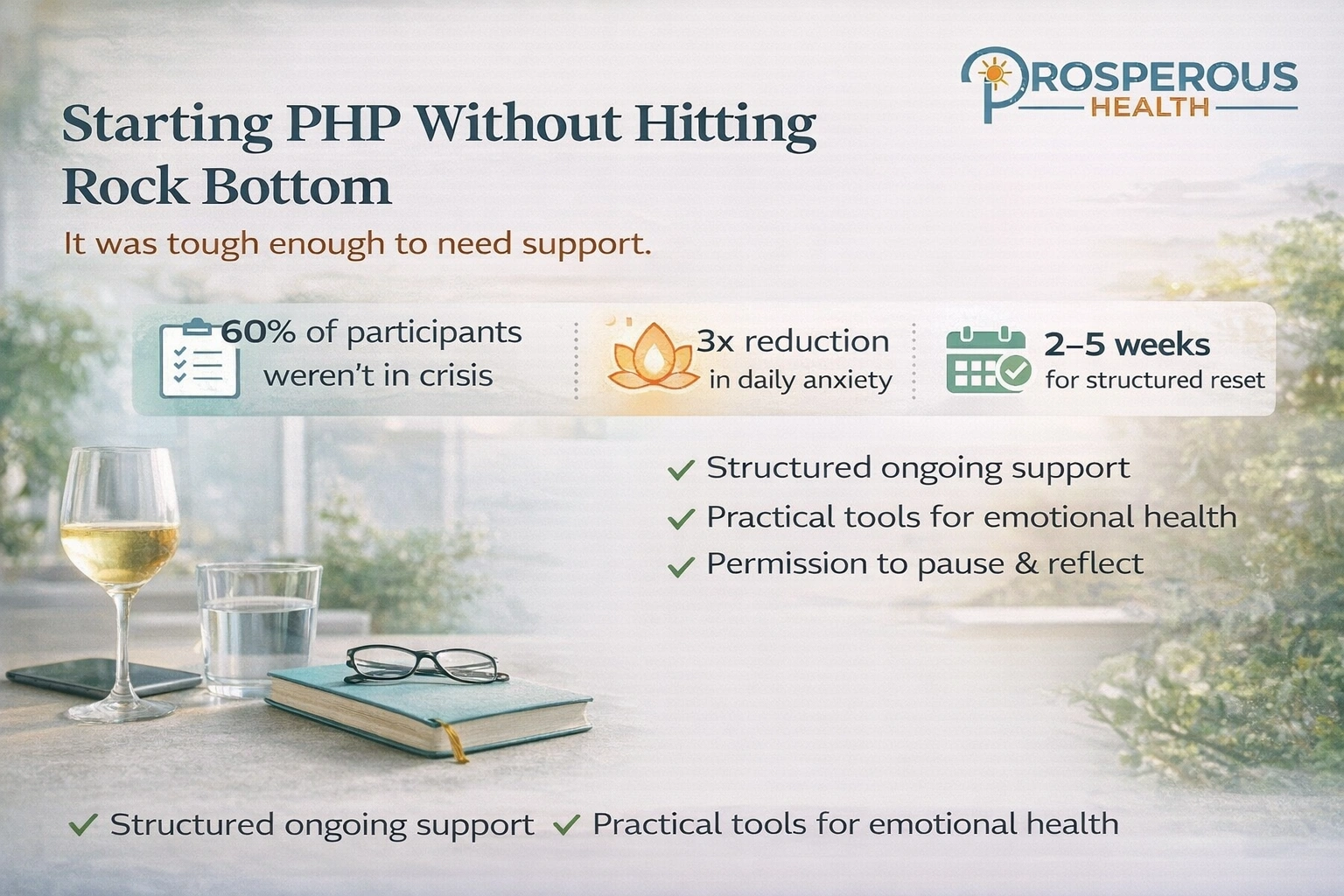
I didn’t come into treatment crashing and burning. I came in with quiet dread. That low-grade hum of anxiety that never shut off. That creeping feeling that something in my life wasn’t right—without a big, dramatic moment to prove it.
I wasn’t sure if I was “sober” or “not sober.” I just knew that alcohol had become more of a reflex than a joy. It wasn’t destroying my life. But it was dimming it.
I didn’t feel out of control. But I didn’t feel in control either.
That in-between space? That’s where I lived. And it’s where I finally asked for help.
What I found in a Partial Hospitalization Program wasn’t punishment. It wasn’t shame. It wasn’t even a clear answer.
It was space.
And it gave me something I hadn’t felt in a long time: permission to slow down.
I Didn’t Need a Breakdown to Belong
I used to think programs like PHP were only for people deep in addiction, or people who had been hospitalized. That wasn’t me. I hadn’t hit bottom. I wasn’t legally mandated. I was still getting by.
But getting by was exhausting.
So when someone I trusted mentioned PHP, my first instinct was: Isn’t that a little extreme?
It wasn’t. In fact, it was exactly right. Because PHP isn’t about being “bad enough.” It’s about getting honest before things get worse.
The truth was, I had already started spiraling—just quietly.
And that was enough reason to start something different.
Structure Gave Me Back My Breath
Before PHP, my life was a blur of work, obligations, social drinking, and anxiety I couldn’t name. I never really stopped. I just kept moving—thinking if I kept going fast enough, maybe I wouldn’t have to feel anything.
PHP forced me to stop.
It gave me structure—5 to 6 hours a day, several days a week—and that structure held me. For the first time in years, I wasn’t performing. I was just being.
There were group sessions. One-on-ones. Mindfulness. Education. Actual skills I could use. And even more than that, there were quiet moments where I wasn’t expected to have it all together.
The rhythm helped me breathe again.
No One Asked Me for a Label
One of my biggest fears walking into treatment was that someone would slap a label on me the minute I spoke.
I wasn’t sure I was ready to say I had a substance use disorder. I wasn’t sure what “sober” meant for me. I didn’t know where I landed.
The best part? No one asked me to define myself on day one.
Instead, they asked:
“What’s not working for you anymore?”
That opened up everything. I talked about how foggy I felt. How I used alcohol to unwind but hated the way it made me feel the next day. How I couldn’t tell the difference between being relaxed and being numbed out.
They didn’t diagnose me into a corner. They listened. And they let me figure it out at my own pace.
The People Were Messy, Honest, and Just Like Me
I thought I’d be the only “gray area” drinker in the room.
Turns out, I wasn’t. Not even close.
PHP was filled with people across the spectrum—some newly sober, some still figuring it out, some managing anxiety or depression, some just tired of feeling emotionally bankrupt. We weren’t all on the same path, but we were in the same place: ready for something different.
No one judged me for still being unsure.
No one told me what I “had” to do next.
They just made room for me.
Especially if you’re near The Valley, California, you’ll find help in Addiction that understands this kind of emotional middle ground. No pressure. No panic. Just support.
I Learned to Sit Still Without Escaping
Before treatment, silence made me anxious. I couldn’t sit still without checking my phone, opening a drink, or planning my next distraction. Stillness felt like a threat.
In PHP, I didn’t have the usual ways to numb out. And that scared me—until it didn’t.
I started sitting through emotions I would’ve normally avoided. Frustration. Loneliness. Boredom. Fear. They came up, and I stayed.
At first, I counted the minutes. Then, I stopped needing to.
That stillness taught me that slowing down isn’t the same as falling apart. Sometimes, it’s the only way to hear what your body has been trying to say for years.
I Got Real Skills, Not Just Talk
I thought therapy would just be a bunch of people talking in circles. But in PHP, we learned things—like actual, real-world skills I still use.
I learned how to:
- Interrupt negative thought spirals
- Sit with discomfort without reacting
- Reframe cravings as messengers, not enemies
- Set boundaries without over-explaining
- Recognize emotional relapse before it became behavioral
These tools helped me rebuild how I relate to stress, to myself, and to the idea of control.
It wasn’t about fixing myself. It was about understanding myself—and learning how to care for the parts I used to ignore.
I Started Asking Better Questions
Once I slowed down, I started getting curious.
- What would life feel like without always needing to escape it?
- What if sobriety didn’t mean losing something—but gaining clarity?
- What does actually liking myself look like?
PHP didn’t answer those questions for me. But it gave me the headspace and the safety to ask them.
And that was enough to start changing things.
If you’re based near Palos Verdes, California, you’ll find help in Palos Verdes that supports this kind of self-inquiry—without pushing an identity you’re not ready to claim.
I Didn’t Decide My Whole Future—Just My Next Step
I wasn’t ready to say I’d never drink again. I still don’t know if that’s where I’ll land forever.
But I do know this:
PHP helped me slow down long enough to see my life clearly.
And from that space, I made better choices. Braver ones. Kinder ones.
I didn’t commit to a label. I committed to showing up.
One day at a time.
FAQ: If You’re Sober Curious and Thinking About PHP
Do I have to stop drinking completely before starting?
Not necessarily. You’ll be asked to stay substance-free during program hours and may be encouraged to pause use to gain clarity—but it’s not about perfection.
What if I’m still unsure about being “sober”?
That’s okay. PHP welcomes people exploring their relationship with substances. Curiosity and willingness are enough.
Will I be forced into 12-step meetings or one specific path?
No. PHP includes various approaches—CBT, DBT, mindfulness, psychoeducation. You’ll have options, not mandates.
Can I still work while doing PHP?
Some people take time off, others adjust schedules. PHP is intensive, but your care team will help you plan around your real life.
Is it all about addiction?
Not at all. Many people attend PHP for anxiety, depression, burnout, trauma, or emotional overwhelm—with or without substance use.
You Don’t Need to Spiral to Slow Down
Call (888) 308-4057 or visit Partial Hospitalization Program in California to learn more.
You don’t need a crisis to want clarity. You just need a moment of willingness. That’s more than enough. We’ll meet you right there.