

Your child is not okay—and you can feel it in your bones.
Maybe they’re sleeping through entire weekends. Or maybe they’re barely sleeping at all. Maybe they haven’t said anything explicitly scary, but something in their eyes tells you: they’re not here. Not really.
As a parent, you’re trying to stay steady. Show up for work. Make dinner. Handle logistics. All while a quiet panic runs under everything: What’s happening to my kid? What if I miss something? What if it gets worse before it gets better?
This is for you.
You don’t have to wait for a diagnosis to get help. Depression treatment at Prosperous Health is designed for families who are afraid right now—but still want to respond with clarity and care. You’re not overreacting. You’re showing up.
Let’s walk through what depression treatment really involves, and how it can support your child (and you) in this moment of crisis.
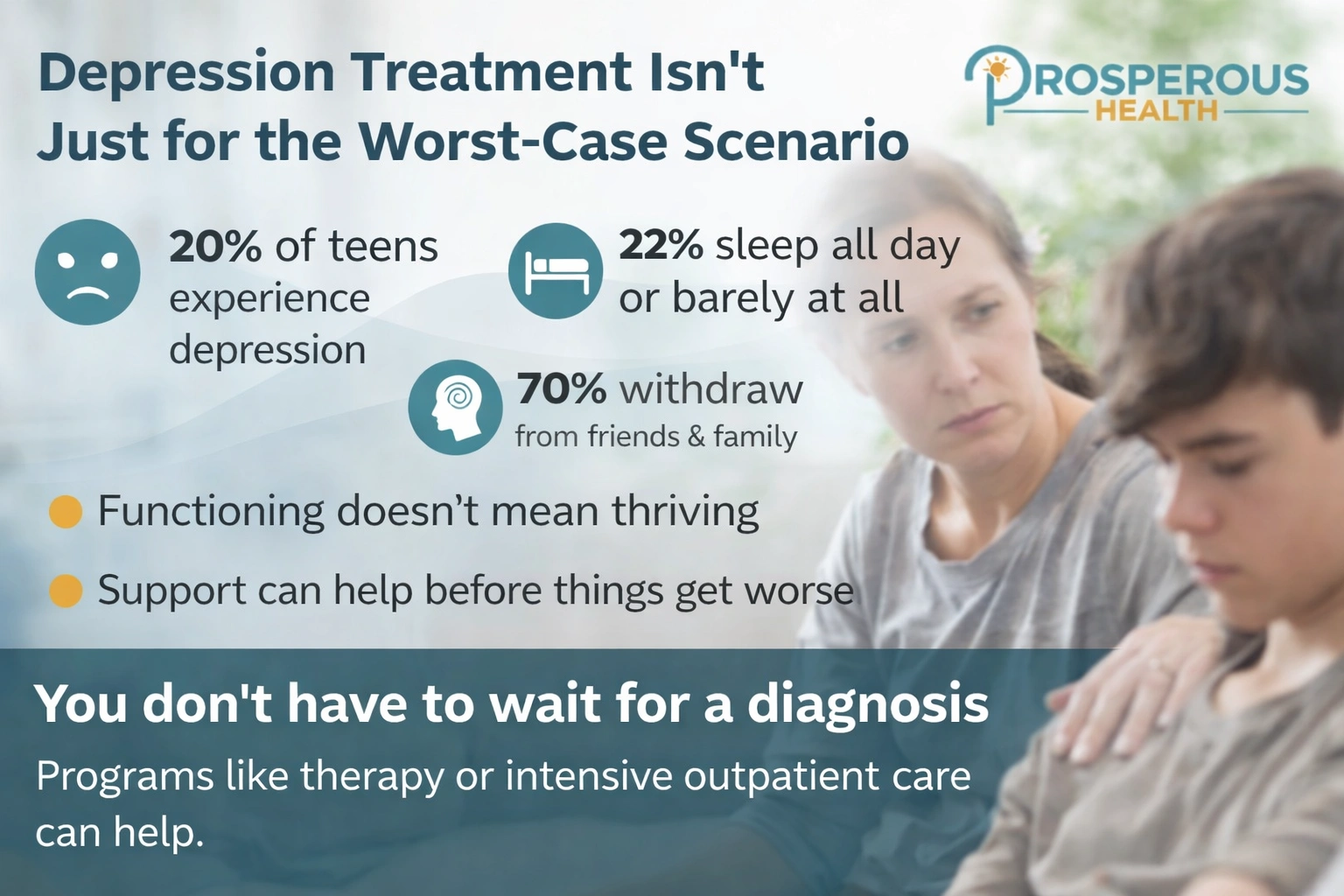
Depression Treatment Isn’t Just for the Worst-Case Scenario
One of the biggest myths parents believe is: “They’re not bad enough for treatment.”
We hear this a lot—especially from parents of teens and young adults who are still “functioning” in some ways. Maybe your child still goes to class or work. Maybe they even joke with friends sometimes.
But here’s what we want you to know:
- Depression hides.
- It doesn’t always look dramatic.
- Functioning doesn’t mean thriving.
If your child is barely holding it together, withdrawing, or saying things like “None of this matters”—that’s enough to explore treatment.
Depression treatment isn’t about labeling your kid. It’s about giving them access to support before things spiral further.
Programs vary based on need. Some kids may benefit from weekly therapy. Others need more structured support like IOP (intensive outpatient) or PHP (partial hospitalization). You don’t have to know which is right yet—an evaluation will help with that.
What matters now is acknowledging that this is a real crisis, even if it doesn’t look like one from the outside.
Treatment Centers Built for Crisis Won’t Blame or Shame
Let’s name something heavy: the fear that this is somehow your fault.
Many parents wait to seek help because they feel responsible. Others worry their child will be judged, over-medicated, or punished in treatment. Some families have been burned before by care systems that were rigid, cold, or even traumatic.
Good treatment centers—like Prosperous Health—do it differently.
We work from a trauma-informed, relationship-first model. That means:
- No blame. Ever.
- No shame-based tactics.
- No punishment for being sick, angry, or scared.
Instead, the focus is on stabilization, trust, and emotional safety.
When you walk into one of our programs, especially if you’re near The Valley, California, you’ll meet a team trained to hold crisis without making it worse. No scare tactics. No ultimatums. Just steady, compassionate care from people who get it.
Your Child Doesn’t Have to Want Treatment to Benefit from It
This part’s hard: a lot of kids don’t want treatment. They’re angry. Numb. Shut down. Terrified.
You may be trying to talk them into it, or scared to bring it up at all. You might feel like you’re tiptoeing around a bomb.
Here’s the truth: depression makes it hard to believe help is possible.
It convinces people that nothing will work—so they resist even the idea of care. That doesn’t mean treatment won’t help. It just means we need to meet them gently, not force them into insight they don’t yet have.
Our team knows how to work with ambivalence. How to support clients who don’t yet see the point. We don’t expect your child to arrive ready to talk, trust, or open up. That comes later.
First, we focus on stability. Rest. Safety. And creating an environment where hope becomes imaginable again.
You Deserve Support, Too
Let’s pause and focus on you.
Being the calm one in a crisis is brutal. You’re juggling fear, logistics, and exhaustion. You’re expected to be your child’s advocate, therapist, project manager, and emotional safe haven—all while trying to hold your own mental health together.
Depression treatment shouldn’t just help your child—it should support you, too.
That includes:
- Parent communication and updates
- Optional family therapy
- Resources for navigating tough conversations
- Practical help with school, work, or legal considerations
- A care team that sees your emotional load, not just theirs
You don’t have to prove you’re holding up. You’re allowed to fall apart, too. And you’re allowed to want help navigating all of this.
If you’re in or near Palos Verdes, California, there are local teams available who understand both your fear and your strength—and who offer care that holds space for both.
What Happens in a Depression Treatment Program?
Each program has its own rhythm, but at Prosperous Health, here’s what the first few days often include:
- Clinical evaluation to understand your child’s mental, emotional, and physical health
- Treatment planning that considers school, family, and personal needs
- Therapeutic support including group and individual sessions
- Medication consultation, if needed—but never pressured
- Crisis support that prioritizes safety, not control
- Real-time updates and communication for families
From there, the journey evolves based on how your child responds. Some stay in IOP for 4–8 weeks. Others move into ongoing therapy or additional care. The goal isn’t to rush—it’s to rebuild trust and function at a sustainable pace.
You’re Not Overreacting. You’re Responding With Courage.
If you’ve found yourself thinking, “I can’t tell if I’m overreacting or missing something huge”—you’re not alone.
We hear this every day. It’s one of the cruelest tricks of depression: it makes everything blurry. Is this just a phase? Or is this dangerous?
Here’s your permission slip: If your gut says something’s wrong, you’re allowed to act. You don’t have to wait for a suicide note or a psychiatric hold. You don’t need to wait for them to ask for help out loud.
Sometimes the most powerful thing a parent can do is act before the breakdown. Before the ER visit. Before the crisis call.
You’re not too early. You’re right on time.
FAQ: What Parents Need to Know About Depression Treatment
What if my child refuses to go?
Many teens and young adults are hesitant or outright resistant to treatment. Our team has experience working with ambivalence. You’ll receive support for how to talk about treatment, explore family-based options, and create gentle accountability.
Does treatment mean hospitalization?
Not necessarily. Programs like IOP or PHP provide intensive support without requiring overnight stays. Hospitalization is only used when safety is a serious concern—and even then, it’s a short-term measure.
Will my child be forced to take medication?
No. Medication may be discussed as part of treatment, but your child’s preferences and your family’s values are always considered. Nothing is forced. We believe in collaborative care.
Can treatment happen without missing school or work?
Yes. Many programs offer flexible scheduling. In fact, maintaining some structure (like school or part-time work) can be beneficial in recovery. We’ll help build a plan that works for your child’s real life.
What if this isn’t their first time in treatment?
That’s okay. Recovery often requires multiple rounds of support. What matters is not that they’ve “failed”—but that they’re still here, and you’re still trying. Every new step is still a step forward.
We’ll Help You Take the Next Step
Call (888) 308-4057 or visit Depression Treatment in California to learn more.
You don’t have to wait for the perfect words or the perfect moment. Just the willingness to keep going. We’ll walk the rest with you.