

Your stomach’s full from another late-night snack. Your feed is empty, and so is your phone. It’s quiet—but not peaceful. This is what early sobriety can feel like: lonely, slow, and brutally clear.
If you’re asking whether a PHP (Partial Hospitalization Program) can help you actually build a life—not just stay clean—you’re asking the right question. You’re not just trying to avoid relapse. You’re trying to feel real again.
Prosperous Health’s PHP in San Diego was designed for that exact stretch of time—when you’ve stopped using, but don’t yet know how to live sober.
What exactly is PHP—and how does it support early recovery?
PHP stands for Partial Hospitalization Program, but don’t get stuck on the name. There’s no hospital bed, and you’re not being watched 24/7.
Here’s what PHP really looks like:
- Structured daily support (about 5–6 hours a day, five days a week)
- Group therapy and individual therapy that actually goes somewhere
- Psychiatric support if you’re navigating mental health symptoms or medication
- Peer connection with people in the same rebuilding phase
- Time—to slow down, breathe, and sort out who you are without substances
If inpatient felt like a reset button, PHP is the blueprint that helps you build something stable afterward. And if you never went to inpatient? It can still be the solid ground your early recovery needs.
Why does structure matter so much right now?
Because early recovery isn’t just about staying sober—it’s about not unraveling when the rush stops.
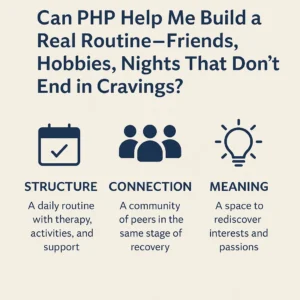
When you first stop using, your days stretch out in ways that can feel impossible. It’s not just that you’re bored—it’s that your nervous system doesn’t know what to do with calm. PHP offers a rhythm:
- You get up.
- You show up.
- You process, reflect, rest, repeat.
Cravings love chaos. PHP gives you something predictable, safe, and steady—until you can build that for yourself.
Can PHP really help with friendships and community?
It can. And not just the kind of surface-level stuff you find in group texts or awkward “support” circles. Real connection happens when people feel seen in the mess. That’s what PHP does differently.
You’re not just sharing space with other people—you’re sharing this very specific part of the journey:
- The part where weekends feel like a trap
- The part where you forget what fun even is
- The part where you wonder if you’re the only one who feels empty
You’re not.
At Prosperous Health’s San Diego PHP, you’ll meet people who get it—and more importantly, people who are actively trying to grow through it, just like you.
What if I don’t know what I like anymore?
That’s normal. Substances often become the default hobby, the default reward, the default comfort. When they’re gone, you might feel like a stranger to yourself.
That’s where PHP’s experiential therapies come in. You’ll get to try things that help you feel connected to your body, your creativity, your joy—even if it feels rusty at first:
- Movement therapy (for people who hate gyms)
- Art expression (even if you’re “not artistic”)
- Music, mindfulness, community service, and more
You’re not here to find your “one true passion.” You’re here to remember that you can feel curious, inspired, calm—or anything other than numb.
What if I’ve already done IOP or outpatient—and it didn’t help?
Then PHP might be exactly what you need. Many people try outpatient first, thinking it will be enough. But early recovery needs more time, more structure, and more safety than three hours of therapy a few nights a week can offer.
Here’s a breakdown:
| PHP | IOP | |
|---|---|---|
| Time Commitment | 5–6 hours/day, 5 days/week | 3 hours/day, 3–5 days/week |
| Structure Level | High (daily routine) | Moderate |
| Support Access | Clinical + group + psych + rec | Group-focused, some therapy |
| Ideal For | Early recovery, recent discharge | Transitioning or part-time |
PHP is not a punishment for struggling. It’s a place to land before you slide back into old patterns. That makes it a powerful re-entry point whether you’re fresh out of detox or just emotionally raw and trying not to ghost your progress.
Can PHP really reduce my cravings?
Not through magic. But through rhythm. Through connection. Through the simple, stubborn truth that cravings thrive on isolation and idle time.
Here’s how PHP helps:
- You’re not alone with your thoughts for 10 hours a day
- You have people to text before the craving escalates
- You start to build a body and mind that doesn’t feel like a war zone
It’s not instant. But day by day, you stop feeling like you’re holding your breath. You start living again.
What happens after PHP ends?
This isn’t a one-and-done situation. Most people transition to IOP (Intensive Outpatient Program) after PHP. It’s a step-down in hours but still offers clinical support and group connection.
From there, you might shift into:
- Weekly therapy
- Alumni meetings
- Peer support groups
- Personal routines that don’t fall apart the second you’re stressed
Think of PHP as the scaffolding. You don’t stay in it forever. But without it, trying to “build a life” in early recovery can feel like hammering in the dark.
FAQ: Common Questions About PHP in Early Recovery
How do I know if PHP is the right level of care for me?
If you’re in early recovery, feeling emotionally overwhelmed, or struggling to stay sober with outpatient support alone, PHP could be the right fit. It offers more structure than IOP, but without the need for residential treatment.
Can I do PHP while living at home?
Yes. That’s the beauty of it. PHP allows you to receive intensive clinical support during the day while continuing to live at home (or in a sober living environment).
What’s the difference between PHP and inpatient?
Inpatient requires 24/7 residence at a facility. PHP allows you to return home at night, making it more flexible while still providing a high level of therapeutic support.
Does insurance cover PHP?
Often, yes. Most insurance plans recognize PHP as a medically necessary level of care for addiction and mental health. Our team at Prosperous Health can walk you through verification and help you understand your options.
What if I’m not in San Diego?
We have several locations throughout California. If you’re not in San Diego, consider our Valley, CA or Palos Verdes PHP programs.
You Don’t Have to Survive Sobriety Alone
If you’re newly sober and feel like everything is too quiet, too hard, or too empty—PHP might be the structure you need. Not to “fix” you. But to hold space for the version of you that’s just beginning to grow.
PHP isn’t the finish line. It’s the first safe place you land when everything else feels wobbly. And that matters.
📞 Ready to take the next step?
Call (888) 308-4057 or visit our PHP program in San Diego, CA to learn more. Whether you’re one day sober or one week in, there’s a way forward that doesn’t have to be lonely.