

You’ve put in the work.
You’ve stayed sober.
You’ve built a new life—or at least something that looks like one.
And now… you feel stuck.
Not in danger. Not on the brink. Just adrift in a strange emotional quiet.
If this feels like where you are, you’re not broken. You’re not alone. And you’re not going backwards if you feel the need to reach forward again.
At Prosperous Health, we meet a lot of long-term alumni who find themselves in this place. They’re not in active addiction. But they’re not quite connected to their recovery anymore either. It’s a confusing, disorienting stretch of the road—and it’s often one you walk in silence.
This blog is here to say: that silence can be broken. That moment doesn’t have to stay stuck. And that rediscovering yourself through alcohol addiction treatment might be the most honest next step you could take.
Recovery Isn’t a Finish Line—It’s a Landscape
In early sobriety, everything is sharp. Urgent. Focused.
You’re learning how to function again. How to manage cravings. How to rebuild trust. The work is obvious, even if it’s hard.
But after a while, the edges soften. The goals get met. The crisis passes.
And then what?
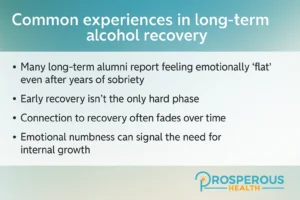
This is where many long-term alumni get surprised: by the flatness. The sense that things should feel brighter, richer, more rewarding by now—but somehow don’t.
It doesn’t mean something’s wrong with you. It means you’ve entered a new part of the landscape. A quieter part. And it’s just as real.
Feeling Disconnected Doesn’t Mean You’re Failing
Here’s what we wish more people said out loud:
Sobriety isn’t always joyful.
Sometimes it’s just… fine. And then, other times, it’s frustratingly neutral.
You wake up, you go through the motions, you maybe go to meetings or maybe not. And then you wonder:
- Why don’t I feel excited about life?
- Is this all there is?
- Am I the only one still struggling with this sense of disconnection?
We’ve sat with people who haven’t touched alcohol in years and still say, “I don’t know who I am anymore.”
That isn’t failure. That’s a stage. And it’s one you’re allowed to name.
You Can Re-Engage Without Starting Over
Let’s clear something up:
Returning to treatment or support doesn’t mean going back to square one.
In fact, it might be the most advanced move you’ve made so far. It says:
- I’ve built stability.
- I’ve sustained sobriety.
- And I want more—more meaning, more connection, more vitality.
At Prosperous Health, we offer care that meets you at this phase. Whether that’s renewed therapy, trauma processing, group work, or creative exploration, it’s not about preventing relapse. It’s about promoting re-connection.
And that matters just as much.
Your Needs Have Changed—So Can Your Recovery
When you first got sober, your biggest need might have been survival. You needed structure. Containment. Tools.
Now? You might need depth. Room to question. Space to evolve.
And that’s not only valid—it’s essential.
Recovery isn’t meant to freeze you in the person you were when you first entered treatment. It’s meant to free you into becoming the person you’re still uncovering.
That’s why long-term care doesn’t look like early sobriety. It looks more like personal development. Emotional refinement. Inner work. Creative expansion.
You’ve changed. It’s okay—necessary, even—for your recovery to change with you.
Numbness Is a Signal—Not a Sentence
We see a lot of clients who aren’t actively depressed, but who describe a kind of flatness:
- They don’t feel overwhelmed. They feel underwhelmed.
- They don’t feel broken. They feel… invisible.
- They don’t feel tempted to drink. They just feel tired.
This emotional numbness is not something to “push through.” It’s something to listen to.
It could be your mind asking for new ways to grow.
It could be your nervous system flagging unprocessed trauma.
It could be your spirit asking for more beauty, purpose, or connection.
Whatever it is—it’s not weakness. It’s communication. And it’s allowed to be honored.
Alcohol Addiction Treatment Isn’t Just for People in Crisis
You might feel like seeking help now is “taking a spot” from someone who needs it more. Let’s dismantle that idea right now.
Care isn’t a finite resource.
You’re not stealing oxygen.
You’re not overreacting.
Your need for meaning matters.
Your desire for re-engagement matters.
Your longing for connection, expansion, and deeper emotional resonance matters.
At Prosperous Health, many of our long-term alumni return not because they’re spiraling—but because they’re searching. And we’re here for that too.
Gratitude Doesn’t Cancel Out Growth
If you’re feeling guilty for wanting more, you’re not alone.
Recovery culture can sometimes overemphasize gratitude—to the point where wanting more feels selfish. But here’s the truth:
Gratitude and growth are not mutually exclusive.
You can be grateful for your sobriety and still long for connection.
You can be proud of your progress and still wish for joy.
You can love your life and still feel like something’s missing.
That’s not betrayal. That’s honesty. And it’s what deep recovery is made of.
FAQ: Rediscovering Yourself in Long-Term Recovery
Is it normal to feel disconnected even after years of sobriety?
Yes. Many people experience emotional flatness or disconnection long after active addiction ends. It’s a common and treatable phase of long-term recovery.
Do I need to relapse to return to treatment?
Not at all. You don’t have to be in crisis to seek care. In fact, many people return to treatment simply to deepen their emotional work or reconnect with themselves.
What kind of support is available for long-term alumni?
We offer therapy, alumni support groups, workshops, medication consults (if needed), and creative or somatic-based work to help you reconnect emotionally.
What if I don’t know what I need—just that I feel stuck?
That’s enough. Many people come to us not knowing what’s wrong—only that something feels off. We work with you to clarify that and build a plan that fits where you are now.
Can I change my recovery approach after years of doing it a certain way?
Absolutely. In fact, evolving your recovery tools is often a sign of maturity. As you grow, your needs shift—and your approach can too.
Will this be like starting over from scratch?
No. You bring all of your experience, wisdom, and resilience with you. This isn’t square one. It’s a new chapter—with different questions and deeper support.
You’ve Done the Work. Now Let’s Go Deeper.
Call (888) 308-4057 or visit our Alcohol Addiction Treatment page to explore care that supports long-term alumni like you in rediscovering what’s next. Sobriety was the start connect here – The Valley, San Diego, Palos Verdes. Let’s see what else is possible.