

The first time I went to IOP, I honestly thought I was doing something brave. But underneath that? I was terrified. Not just of the work ahead, but of the part of me that didn’t fully believe recovery was possible.
And when I relapsed, it felt like proof. I told myself: “See? This stuff doesn’t work for people like you.”
But I came back. Not because I believed right away—but because I couldn’t go on pretending I didn’t need help.
And that second round? It didn’t look like a Hallmark movie. But it worked. Because I was different. Here’s why that’s not just my story—it’s a pattern that a lot of us live through.
Let’s talk about the five real reasons people return to an intensive outpatient program—and why, the second time, it often works in a deeper, more lasting way.
1. Because the First Time Was Just Survival Mode
When I walked into IOP the first time, I was still detoxing emotionally—even if the substances were technically out of my system. I couldn’t process what people were saying. I sat in group and nodded, but none of it landed. I was just trying to survive.
And here’s what nobody tells you: that’s okay.
Sometimes we need that first attempt just to realize how much we’ve been holding in. The second time, the fog starts to lift. You’re not scrambling to stay upright—you’re ready to start actually doing the work. And that shift? That’s where growth begins.
“At first I was just showing up so I wouldn’t drink. This time, I’m showing up so I can live.”
— Former IOP Client, 2024
2. Because This Time, You Know What You Need (And What You Don’t)
The first round of treatment is like being dropped into a foreign country. New language. New routines. New rules. You spend half the time trying to look like you’re okay, and the other half pretending you get it.
Coming back to IOP, you’re not a tourist anymore. You’ve lived a little. You’ve seen what happens when you stop showing up. And you’ve probably gained clarity—about your triggers, your supports, and where things started to slip.
This time, you walk in knowing what to ask for. Maybe you know you need more trauma work. Or more structure at night. Or a different sponsor. That clarity isn’t failure—it’s wisdom.
3. Because Life Got Loud Again—and You Forgot How to Hear Yourself
When you’re in early recovery, things are fragile. Even with a plan in place, life doesn’t stop throwing curveballs.
Maybe you got back into work too fast. Maybe your relationship blew up. Maybe you just slowly drifted back into old habits—not with a bang, but a whisper. A missed meeting. A skipped check-in. A week without journaling. It happens.
IOP is a space that quiets the noise. It pulls you back into intentional living. The world might still be chaotic, but in group? In that therapist’s office? You remember what your voice sounds like. And you start listening again.
4. Because This Time, You Get to Recover On Your Own Terms
If we’re being honest, the first time many of us go to treatment, it’s to meet someone else’s expectation. A court order. A family ultimatum. A job at risk.
And that’s not wrong—but it’s not yours, either.
The second time? It often comes from a deeper place. Not because someone else told you to. Because you want to feel different. You want more.
And that kind of motivation—quiet, personal, self-driven—is powerful. In Prosperous Health’s Southern California IOP, the program adapts to who you are now. Not who you were before.
5. Because You Finally Believe You’re Still Worth Helping
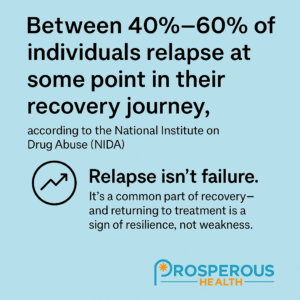
The hardest part about relapse isn’t the substance—it’s the shame. You think everyone will judge you. That they’ll say, “Well, I guess they didn’t take it seriously.”
But real recovery communities know the truth: relapse isn’t a moral failure. It’s part of the story for many of us. Not a chapter to be proud of—but one you can write your way out of.
At Prosperous Health, when someone comes back to IOP, they’re not treated like a dropout. They’re welcomed like someone courageous enough to return.
And sometimes, just being seen that way is what makes the difference.
💬 What People Say
“I was afraid to go back. But they treated me like I never left.”
— Alumni, 2023
“Second time was the real one. I actually heard myself for the first time.”
— IOP Client, 2024
“Coming back wasn’t failure. It was the start of my real recovery.”
— Outpatient Graduate, 2022
Frequently Asked Questions
Is it normal to relapse after treatment?
Yes. Many people experience relapse, especially early in recovery. It doesn’t mean treatment didn’t help—it means more support may be needed, and that’s exactly what returning to IOP can offer.
Will I be judged if I come back to IOP?
Not at Prosperous Health. You’ll be met with compassion, not criticism. The staff understands that recovery isn’t linear, and your willingness to return is seen as strength—not weakness.
What’s different about the second time in IOP?
You are. You come back with insight, experience, and a clearer understanding of what you need. That self-awareness can make treatment more effective and more personal.
Can I keep working or caring for my family while in IOP?
Absolutely. The intensive outpatient program is designed to fit around your life. Many clients continue working, parenting, or attending school while receiving support.
How do I know if I’m ready to come back?
If you’re asking that question—you’re probably ready. You don’t have to wait for a rock bottom. If life feels overwhelming, isolating, or off-track, returning to IOP can help you reset before things get worse.
📞 Ready to Take the Next Step?
You’re not starting over—you’re returning with more strength than you had before. And you’re not alone.
Call Prosperous Health at (888) 308-4057. Whether it’s been weeks or years, the door is still open.