

For a long time, I didn’t think I needed help. Not because things were good, but because they weren’t bad enough. I was still showing up to work. I didn’t lose my apartment. Nobody in my family had staged a tearful intervention. I thought that meant I was okay.
But if you had followed me around for a day—or even an hour—you would’ve seen the truth: I was far from okay. And it took entering an outpatient detox program to finally admit that to myself.
The Myth of “Still Functioning”
I want to talk to the person who’s quietly unraveling under the surface. The one who’s keeping up appearances but is absolutely exhausted. The one who doesn’t drink before 5pm—except on weekends. Who doesn’t use every day—but never goes more than a few without it. Who’s mastered the art of high-functioning addiction.
That was me.
I didn’t feel “addicted.” I felt overworked, anxious, always on. I told myself substances were just a release valve. A coping strategy. Something to take the edge off.
But the truth was, I had no edge left. I was all blur. No line between function and fraudulence. I kept thinking: If I’m doing okay on paper, how bad could it really be?
Turns out, pretty bad.
The Quiet Breaking Point
There wasn’t some dramatic collapse. Just a moment. A Tuesday afternoon, sitting in my car, hands shaking, trying to act normal on a Zoom call. I’d had “just one drink” at lunch. But that one turned into three. And now I was trying to balance my laptop on the steering wheel, praying I didn’t say anything too slurred.
That was the moment I stopped lying to myself.
No one else called me out. No crisis forced my hand. Just a quiet realization: I was tired of this. Tired of hiding. Tired of not knowing who I was without a drink in my hand or a pill in my pocket.
So I Googled “outpatient detox near me.” I didn’t even know if that was a thing.
Turns out, it is.
And it saved my life.
What Is an Outpatient Detox Program, Really?
I always thought detox meant going away for weeks, lying in a hospital bed, cut off from life. That didn’t feel possible. Or even necessary. I didn’t want to blow up my job. I didn’t want to answer awkward questions.
But outpatient detox is different. It’s medical support for withdrawal and stabilization—without requiring you to move into a facility. For me, it meant:
- I could keep going to work while safely coming off alcohol and benzos.
- I was monitored by professionals who knew what symptoms to expect and how to manage them.
- I had access to medication to make the process bearable.
- I didn’t have to face detox alone—or in silence.
Outpatient detox doesn’t mean it’s easy. It just means it’s possible to get help before everything crashes.
And that was the window I needed.
What They Don’t Tell You About “Just Cutting Back”
Before detox, I’d tried to quit on my own. Just white-knuckle it. I made rules. No drinks during the week. No more pills unless I had a “really bad day.”
But withdrawal isn’t just discomfort. It’s dangerous.
I didn’t realize how dependent I’d become until I tried to stop. The night sweats, the tremors, the brain fog, the panic—none of that was just anxiety. It was my nervous system screaming.
Trying to detox alone nearly put me in the ER. Outpatient detox gave me a safer option.
They monitored my vitals, adjusted medications, made sure I was sleeping, and—most importantly—reminded me I wasn’t a failure for needing help. I was someone finally choosing to live.
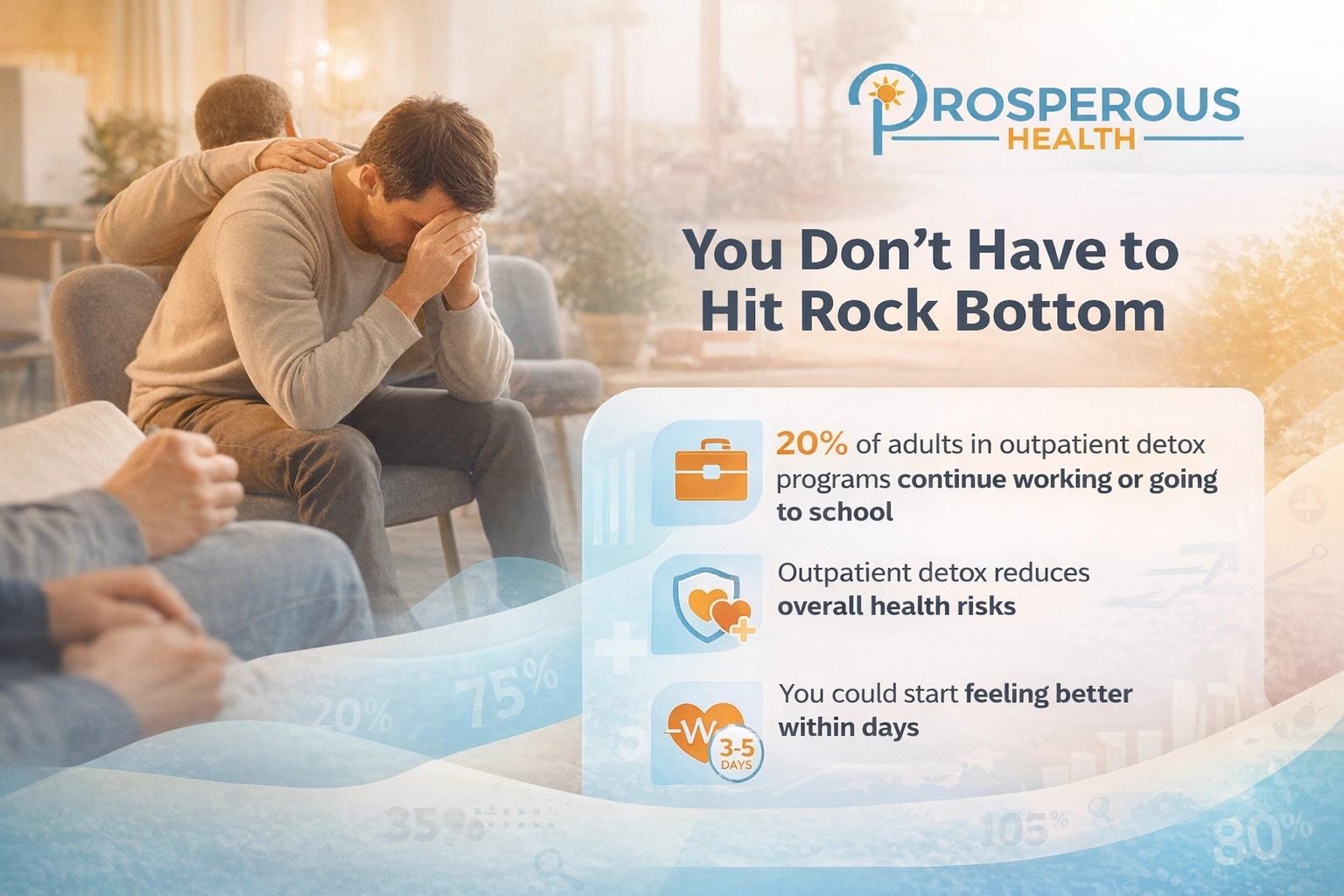
You Don’t Have to Hit Rock Bottom
This is what I want you to know.
You don’t have to lose your job.
You don’t have to get arrested.
You don’t have to wreck your relationships.
You don’t have to hit some mythical “bottom” before you’re allowed to get help.
Outpatient detox is for people who still have things to lose—and don’t want to lose them.
I waited too long because I thought I hadn’t earned treatment yet. I thought I had to be worse off. That I wasn’t “bad enough” to qualify.
I was wrong. And if you’re thinking the same thing, so are you.
Outpatient Detox Didn’t Solve Everything—But It Changed the Game
No, detox isn’t a magic wand. It didn’t fix my life. But it gave me the clarity to start fixing it myself.
Once I wasn’t chasing the next dose or drink, I could finally feel things again. Hard things. Real things. But also good things—like pride, sleep, hunger, sunlight.
It made room for the next step: therapy, support groups, real connection. I stopped ghosting my own life. I started remembering conversations. I started remembering me.
I wasn’t just surviving anymore. I was living with my eyes open.
If you’re somewhere in The Valley, CA and you’re tired of pretending everything’s fine, know this: there’s support in The Valley, California that doesn’t require your life to fall apart first.
FAQs About Outpatient Detox Programs
Is outpatient detox right for me if I’m still working?
Yes. That’s exactly who it’s designed for. Outpatient detox allows you to continue living at home and attending work or school while receiving structured, clinical support. You don’t have to choose between your job and your health.
What substances can be treated through outpatient detox?
Outpatient detox can safely address withdrawal from alcohol, prescription medications like benzodiazepines or opioids, and some stimulants. The clinical team will assess whether your case is appropriate for outpatient care or if a higher level of support is needed.
Is outpatient detox safe?
Yes—when medically supervised. Detoxing alone can be risky, especially with substances like alcohol or benzos. In a structured outpatient setting, medical staff monitor vitals, manage symptoms, and intervene when needed.
What happens during outpatient detox?
You’ll attend regular check-ins (daily or several times a week), receive withdrawal medication if needed, and work with both medical and behavioral health staff. Services may include blood work, therapy sessions, medication management, and referrals to longer-term care options.
Will anyone find out I’m in detox?
Outpatient detox is confidential. You don’t have to inform your employer or coworkers unless you choose to. Many programs offer scheduling flexibility to help you keep your privacy.
What comes after outpatient detox?
That’s up to you—but most people benefit from continued care like outpatient therapy, intensive outpatient programs (IOP), or peer recovery support. Detox clears your body. Recovery helps you heal your life.
If you’re tired of holding it together while falling apart behind closed doors, please hear this: you don’t have to keep performing.
Call (888) 308-4057 to learn more about our outpatient detox program in Orange County, CA.
You don’t need to be worse off to get help. You just need to be done doing it alone.