

For someone just beginning to explore treatment, the unknown can feel heavier than the pain itself. You might be wondering: What happens when I show up? Who will I talk to? What if I don’t know what to say?
These are real questions—and they deserve real, gentle answers.
At Prosperous Health, our Partial Hospitalization Program in San Diego, CA is designed to help you feel supported, seen, and steady from the very first step. If you’re scared, you’re not broken. You’re human—and you’re welcome here.
Morning Arrival: What It’s Like to Start the Day
Your day starts gently. When you arrive, you’ll check in at the front desk, grab coffee or tea if you’d like, and take a few moments to settle in. There’s no test to pass. No spotlight. Just a space where showing up as you are is enough.
The first session is usually a grounding or intention-setting group. It might include mindfulness, light movement, or a brief check-in. This is designed to help you feel present and centered, especially if your morning was rushed or emotionally heavy.
Some people speak. Some listen. Everyone is welcome.
Mid-Morning Groups: Learning Emotional Tools That Actually Work
Mid-morning is when core group therapy begins. These sessions are led by trained clinicians and focus on developing real-life skills. You’ll explore things like:
- How to navigate emotional triggers without shutting down
- Why your nervous system responds the way it does—and how to regulate it
- Ways to communicate boundaries without guilt
- How to reduce spirals of anxiety or self-criticism
- Tools to build connection, even when your instinct is to pull away
You’ll be in a group with others also working on their mental health—not perfect people, but real people who get it. You’re not required to share, but many clients find they want to, once it feels safe.
Midday Breaks and Meals: Room to Breathe, Without Expectations
Around midday, you’ll have a lunch break—usually on-site or in a quiet outdoor space nearby. It’s a time to rest, eat, and step out of therapeutic work for a bit. Staff are still around, in case you need support.
There’s no expectation to socialize. You can chat with others, journal, or simply sit quietly. This time is yours. You’re not being “watched”—you’re being held.
This might sound small, but for many clients, this is the first time in a long while they’ve experienced rest that feels safe.
Afternoon Sessions: Going Deeper in a Supported Way
After lunch, the afternoon may include:
- Process groups (space to share personal stories in a structured and supportive setting)
- Creative therapies (art, writing, movement)
- Educational sessions (on trauma, depression, emotional regulation)
- One-on-one time with your assigned therapist
These sessions are the heart of the program. They’re where insight often meets practice—where “I know this” begins to turn into “I can do this.”
It’s normal if this part of the day feels emotionally heavier. That’s not a sign of failure—it’s a sign that something inside you is shifting.
And every shift is met with care. If you ever need a break, a walk, or a private moment with staff, that’s not only allowed—it’s encouraged.
The End of the Day: You Leave With More Than You Came In With
Each PHP day ends with reflection. This might be a group debrief, a journaling prompt, or simply a check-out circle.
You’re not expected to wrap everything up with a bow. It’s okay if you leave with more questions than answers some days. What matters is that you’re not leaving with them alone.
Some clients say the end of the day feels like exhaling after holding their breath for hours—or years. That quiet exhale is part of the healing, too.
Who Is PHP Right For?
You don’t need a diagnosis to benefit from PHP. And you definitely don’t need to be in crisis.
Many first-time clients enter PHP feeling:
- Emotionally overwhelmed, but still “holding it together” on the outside
- Exhausted by masking their pain at work or in relationships
- Disconnected from themselves and unsure how to feel again
- Terrified of opening up—but more terrified of staying stuck
- Nervous about being “too much,” or not enough
If any of that sounds familiar, PHP could be right for you.
PHP Isn’t About Starting Over. It’s About Starting From Here.
One of the most common things we hear is this: “I’m scared I won’t be strong enough to do this.”
The truth is, if you’ve made it this far—reading this blog, considering care—you’ve already shown strength.
PHP isn’t about diving into the deep end. It’s about finding a steady, supported place to begin. You don’t need to feel ready forever. You just need to feel ready enough to take one step.
We’ll walk with you from there.
What Real People Say About Starting PHP
“I was scared of being the ‘worst one’ in the group. Turns out, no one was keeping score. We were all just trying to feel okay again.”
– New Client, 2024
“It wasn’t what I expected. I thought it would be clinical and cold. But it felt like the first place in a long time where I didn’t have to pretend I was okay.”
– PHP Participant, San Diego
“I didn’t have a breakdown—I just couldn’t keep going like I was. PHP helped me pause before I broke completely. I’m so grateful I didn’t wait.”
– Alumni, 2023
Why Choose Our Partial Hospitalization Program in San Diego, CA?
At Prosperous Health, our San Diego PHP is built on compassionate, trauma-informed care. We’ve helped hundreds of people walk through fear, confusion, numbness, grief—and out into something steadier.
We also serve clients in The Valley and Palos Verdes through nearby facilities, offering the same quality of care with location flexibility.
You won’t be rushed. You won’t be judged. You will be supported.
FAQ: Partial Hospitalization Program (PHP)
Do I have to stay overnight?
No. PHP is outpatient—you attend during the day and return home in the evenings. It’s designed to provide high-level support without full hospitalization.
What’s the schedule like?
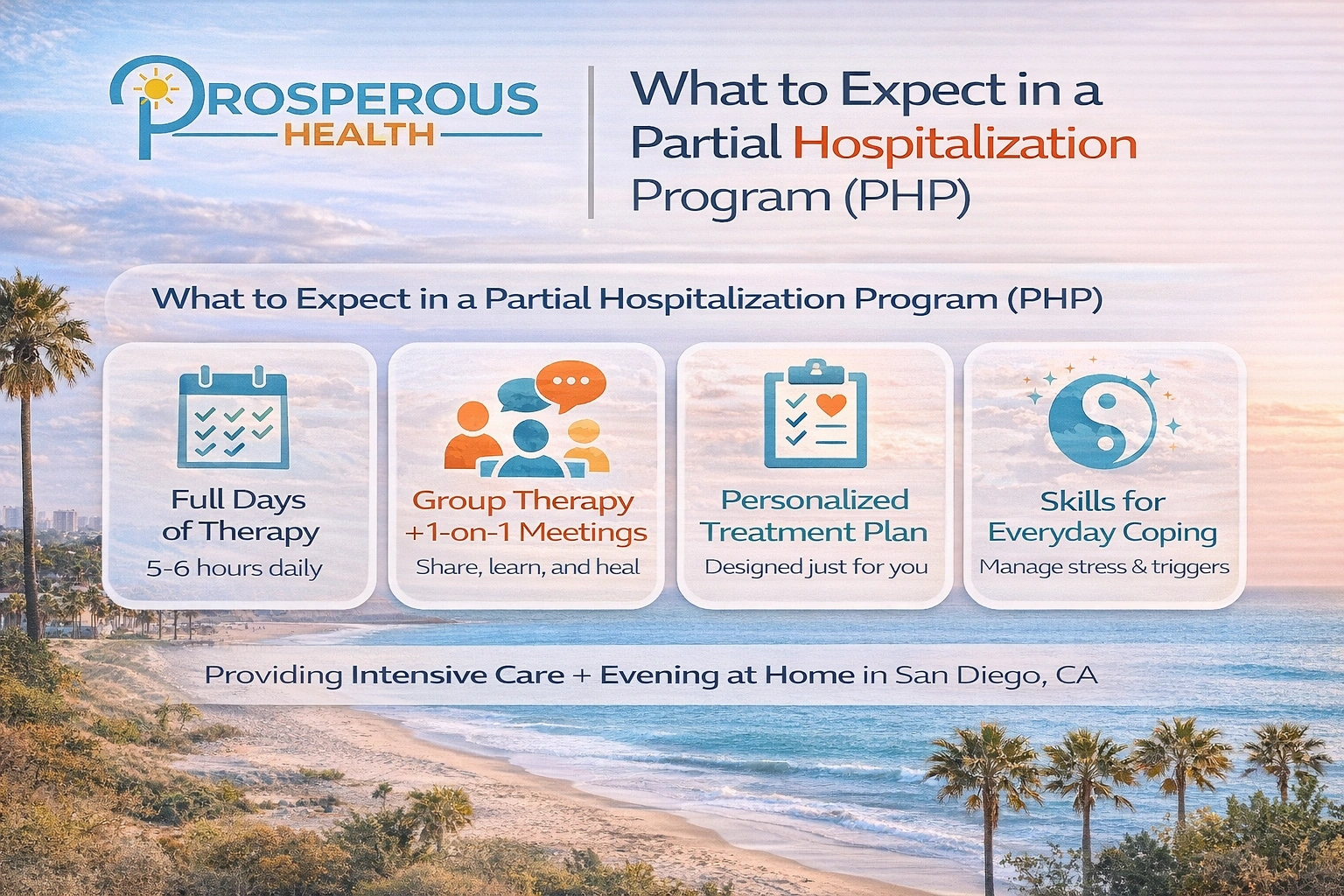
Most programs run Monday through Friday, around 5–6 hours per day. You’ll receive a schedule that includes therapy groups, breaks, and individual sessions.
What if I have a job or childcare responsibilities?
We understand life doesn’t stop for treatment. Our team can help you navigate short-term leave options or adjust your schedule where possible.
Will insurance cover this?
Many insurance plans do cover Partial Hospitalization Programs. Our admissions team will verify your benefits and explain your options before you commit to anything.
What if I don’t “fit in” or feel out of place?
It’s okay to feel unsure at first. Many people worry about this—but quickly realize they’re not alone. Everyone comes with different stories, but most share the same hope: to feel better.
Call (888)308-4057 to learn more about our Partial Hospitalization Program services in San Diego, CA.
You don’t need to have it all figured out. You just need a place to begin—and we’re here, ready when you are.