

There’s a moment many parents never forget.
It might’ve been a scream from behind a closed bedroom door. A panic text. A blank stare across the dinner table. Or a voicemail from someone who found your child somewhere they weren’t supposed to be.
Maybe it was subtle. Maybe it was loud. But the feeling was the same:
Something is very wrong.
And you’re the one expected to fix it—while completely unsure how.
Crisis moves fast. It rarely gives you time to prepare. Suddenly you’re Googling terms you never thought you’d need, calling therapists who don’t have openings, wondering if you’re overreacting or not reacting enough.
At Prosperous Health, we work with parents in this exact space. We offer a type of care called a Partial Hospitalization Program (PHP)—and it exists to help families like yours intervene early, act clearly, and bring calm to chaos.
PHP Is for Families in Crisis—Even If It’s “Not That Bad”
One of the most painful things parents say to us is:
“I didn’t know it had gotten this bad.”
“I thought it was just a phase.”
“They don’t look sick, but something’s off.”
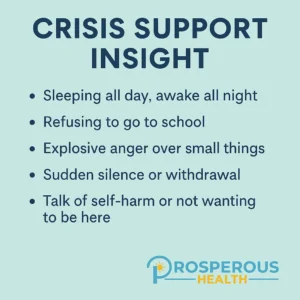
Behavioral health crisis doesn’t always look dramatic. It can look like:
- Sleeping all day, awake all night
- Refusing to go to school or leave their room
- Explosive anger over small things
- Sudden silence or withdrawal from friends
- Self-harm, risk-taking, or talk of “not wanting to be here”
- Shaky explanations about what’s happening “really”
Even if they’re not in immediate danger, you can feel it.
Something is unwell. And everyone’s waiting for someone else to name it.
PHP helps you get ahead of that spiral. It’s not about waiting for rock bottom—it’s about giving your child the care they need while you still have choices.
What a Typical Day in PHP Looks Like
We’re not a hospital. But we are clinical. PHP provides a full day of therapeutic structure and support—without the sterile, locked-down feel of inpatient units.
Here’s what your child might experience at Prosperous Health:
Therapeutic Structure (5–6 hours/day)
- Daily group therapy focused on emotion regulation, distress tolerance, and connection
- Individual therapy sessions with licensed mental health professionals
- Skill-building groups using CBT, DBT, mindfulness, and trauma-informed approaches
- Psychiatric care with medication evaluation and monitoring as needed
- Creative expression groups like art, music, or movement to access hard-to-talk-about emotions
Daily Return Home
- Your child sleeps at home, not in a facility
- They reconnect with home life each evening—with new tools to navigate it
- You begin seeing the difference: fewer outbursts, more engagement, maybe even small moments of hope
Family Support
- Weekly family therapy to reduce blame, improve communication, and reconnect trust
- Psychoeducation to help you understand what’s happening inside your child’s brain
- Real updates from real people—not guesswork or silence
If you’re not local to San Diego, we also offer care through our Partial Hospitalization Program in The Valley, CA and Partial Hospitalization Program in Palos Verdes, CA.
Why PHP Can Feel Like a Lifeline
Parents often tell us:
“I was afraid this meant things were really bad.”
“I didn’t want to make it worse by pushing treatment.”
“I thought they’d hate me for forcing them into something.”
And yet, after just a few days in PHP, they say:
“This was the first time we weren’t walking on eggshells.”
“I slept through the night for the first time in weeks.”
“They came home and actually talked to me.”
PHP isn’t about “fixing” your kid. It’s about helping them feel safe enough to show up. To explore why they’re struggling. To try tools they’d usually roll their eyes at. To feel seen—not just managed.
In many cases, PHP is the first point of real progress after weeks (or months) of stalling, guessing, and waiting.
What If My Child Doesn’t Want to Go?
This is the most common—and most human—fear we hear.
Some resistance is expected. Your child may say:
- “I’m not crazy.”
- “It’s not that bad.”
- “You’re just trying to control me.”
- “I’m not talking to strangers about this.”
- “You’re making it worse.”
What matters more than those words is the pain behind them. Often, they’re scared. Or numb. Or so ashamed they can’t picture sitting in a group of other struggling teens.
Our job isn’t to force participation. It’s to create a space where showing up doesn’t feel humiliating. And we’re good at that.
We start by:
- Meeting them where they are—not where we wish they’d be
- Using warmth, boundaries, and humor to build trust
- Letting them observe group before engaging
- Reinforcing that this isn’t about blame—it’s about relief
And over time, most of them surprise themselves.
Signs PHP Might Be the Right Step
You don’t need a diagnosis to know something’s wrong. But if you’re seeing several of these signs, it’s worth reaching out:
- Sudden, severe mood shifts or rage episodes
- Drop in hygiene, eating, or sleeping habits
- Social withdrawal or complete isolation
- Refusal to attend school or function in daily routines
- Evidence of self-harm or substance use
- Verbal threats of suicide or harm
- Emotional numbness that won’t lift with reassurance
And perhaps the biggest sign: your gut is screaming at you that this isn’t just a phase.
Frequently Asked Questions About PHP
What ages do you serve?
We offer PHP tracks for adolescents (ages 12–17) and young adults (ages 18–28). Age groups are kept separate to ensure developmentally appropriate care and community.
How long is the program?
Most clients attend PHP for 2–6 weeks, depending on their individual needs, goals, and progress. Step-down options include IOP (intensive outpatient program) and outpatient therapy.
Will my child fall behind in school?
We do our best to collaborate with school counselors and teachers when needed. Some clients take a temporary leave; others continue part-time academics during treatment. Your child’s safety comes first—but we’ll help keep the bigger picture in view.
Is this covered by insurance?
Yes, most major insurance plans cover PHP. We’ll verify your benefits and walk you through all out-of-pocket costs before you commit to anything.
Can we get started right away?
In most cases, we offer same-week intakes. Crisis doesn’t wait, and neither should care. Call us to check availability.
Let’s Bring Calm to This Chaos—Together
Call (888)308-4057 to learn more about our Partial Hospitalization Program services in San Diego, CA. You don’t have to fix this alone. Let us help steady the ground under your family’s feet.