
I used to think people only needed to recover if everyone saw them crumble. If you never saw me stumble, then maybe I was fine.
Still, late at night, when I couldn’t sleep, I’d lie awake wanting help—and wanting nobody to know. You can be like that. High‑functioning. Invisible mess. Wanting recovery without the spotlight.
If you’re in San Diego, this is possible. Our Intensive Outpatient Program at Prosperous Health can help you get care that fits your life—not upends it. You don’t have to make recovery public to make it real.
What It Means to Be High‑Functioning—and Why That Adds Pressure
You show up. You work. You manage bills. You keep a clean house, a presentable image. Maybe you drink at night, or smoke, or hide things. But you don’t hit bottom—at least not public bottom.
That image of “everything’s fine” becomes both your shield and your cage. People trust you more than they see. They say: “You seem stable,” but stability feels like walking on glass.
With that functioning, asking for help feels like admitting failing—not just to others, but to yourself. You worry about prestige. Career. Reputation. You’re afraid “treatment” = spotlight, stigma.
But functioning doesn’t mean strong. It often means carrying a private burden. And that burden can fracture you quietly. Asking for help doesn’t erase your “strength.” It redefines it.
Why Privacy Can Be the Key to Doing It at Your Pace
You fear people will talk. Insurance forms will show. Your employer will find out. Or worse—you’ll be “that person.”
You need a program that respects boundaries. That keeps things tight. Because disclosure doesn’t just mean telling someone—it means all the ripple effects: social, professional, familial.
Privacy means:
- Safe space to be honest with yourself
- Fewer external triggers—public judgment, awkward conversations
- Control over what people know—when, how much, to whom
Programs built with confidentiality in mind lower the barrier to entry. They let you start small. Let you heal invisibly until it feels okay to be seen.
Legal Protections That Protect You (Even If You Don’t Know the Details)
You might worry: “If I seek treatment, does that go on my record? Will someone see? Will it matter later?”
Here are some protections that work for people in IOPs in many states:
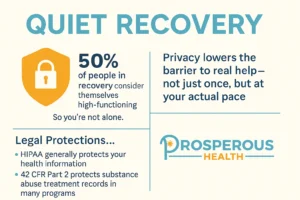
- HIPAA: Generally protects health information so unauthorized people can’t access it.
- 42 CFR Part 2 (in the U.S.): Strict rules about substance abuse treatment records. These rules guard against disclosure of treating status without consent. (NCBI)
- State privacy laws: Many states have additional protections, especially for mental health and substance use.
Knowing policies ahead of time gives you power: you can ask, “What will show up in claims?” “Who sees my records?” “Can I use initials or first names?”
How to Choose an IOP That Respects Your Need for Discretion
You’re not asking for special favors. You’re asking for what makes it possible for you to stay. Here are features to look for:
- Flexible Schedules
Evening cohorts. Virtual/hybrid sessions. So you aren’t skipping work or avoiding routines. - Discrete Locations / Entry Points
Facilities that aren’t obviously labeled, or earlier/later appointment times to reduce being seen. - Minimal Public Exposure
Non‑public waiting areas. Quiet drop‑off/pick‑ups. Confidential check‑in procedures. - Confidential Billing Practices
Ask how insurance will list services. Sometimes generic “behavioral health” or “therapy” labels instead of substance use can be used. - Group Norms that Support Anonymity
First names only. Not required to share more than you are ready for. No enforced disclosures. - Privacy Policies You Can Read Easily
Ask for written policy or explanation of confidentiality. What is shared with whom, and under what conditions.
Balancing Privacy With Real Recovery (Without Going It Alone)
Keeping recovery private can feel lonely. But going completely alone is risky.
Here’s how to balance privacy with getting what you need:
- Select one or two trusted people you can lean on. Maybe a mentor, friend, partner. You share some walls, not all.
- Use therapy to practice disclosure gradually. Say what you need. Pick safe topics first. Test the waters.
- Use virtual tools: tele‑IOP, digital check‑ins, journaling in private. They give distance and some buffer.
- Set boundaries: define what you will share and with whom. You don’t owe an explanation to everyone.
These small moves protect your dignity—and your recovery.
What Recovery Looks Like When You Do It Quietly (But Not Alone)
You might still go to work. Handle your public image. Keep friendships. But inside, things shift:
- You sleep better because anxiety doesn’t get amplified by “who might see me going into treatment.”
- You stop hating your phone for being full of unread texts. You don’t dread meeting people at places where they might wonder.
- You begin to internalize care—not perform it for appearances. Healing becomes private compassion.
Quiet healing isn’t about doing this without support. It’s about calling in just enough—so you don’t get burned but also don’t burn your life.
How Prosperous Health’s Intensive Outpatient Program Helps You Stay in the Shadows—but Get the Support
At Prosperous Health in San Diego, CA, we hear high‑functioning clients’ fears. So we built IOP options with privacy and flexibility baked in:
- Multiple formats: In‑person, virtual, hybrid, evening schedules. Helps you fit care into your life without pausing everything.
- Confidential entry/exit, minimal public exposure for clients.
- Discreet billing and documentation practices, subject to legal privacy protections.
- Group norms that allow selective sharing—no pressure.
- Clinicians trained to respect boundaries and understand the shame/ambition tension.
You don’t need to broadcast your recovery to get it. You just need the right program that respects who you are and what you want.
FAQs: Private Recovery & IOP for the High‑Functioning
Q: Will my employer or coworkers ever find out I’m in IOP?
Often, no. With discreet billing, careful scheduling, virtual options, and confidentiality protections (like 42 CFR Part 2 / HIPAA), you can keep things private. You can ask, “How is your billing showing up?” and “Can I choose evening or virtual groups?”
Q: If I choose virtual IOP, is it less effective?
Not necessarily. Virtual or hybrid IOPs can be very effective if you stay engaged. Many people find virtual sessions more private, easier to attend, more manageable with daily life. Engagement and honesty count more than format.
Q: What if someone overhears or questions why I leave early?
You don’t have to tell them all. Sometimes a simple response works: “I have a routine appointment.” Or “I’m seeing someone for my health.” That’s enough. Your health. Your choice.
Q: Will I be pushed to share more than I want in group?
A good IOP will never force you. You control how much you share. You share as you feel safe. You decide the pace. Respect and comfort should come first.
Q: Is privacy being “dishonest” in relationships or with family?
Not if you’re honest about your boundaries. You can choose not to share everything without lying. You deserve to protect what feels vulnerable without guilt.
Some Moments That Prove It’s Possible
- Someone told no one at their job, used virtual IOP at home after hours, and still built a strong recovery.
- Another avoided the living room during group video calls so family wouldn’t overhear.
- Someone else kept therapy notes private, used a nickname in sessions, and didn’t post on social media—yet felt authentic in recovery.
These aren’t secrets of shame. They’re strategies of strength.
A Quiet Plea to Yourself: You Don’t Have to Sacrifice Who You Are to Heal
If you’ve ever thought:
- “If they saw I needed treatment, I’d lose respect.”
- “I’ll hurt my career or my image.”
- “I just want to be better, but without everyone knowing.”
You’re not alone in thinking that. Many high‑functioning people feel those things. And many find that treatment doesn’t force you to blow up your life. It quietly reclaims parts of you you thought you lost: peace, clarity, alignment.
You deserve both: the privacy AND the healing. The dignity AND the honesty. You can keep your life—and rebuild it from the inside.
Ready to talk? Call (888) 308‑4057 or visit Intensive Outpatient Program services in San Diego, CA to learn how you can get care that respects your privacy and your healing. You don’t have to be loud for recovery to be real.