

You left.
Maybe it was after two sessions. Maybe you ghosted after your first group because something about it didn’t sit right. Maybe it was a slow fade—missed appointments, skipped calls, a quiet exit you didn’t plan but couldn’t stop.
And now? You’re sitting with it.
The guilt. The “what ifs.” The pressure to either show up perfectly or not at all. The fear that if you reach back out, someone’s going to say, “Didn’t you already try this?”
If this is you, take a breath.
Because here’s the truth:
You don’t have to explain, apologize, or punish yourself to begin again.
You’re allowed to return to treatment—even if you’ve walked away before.
We welcome re-entries every week at our Intensive Outpatient Program in San Diego.
And we’d rather meet you mid-mess than watch you suffer in silence.
1. Quitting Isn’t the Whole Story—It’s Just One Moment In It
You might be telling yourself, “I failed,” or “I blew my chance.”
But what if that’s not the story?
What if the truth is:
- Something became too hard
- Something stopped working
- Something about where you were in life just couldn’t hold the weight of treatment
People drop out for all kinds of reasons:
- They felt overwhelmed or exposed
- They didn’t click with the group or the therapist
- Life got chaotic—work, kids, money, stress
- Something traumatic came up they didn’t feel ready to face
Whatever the reason, you weren’t wrong for leaving.
You were doing the best you could with what you had then.
Now is different.
And now is what matters.
2. Ghosting Happens—We Don’t Take It Personally
Treatment centers don’t say this enough, but we should: We expect people to ghost sometimes.
We don’t take it as a sign of disrespect or failure. We take it as a sign you were overwhelmed, scared, or unsure how to stay. That’s normal. Especially in early recovery.
If you’ve ever thought:
- “They probably wrote me off.”
- “It’s been too long—I missed my window.”
- “I’d feel so awkward walking back in.”
Please hear this: There’s no expiration date on re-entry.
If you left, you can still return. And if it’s been weeks, months, or even years—that door is still open.
3. Your Reasons for Leaving Are Valid—and Useful
Coming back isn’t about pretending the past didn’t happen. It’s about understanding it differently.
Ask yourself, gently:
- What made it hard to stay last time?
- Did I feel unsafe? Bored? Misunderstood?
- Was the structure wrong for my life?
- Was I not ready to face certain emotions?
These aren’t just reflections—they’re tools.
When you share this with a clinician, we can help reshape your plan so it fits you, not some ideal version of you who never struggles.
Looking for Intensive Outpatient Program in San Diego, CA? We can tailor your re-entry to match your life, not your shame spiral.
4. You Don’t Have to Start Over From Scratch
Another common myth?
That if you leave treatment, you have to go all the way back to the beginning—restart detox, redo every group, rebuild every step.
But healing isn’t a video game.
It’s not “game over” when you pause.
It’s a process with space to stop, rest, and resume.
In many cases, restarting IOP simply means:
- A brief re-assessment
- A new treatment plan
- A re-entry conversation (if helpful)
You don’t have to relive your exit to earn your way back in.
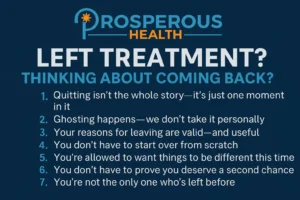
5. You’re Allowed to Want Things to Be Different This Time
A lot of returning clients feel afraid to say what didn’t work before. But you can say:
- “I need a different therapist.”
- “I didn’t feel seen in group.”
- “Evening sessions would work better for me.”
- “I want to go slower this time.”
And we’ll listen.
We won’t punish you for being clear.
We’ll thank you for being honest.
Because recovery doesn’t require perfection—it requires participation.
And participation starts with speaking up about what you need.
Looking for Intensive Outpatient Program in The Valley, CA? We make adjustments all the time—especially for people returning after a break.
6. You Don’t Have to Prove You Deserve a Second Chance
Maybe you’re thinking:
- “I’ve already used up my shot.”
- “They won’t take me seriously now.”
- “What if I mess it up again?”
Let us say this clearly:
You don’t have to earn your way back into care.
You’re not being graded.
You’re being invited—again—to care for yourself differently.
We don’t want your apology.
We want your willingness.
If you’re feeling that quiet pull—“Maybe I’m ready this time”—that’s enough.
7. You’re Not the Only One Who’s Left Before
Here’s something we wish more people knew:
Many of the clients thriving in our programs now once left before.
They ghosted.
They skipped appointments.
They spiraled for a while.
Then they came back—and found a better rhythm, better timing, better support.
You are not the exception.
You’re not behind.
You’re simply in the middle of your process.
FAQs: Coming Back After Quitting IOP
How long do I have to wait before I can return?
No waiting period. You can return when you’re ready. Whether it’s been days, weeks, or months—we’re still here.
Will I have to explain why I left?
Only if you want to. You can share what happened, or you can simply say, “I want to come back.” That’s enough.
Can I request changes this time?
Yes. You can ask for a new group, a different therapist, or a schedule adjustment. We’ll work with you to create a plan that works better this time.
What if I left multiple programs before?
That’s okay. Many people need several attempts before things click. You are still welcome here.
Will I be judged?
No. Our team is trained to support re-entry without shame. We focus on what you need next—not what happened before.
You don’t need to explain everything. You just need to come back.
Call (888)308-4057 to learn more about our Intensive Outpatient Program services in San Diego, CA.