

You don’t have to hit rock bottom to ask if your drinking is a problem.
In fact, the gray area is often harder to navigate—because everything still looks “fine” on the outside. You’re holding your job. Your relationships are okay. You haven’t lost control in a dramatic, movie-scene way. But inside? You’re not okay. Something’s off.
Maybe it’s the regret you feel when you break your own drinking rules. Or the way your anxiety flares on Monday mornings. Or how your joy feels muted—even when everything in your life says it shouldn’t.
That’s gray area drinking—where alcohol isn’t destroying your life, but it’s definitely stealing from it.
This blog is for you if you’re sober curious, exhausted by your own mental math, or wondering if you really need help—or if you’re just being dramatic.
Spoiler: you’re not being dramatic.
Here’s how to spot the signs that it’s time to act—and why a Partial Hospitalization Program might be the exact kind of support you’ve been craving but couldn’t name.
1. You Keep Re-Negotiating With Yourself
Gray area drinking often starts with “rules.”
- Only on weekends.
- No more than two glasses.
- Not alone. Not before 5. Not during the week.
But the rules bend. Quietly. Then often.
You start compromising. Just tonight. Just this one thing. Just because you had a hard day. And before you know it, you’re not sure where the line even is anymore—only that you’re crossing it.
If this sounds familiar, you’re not broken. You’re stuck in a loop that thrives on shame and self-forgiveness…and then more shame.
A Partial Hospitalization Program offers a reset without requiring a crisis. It’s where structure, clinical care, and emotional clarity come together to help you take back your internal compass—not because you’ve lost control, but because you want to regain connection to your own integrity.
2. You Feel “Fine” but Far from Clear
Gray area drinking doesn’t always leave you hungover. But it does leave you off. Foggy. Dull. Not as sharp or connected as you used to feel.
You’re functioning—sure. But you’re also flattening.
- Conversations feel more performative than real.
- Your body doesn’t feel energized.
- Mornings come with a subtle dread.
- Joy is quieter.
- Everything feels like “just getting through.”
This isn’t about whether you drink too much. It’s about whether you feel like yourself. If alcohol is making your days less vibrant, less grounded, or less you—it’s already costing you something.
Programs like the one we offer in San Diego are designed for people who don’t fit the “addict” label—but who do want help reconnecting to who they are without the haze.
3. You’ve Tried Moderation, but the Pattern Keeps Coming Back
If you’ve ever done a Dry January, used sober-tracking apps, or sworn off tequila after a wild night—you’re not alone.
Many gray area drinkers have already tried to moderate. The problem isn’t effort—it’s support.
You might white-knuckle your way through a few weeks, only to find yourself right back in the same mental loop:
- “Should I drink tonight?”
- “Is it weird if I say no?”
- “One won’t hurt, right?”
- “Why do I feel like I need this to relax?”
Trying to moderate without support is like trying to renovate a house while still living in it. You’re trying to change the wiring while the power’s still on.
A Partial Hospitalization Program gives you space, tools, and guided structure to actually make the change—safely, thoughtfully, and with people who get it.
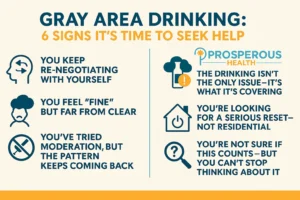
4. The Drinking Isn’t the Only Issue—It’s What It’s Covering
Here’s the hard truth: alcohol is often the visible symptom, not the root issue.
Gray area drinkers are often masking:
- High-functioning anxiety
- Work-related burnout
- Relationship stress
- Trauma that hasn’t been named
- Depression that feels too subtle to take seriously
When you stop drinking—even temporarily—those things rise to the surface. And that’s exactly why support matters. Not to judge. Not to label. But to help you hold what comes up when the buffer disappears.
PHP helps you manage both the drinking and what it’s been helping you avoid. It’s deeper than detox. It’s about reclaiming your emotional bandwidth.
5. You’re Looking for a Serious Reset—Not Residential
This might be the biggest myth about treatment:
“You don’t qualify unless you’re falling apart.”
Here’s the truth: a Partial Hospitalization Program is built for the gray space. It’s a place for people who are still holding it together—but at great cost.
If you’re not ready for residential care, but you do want more than a once-a-week therapy session, PHP meets you in the middle:
- You live at home
- You receive care 5 days a week
- You get therapy, clinical oversight, group support, and daily accountability
- You keep your life going—but with real help
Looking for Partial Hospitalization Program in The Valley, CA? We have programs designed for flexible access, including options in Palos Verdes and beyond.
6. You’re Not Sure if This Counts—But You Can’t Stop Thinking About It
You’ve Googled phrases like:
- “Am I drinking too much?”
- “What is gray area drinking?”
- “How do I know if I need help?”
You’ve tried comparing yourself to others. You’ve told yourself you’re fine because you haven’t hit bottom.
But here’s the thing: if you’re spending this much mental energy wondering if you’re okay—you probably aren’t.
And that’s not an accusation. It’s an invitation.
Curiosity is a gift. It means some part of you still wants more—more clarity, more vitality, more peace. PHP is where that curiosity can grow into clarity, with support instead of shame.
What People Like You Have Said After Trying PHP
“I thought I’d be the weird one in the group. Turns out I was the most typical story there.”
“I didn’t need to hit bottom—I just needed help getting unstuck.”
“PHP gave me my spark back. I didn’t even know I’d lost it.”
These aren’t people in crisis. These are people like you—smart, self-aware, and tired of pretending things feel okay when they don’t.
FAQ: Gray Area Drinking & Partial Hospitalization Programs
Is PHP only for people with diagnosed addiction?
No. PHP is for anyone who needs intensive, structured support—regardless of whether they meet diagnostic criteria. Many clients come in sober curious or unsure if they “qualify.”
Can I keep working while doing PHP?
It depends on your schedule. PHP typically runs 5–6 hours a day, 5 days a week. Many clients use PTO, short-term leave, or flexible work arrangements during this time.
How long does PHP last?
Programs often range from 2 to 6 weeks, depending on your needs. We adjust your care plan as progress unfolds.
Is this covered by insurance?
Often, yes. Most commercial insurance plans cover PHP if there’s medical necessity. Our admissions team can help verify benefits and guide you step-by-step—no pressure.
What’s the difference between PHP and IOP?
Think of PHP as more intensive. It’s typically daily care. IOP (Intensive Outpatient) is often 3–4 days a week for fewer hours. If you’re unsure, we can help determine the best fit.
Ready to Turn Curiosity Into Clarity?
Call (888)308-4057 or visit Partial Hospitalization Program in San Diego, CA to learn more about how we help people in the gray area find solid ground again. No shame. No judgment. Just real support for your next right step.