

For a long time, my job was my defense.
If I could perform, I wasn’t in trouble. If I could deliver, I wasn’t spiraling. If I could outwork the hangovers, I wasn’t addicted. That’s what I told myself.
I wasn’t calling out sick. I wasn’t missing deadlines. I wasn’t showing up drunk.
But I was waking up shaky. I was relying on something just to feel normal. I was using just enough to keep up appearances, but slowly burning out behind them.
No one asked questions—because I didn’t give them a reason to.
When Being “Functional” Becomes Its Own Kind of Cage
I wasn’t in denial. I knew I was drinking too much. I just couldn’t imagine how to fix it without breaking the life I’d built. I had a good role, a reputation, responsibilities. I couldn’t disappear for 30 days. I couldn’t “pause” my life.
So I tried to manage it in secret. Cut back. Only drink after 6 p.m. Switch from hard stuff to wine. None of it worked for long. The anxiety crept in earlier each day. The cravings got louder. My sleep tanked. My patience evaporated.
Then one night I skipped a client dinner because I couldn’t trust myself not to go too far.
That was my wake-up call. I wasn’t in control anymore. I needed help.
Why I Chose Outpatient Detox
I started searching for options. I kept seeing inpatient programs—pack your bags, leave town, tell your boss you’re “taking time for health.” That didn’t feel like an option.
Then I came across Prosperous Health outpatient detox in San Diego.
It was the first time I saw a path that didn’t require walking away from everything. A program built for people like me—people still living their lives, still working, still showing up—but quietly unraveling.
Outpatient detox meant I could get real, clinical support while staying active in my life. It sounded almost too good to be true. But it wasn’t.
It was exactly what I needed.
What Detox Looked Like While Still Working
I didn’t tell my boss. I didn’t need to.
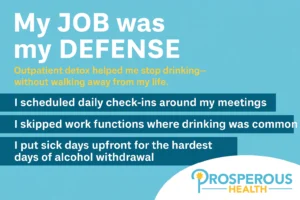
I used a few sick days to frontload the more intense part of detox. Then I scheduled daily check-ins and support appointments around my meetings. Morning vitals. Medication support. A few group sessions that I could join remotely.
My days still looked normal from the outside. But on the inside, I was healing—slowly, steadily, safely.
There were rough patches. Some cravings. Some withdrawal symptoms. But I wasn’t going through it alone. I had a team walking with me. I had structure. And I had hope.
Outpatient Detox Let Me Keep My Identity While Changing My Life
I didn’t want to lose my job. Or my reputation. Or my role in the family. I didn’t want to become “the person in treatment.”
Outpatient detox let me stay me—but better.
I was able to stay in control of my schedule while letting go of the control I clung to emotionally. I didn’t need to hide anymore. I didn’t need to lie to myself or to anyone else.
Every time I walked into that center in San Diego, I felt less like a case and more like a person.
High-Functioning Doesn’t Mean Healthy
Here’s what I wish someone had told me sooner:
Just because you can keep going doesn’t mean you should.
Just because you’re functional doesn’t mean you’re well.
Just because it hasn’t blown up yet doesn’t mean it’s working.
I kept waiting for something drastic to force change—a job loss, a medical scare, someone finding out. But change didn’t come from falling apart. It came from choosing to stop pretending.
If you live in San Diego or nearby—especially if you’re looking for outpatient detox in The Valley, CA or Palos Verdes, CA—Prosperous Health has centers that understand this high-functioning dynamic. You don’t have to explain yourself. They already get it.
How I Balanced Work and Recovery Without Burning Out
Here’s what helped me stay steady while detoxing and working:
- I communicated less and scheduled more. I didn’t overshare. I just blocked time in my calendar and stuck to it.
- I kept a journal. Not for reflection, but for reminders: how I felt in the morning. What worked. What didn’t. What I never wanted to go back to.
- I said “no” to more things—and survived. Declining one meeting, skipping one happy hour, delegating one task—it didn’t end my career. It helped save my life.
- I used the tools the clinic gave me. Breathing strategies. Hydration tips. Medication when needed. Accountability calls. Every little thing added up.
This wasn’t about becoming a different person. It was about removing the thing that was eroding who I already was.
Life After Detox: The Subtle Wins That Matter Most
I still have my job. My email still pings. My responsibilities didn’t vanish.
But now, I sleep through the night.
I wake up clear.
I answer questions without irritation.
I don’t stare at the clock, counting down to when I can drink again.
I didn’t think outpatient detox could change so much without changing everything. But it did.
And that’s why I’m telling you this.
What You Need to Know If You’re Where I Was
If you’re reading this and thinking, “I relate, but I don’t think it’s bad enough to need help,”—I want to gently challenge that.
Because I said the same thing. And underneath it, I was exhausted. Lonely. Scared to ask for help because I thought it meant losing everything.
Turns out, getting help helped me keep it.
If you’re holding it all together but wondering when it’s going to snap—you don’t have to wait.
If you’re worried that detox will derail your life—it won’t. Not if you choose the right kind of detox.
And if you’re based in San Diego County or the surrounding areas, Prosperous Health has programs that actually work for people like us—high-functioning on the surface, silently drowning underneath.
FAQs from a Fellow High-Performer in Recovery
Can I really detox without taking time off work?
Yes. With outpatient detox, you don’t need to leave your job. You’ll work with your team to schedule support around your existing responsibilities.
Is it private? Will anyone find out?
Privacy is a priority. No one needs to know unless you choose to tell them.
What if I start and can’t finish?
That was my fear too. But the structure, support, and medical guidance made it manageable. Every step is designed to keep you steady.
How long does outpatient detox last?
It varies. For me, the acute phase was about 5–7 days, followed by a few more weeks of ongoing support.
What happens after detox?
You get options. Therapy. Groups. Continued check-ins. The pressure to “do it all” isn’t there—you take the next right step, one at a time.
Is this available outside San Diego?
Yes. If you’re looking for outpatient detox in The Valley or Palos Verdes, Prosperous Health has locations that provide the same level of care and flexibility.
I thought I had to choose: career or recovery. Life or detox. Identity or honesty.
Turns out, I didn’t have to choose.
I kept my job. I kept my role. But I got my life back.
And if you’re even a little curious whether this could be you, too—make the call.
Call (888) 308‑4057 or visit Prosperous Health’s outpatient detox program in San Diego, CA. This might be the one thing that helps you keep everything else.
You don’t need a dramatic ending. You just need a better beginning.