

Even when your calendar is full and your mask is on tight, the weight of holding it all together can grind you down. For people living with a chronic illness, it’s not just exhaustion—it’s the constant calculation of how much energy you can spend, who gets to see the truth, and what’s left for yourself.
At Prosperous Health, we’ve seen it up close: the high-functioning people who show up for everyone else, keep their careers on track, make their medical appointments, and somehow still feel like they’re failing behind the scenes. That’s why our Virtual IOP in San Diego isn’t just about convenience—it’s about making mental health care possible for people who would otherwise go without it.
When Your Body Sets the Pace
If you live with a chronic illness, your health dictates your schedule whether you admit it or not. Some days you can push through. Other days, your body makes the decisions for you.
Traditional in-person treatment programs often ignore that reality. They expect you to be in the building three or four times a week, for several hours at a time. For someone managing unpredictable pain, fatigue, or other symptoms, that’s not just difficult—it can be impossible.
Virtual IOP changes that equation. You can plan your treatment around flare-ups, medical appointments, and the reality of energy crashes. And when a bad day hits, you can still log in and stay connected instead of missing out entirely.
One client put it simply:
“On the days my symptoms spiked, I could still log in from bed and not lose the momentum I’d built in therapy.”
That kind of continuity can make the difference between feeling like you’re making progress and feeling like you’re always starting over.
The Privacy of Home Without the Isolation
High-functioning people often carry their struggles quietly. You may not want your coworkers to know about your mental health challenges, or even your closest friends. Maybe you’ve learned to smile through fatigue and “push through” because that’s what keeps the questions away.
But the downside of this privacy is isolation. If no one sees you struggle, then no one sees when you need support.
Virtual IOP offers a middle ground. You can stay in your own space—whether that’s your living room, bedroom, or home office—but still connect with a group of people who understand what it’s like to carry invisible challenges.
And because you’re not walking into a clinic, you can avoid the anxiety of being seen and misunderstood. Instead, you can open up on your own terms, with people who get it.
San Diego Access, Without the Commute
If you’ve ever tried to get across San Diego at rush hour, you know how draining the commute can be. Add in chronic illness, and that 40-minute drive might as well be a brick wall between you and getting help.
Virtual IOP removes that barrier. When you’re looking for Virtual IOP in San Diego, CA, you don’t have to factor in traffic, parking, or the energy drain of just getting there. You log in, get the support you need, and log off—leaving you more energy for the rest of your day.
For clients in surrounding areas like The Valley or Palos Verdes, this also means access to specialized care without uprooting your life or spending hours on the road.
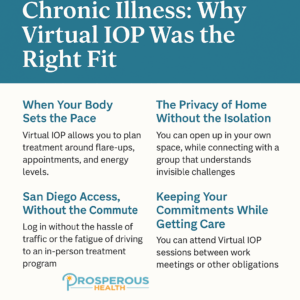
Keeping Your Commitments While Getting Care
High-functioning doesn’t mean high-capacity. It just means you’ve gotten good at running on empty. You might be holding down a job, managing a family, showing up for community commitments—and all of that while balancing the physical demands of your chronic illness.
Adding traditional treatment into that mix can feel impossible. Virtual IOP is designed to fit into real lives, not just ideal schedules. You can attend sessions in between work meetings, during a quiet afternoon at home, or while pacing your living room if sitting for long periods is painful.
It’s not about lowering the bar for treatment—it’s about removing the unnecessary obstacles that keep people from getting it.
Why It Worked for Our Clients
Some clients join Virtual IOP expecting it to be a short-term fix until they “can manage in person.” They stay because it works.
One client told us:
“I thought I’d feel less connected online. But the group understood me faster than people in my own life. They didn’t question why I needed to lie down mid-session—they got it.”
That’s one of the hidden strengths of Virtual IOP: it attracts people who understand flexibility, empathy, and meeting each other where they are.
Addressing Concerns About Virtual Care
We’ve heard all the questions:
- “Will it feel as real as in-person?”
- “Will I still connect with my group?”
- “Can therapy actually help if I’m not in the same room?”
The truth is, online therapy has been proven to be just as effective as in-person for many people. And for clients with chronic illness, it often works better—not because the therapy is different, but because the accessibility means you actually show up.
The Bottom Line
If you’re balancing a chronic illness with the unspoken pressure to keep performing, you don’t have to choose between your health and your healing. Virtual IOP makes space for both.
You can get structured, professional support without draining what little energy you have left for the rest of your life. And you can do it surrounded by people who understand what it means to look “fine” on the outside while fighting a battle no one sees.
FAQ: Virtual IOP for People with Chronic Illness
1. What is a Virtual IOP?
A Virtual Intensive Outpatient Program (IOP) is a structured mental health treatment program that meets several times a week via secure video conferencing. It combines group therapy, individual sessions, and skill-building activities—all from the comfort of your own home.
2. How does Virtual IOP help people with chronic illness?
It removes the physical and logistical barriers of in-person care. You can attend even on difficult days, avoid commuting fatigue, and set up your space in a way that supports your comfort and medical needs.
3. Will I still connect with other people online?
Yes. Many clients are surprised at how quickly bonds form in virtual groups. In fact, for people with chronic illness, the understanding and flexibility of peers can make the connection even stronger.
4. Is Virtual IOP covered by insurance?
Most insurance plans that cover in-person IOP will also cover virtual care. Our team can help verify your benefits and walk you through the process.
5. Do I have to live in San Diego to attend Prosperous Health’s Virtual IOP?
While our program is based in San Diego, some clients in other parts of California—such as The Valley or Palos Verdes—can also participate, depending on state licensing and insurance requirements.
📞 Call (888)308-4057 or visit to learn more about our Virtual IOP services in San Diego, CA.