

Sometimes, you stop showing up—and you’re not even sure why.
It’s not always dramatic. Maybe you missed one session because work ran late. Then your camera stopped working. Then you forgot the group time. Before you knew it, two weeks passed. You ghosted your virtual IOP, and now it feels awkward to return.
If that sounds familiar, take a breath. It doesn’t mean you’ve failed. And it definitely doesn’t mean you’re not ready. Accountability in treatment doesn’t look like perfection—it looks like permission to try again.
Whether you’ve missed a few sessions or fully dropped out, here’s how to rebuild structure and connection in virtual IOP (Intensive Outpatient Program)—without shame, pressure, or unrealistic expectations.
1. Start With One Honest Check-In
Reconnecting doesn’t require a perfect plan or a long explanation. Just one honest message can restart your care. It might sound like:
- “I stopped showing up, but I want to come back.”
- “I’ve been struggling. Can I rejoin group?”
- “I think I need help again.”
That’s all it takes. You don’t need to explain your silence or apologize for being human. At Prosperous Health, our virtual IOP team understands that stops and starts are part of recovery. We’re not keeping score. We’re keeping the door open.
2. Make Logging In Friction-Free
If just opening your laptop feels overwhelming, you’re not alone. Here’s how to make re-entry easier:
- Bookmark your Zoom or Telehealth link.
- Set a recurring reminder on your phone with the session day and time.
- Create a dedicated space at home, even if it’s just a cleared-off corner.
- Make sure your charger, headphones, or camera are ready in advance.
In virtual IOP, the structure is what holds you—so it helps to design your environment to support that.
3. Don’t Wait for Motivation to Return
Here’s the truth: You don’t need to feel motivated to show up.
Most people return to treatment still feeling messy, uncertain, and emotionally raw. Motivation doesn’t usually come before action—it comes after. When you show up consistently, even without energy or clarity, your brain begins to associate treatment with relief and progress.
That shift can’t happen if you’re waiting to feel “ready.” Just show up anyway.
4. Create a Transition Ritual
In-person IOP often includes things like a drive to the facility, sitting in the waiting room, or saying goodbye at the end. Those physical transitions help your brain prepare for emotional work.
In virtual IOP, those rituals are missing—so it helps to create your own. Try this:
- Before group: Make tea, light a candle, take five deep breaths, or write a sentence in your journal.
- After group: Go for a short walk, do a stretch, or text a check-in to someone safe.
These tiny actions signal to your brain that group is something meaningful—not just another video call.
5. Tell One Person You’re Trying Again
Accountability doesn’t require a whole support network. Sometimes, it just takes one person who knows you’re trying.
You could text a friend, “Hey, I’m starting IOP again today. Can I check in with you after?” Or let your therapist know you want help staying on track. Even mentioning it in group can create an internal sense of commitment.
When someone else knows what you’re aiming for, it becomes a little easier to stick with it. Not out of pressure—but out of connection.
6. Redefine What Accountability Really Means
When people hear “accountability,” they often think of consequences, contracts, or someone watching over them. But in recovery, accountability is something different.
It means:
- Honoring your needs even when they’re inconvenient.
- Naming when things aren’t working.
- Choosing structure when chaos would be easier.
It’s not about being punished when you fall short. It’s about making small, kind choices that move you back toward stability. That includes reaching out—even after a pause.
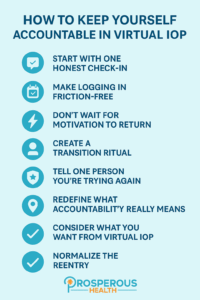
7. Consider What You Want From Virtual IOP
If you stopped showing up, it might be because the group wasn’t giving you what you needed. That’s not a failure. It’s information.
Ask yourself:
- What felt helpful the last time you attended?
- What felt hard, confusing, or off-putting?
- What would make it easier to participate this time?
If you’re in San Diego, our virtual IOP program is structured to meet you where you are. We offer trauma-informed care, flexible scheduling, and nonjudgmental staff who understand that people come and go—and come back again.
You can learn more here if you’re exploring options for virtual IOP in San Diego.
8. Normalize the Re-Entry
You are not the only one who has disappeared mid-program. You won’t be the first to return. You won’t be the last.
We see it every day. People ghost, then reappear weeks or months later, sheepish and unsure. And what we always say is:
“We’re glad you’re here now.”
That’s it. No scolding. No catch-up lectures. Just a welcome back.
You don’t have to wait for a rock bottom. You can pick up where you left off—or start fresh. Either way, it counts.
FAQ: Accountability and Virtual IOP
What if I stopped going months ago? Can I still return?
Yes. There’s no expiration date on coming back. Whether it’s been a few weeks or longer, you’re welcome to reconnect. We’ll work with you to assess whether rejoining group or starting with individual support makes the most sense.
Is it normal to ghost during treatment?
More common than you think. People pause treatment for all kinds of reasons—overwhelm, depression, shame, life chaos. Ghosting doesn’t make you a failure. It makes you human. What matters is your willingness to try again.
How do I know if virtual IOP is still the right fit for me?
If you’re looking for structured support without inpatient commitment, virtual IOP is often a great option. We can help you evaluate whether the current format, group dynamics, or level of care still align with your needs.
What if I’m actively using again?
You can still return. Let us know where you’re at so we can match the support to your situation. You don’t need to “clean up” before reaching out.
Do I have to explain why I left?
No. You’re welcome to share, but it’s not required. The focus is on where you are now and how we can support your next step forward.
You don’t have to be perfect to be welcome.
Virtual IOP can hold you—even if you’ve dropped the thread. Even if you’re unsure. Even if you feel like a mess. And if you’re in San Diego, there’s a team at Prosperous Health who’s ready to meet you where you are.
📞 Call (888)308-4057 or visit to learn more about our virtual IOP services in San Diego, CA. No pressure. Just possibility.